An overview of how the Supreme Court has shaped defamation law, balancing individual reputation with First Amendment protections for speech and press, distinguishing standards for public officials, public figures, and private individuals.
Defamation law sits at the volatile intersection of individual reputation and the constitutional guarantees of freedom of speech and press. Historically, common law allowed individuals to sue for libel (written defamation) with relatively low hurdles, often allowing for "presumed damages" where a jury could award money simply because a statement was false and injurious. However, the Supreme Court has spent decades refining these rules to ensure that the fear of massive lawsuits does not create a "pall of fear and timidity" that chills public debate.
Through a series of landmark cases, the Court has moved away from "strict liability"—where a speaker is responsible for errors regardless of intent—toward a system that distinguishes between different types of plaintiffs based on their access to the media and their role in public life.
The Foundation: Public Officials and Actual Malice
The modern era of defamation law began with New York Times v. Sullivan (1964). In this case, an Alabama official sued the New York Times over an advertisement containing factual inaccuracies regarding the treatment of civil rights protesters. The Supreme Court reversed the judgment, ruling that the First and Fourteenth Amendments protect even false statements about the conduct of public officials, provided they do not meet a specific constitutional threshold.
To prevent the "chilling effect" of libel suits, the Court held that a public official cannot recover damages for a defamatory falsehood relating to their official conduct unless they prove the statement was made with actual malice.
Exam Tip: In constitutional law, "actual malice" does not mean ill will, spite, or hatred. It is a technical term of art referring to the defendant's state of mind regarding the truth.
Under this standard, "actual malice" is defined as publishing a statement with:
Knowledge that it was false; OR
Reckless disregard of truth (meaning the defendant had serious doubts about the truth but published anyway).
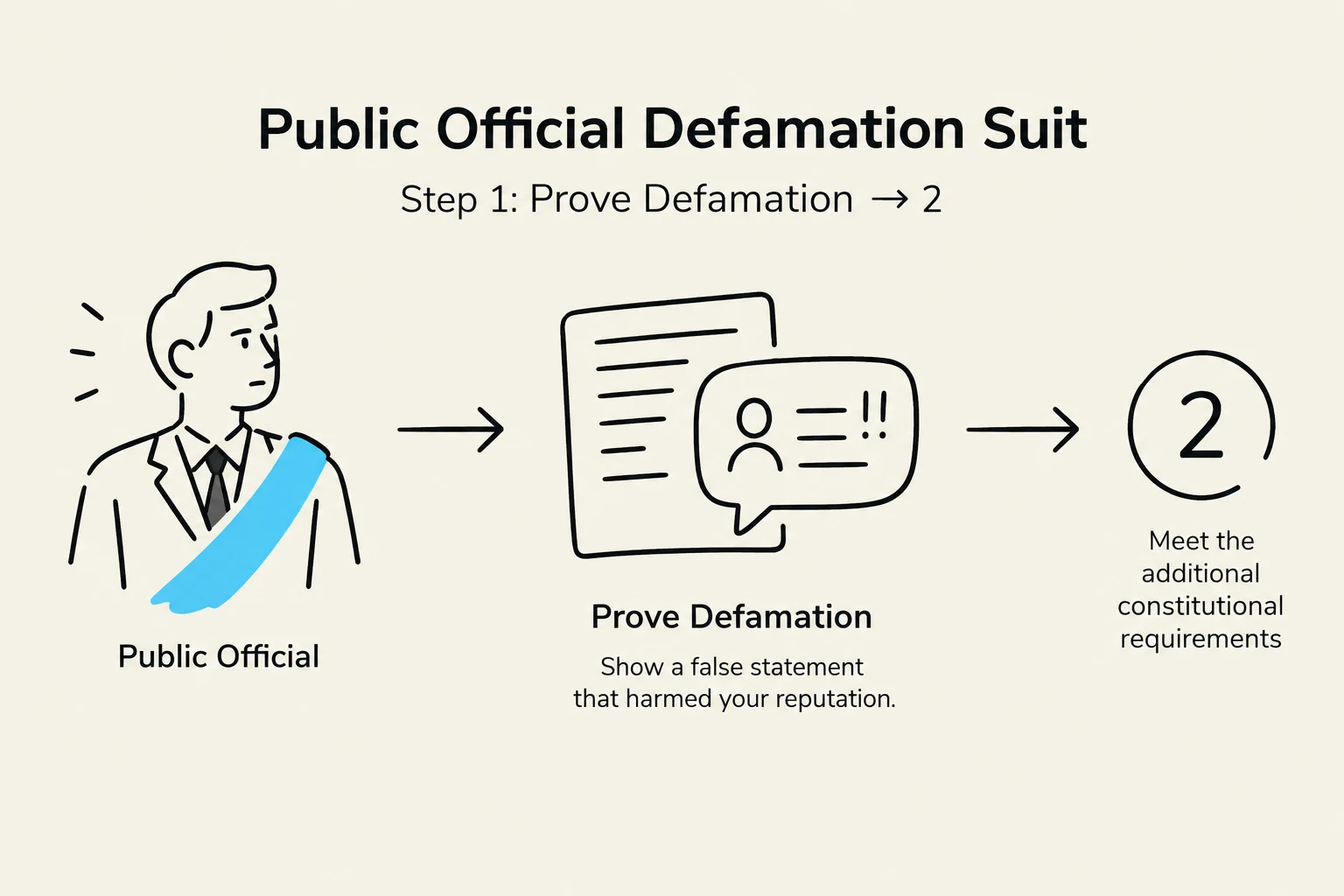
This diagram illustrates the initial steps in a public official defamation suit, emphasizing the need to prove defamation and meet constitutional requirements.
Expanding the Scope: Public Figures
Following Sullivan, the Court extended these protections to public figures in cases like Curtis Publishing Co. v. Butts. Public figures are individuals who, while perhaps not holding government office, have attained notoriety or have thrust themselves into the forefront of public controversies.
The reasoning is that public figures, like officials, have greater access to the "channels of effective communication" and can more easily counteract false statements through the media. Therefore, they must meet the same high "actual malice" standard to prevent the media from self-censoring out of fear of litigation.
The Protection of Private Individuals
The most significant distinction in modern defamation law is between public persons and private individuals. In Gertz v. Robert Welch (1974), the Court addressed whether a private citizen—who has not voluntarily entered the public spotlight—should be held to the same standard as a politician.
The Court concluded that private individuals are more vulnerable to injury and have less opportunity for self-help (rebuttal). Consequently, the standard for liability is lower for them:
Negligence: A private individual generally only needs to prove that the publisher acted with negligence (failed to exercise reasonable care) to recover damages.
Even when a plaintiff wins a defamation suit, the First Amendment places strict limits on what they can recover in money. The Court distinguishes between different types of harm to ensure that the law compensates victims without unnecessarily punishing the press.
1. Actual Injury
If a private individual proves only negligence, they must demonstrate actual injury to recover damages. This is not limited to out-of-pocket financial loss; it includes:
Impairment of reputation and standing in the community.
Personal humiliation.
Mental anguish and suffering.
2. Presumed and Punitive Damages
Under traditional common law, many jurisdictions allowed for libel per se—where certain statements (like accusing someone of a crime) were considered so inherently harmful that damages were "presumed" without proof of loss.
However, the Supreme Court has restricted this for private individuals. If a plaintiff only proves negligence, the state cannot allow the recovery of:
Presumed damages: Money awarded without evidence of actual harm.
Punitive damages: Money intended to punish the defendant rather than compensate the victim.
Note: If a plaintiff (even a private one) can prove the defendant acted with actual malice, they may still recover substantial or punitive damages.
Matters of Private Concern
Finally, the level of constitutional protection depends heavily on whether the speech involves matters of private concern. In Dun & Bradstreet, Inc. v. Greenmoss Builders, Inc., the Court clarified that when a publication involves no issue of public concern, the First Amendment interest is much lower. In such cases, the state may apply traditional common law rules, including the ability to award presumed and punitive damages, because the speech does not contribute to the "uninhibited, robust, and wide-open" debate essential to democracy.
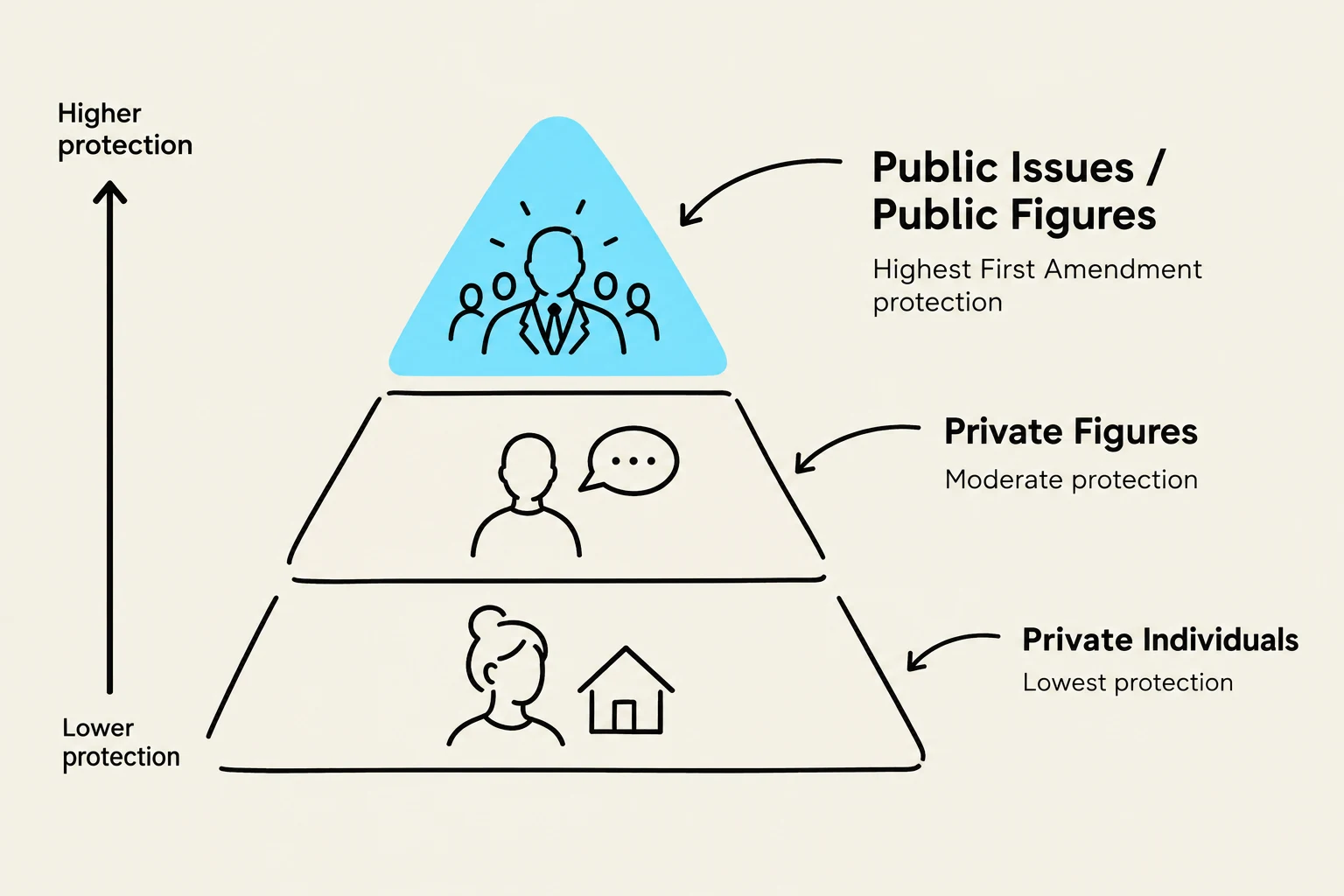
This diagram illustrates the varying levels of legal protection afforded to different categories of individuals and issues, with public figures and public issues receiving the highest protection and private individuals receiving the lowest.
Keep reading for free.
Create an account to finish this reading and make it part of your study routine.