Constitutional Limitations on Criminal Law in the U.S.
Examines the constitutional principles that limit government power in enacting criminal statutes, focusing on individual rights and the balance with social order. Covers the rule of legality, prohibitions on arbitrary legislation, statutory clarity, equal protection, and protected liberties.
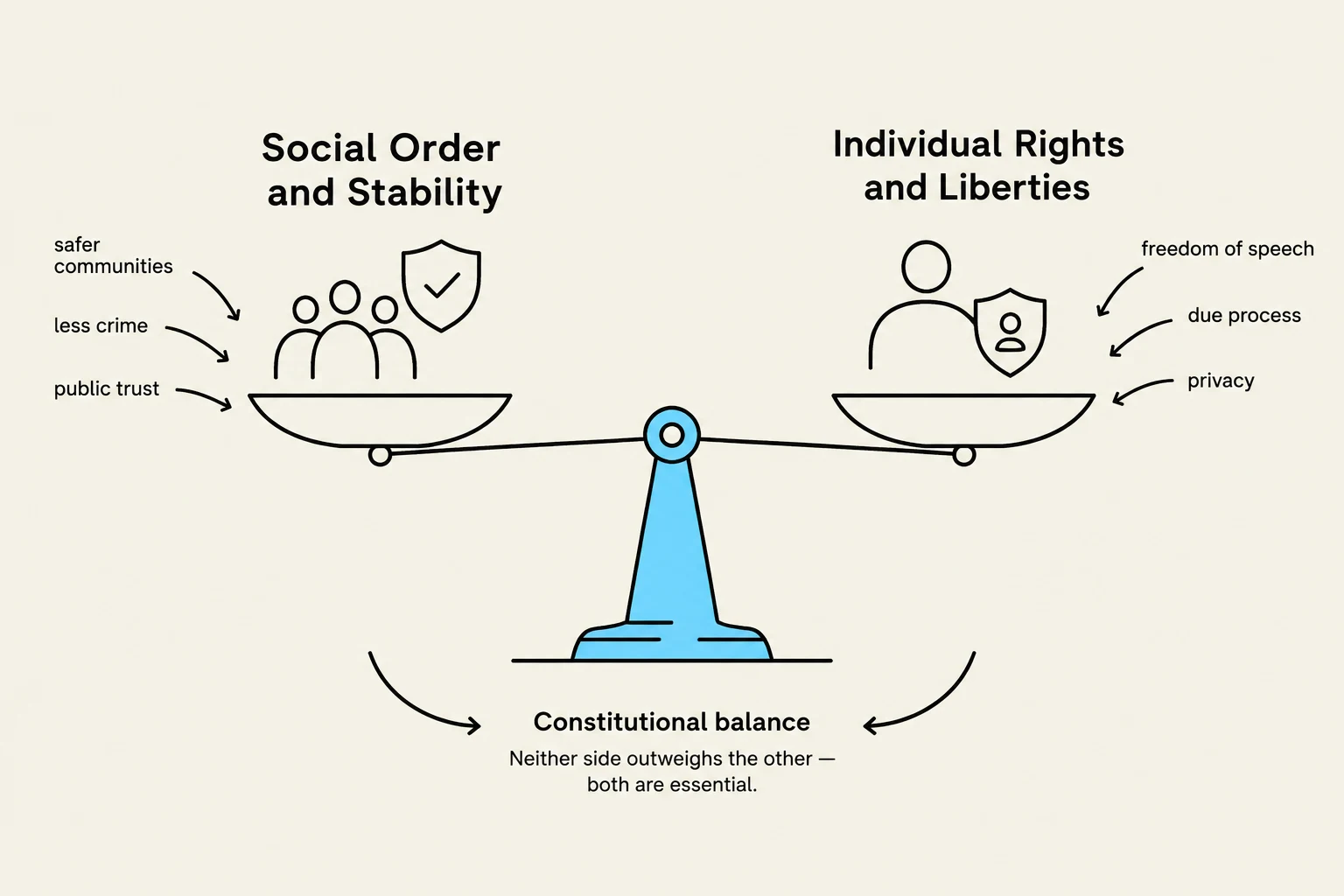
In the American democratic system, the power of the government to enact criminal statutes is not absolute. The Founding Fathers, influenced by the harshness of British colonial rule, designed a constitutional framework intended to protect individual rights against government tyranny and the potential intolerance of democratic majorities. This framework creates a delicate balance: it seeks to protect "natural and inalienable rights" while simultaneously ensuring the social order and stability necessary for a functioning society.
Because this balance is not a scientific process, the emphasis in American history has shifted over time between the control of crime and the protection of individual liberties. To understand how criminal law operates within these bounds, we must examine the core constitutional principles that limit legislative and executive power.
The Rule of Legality
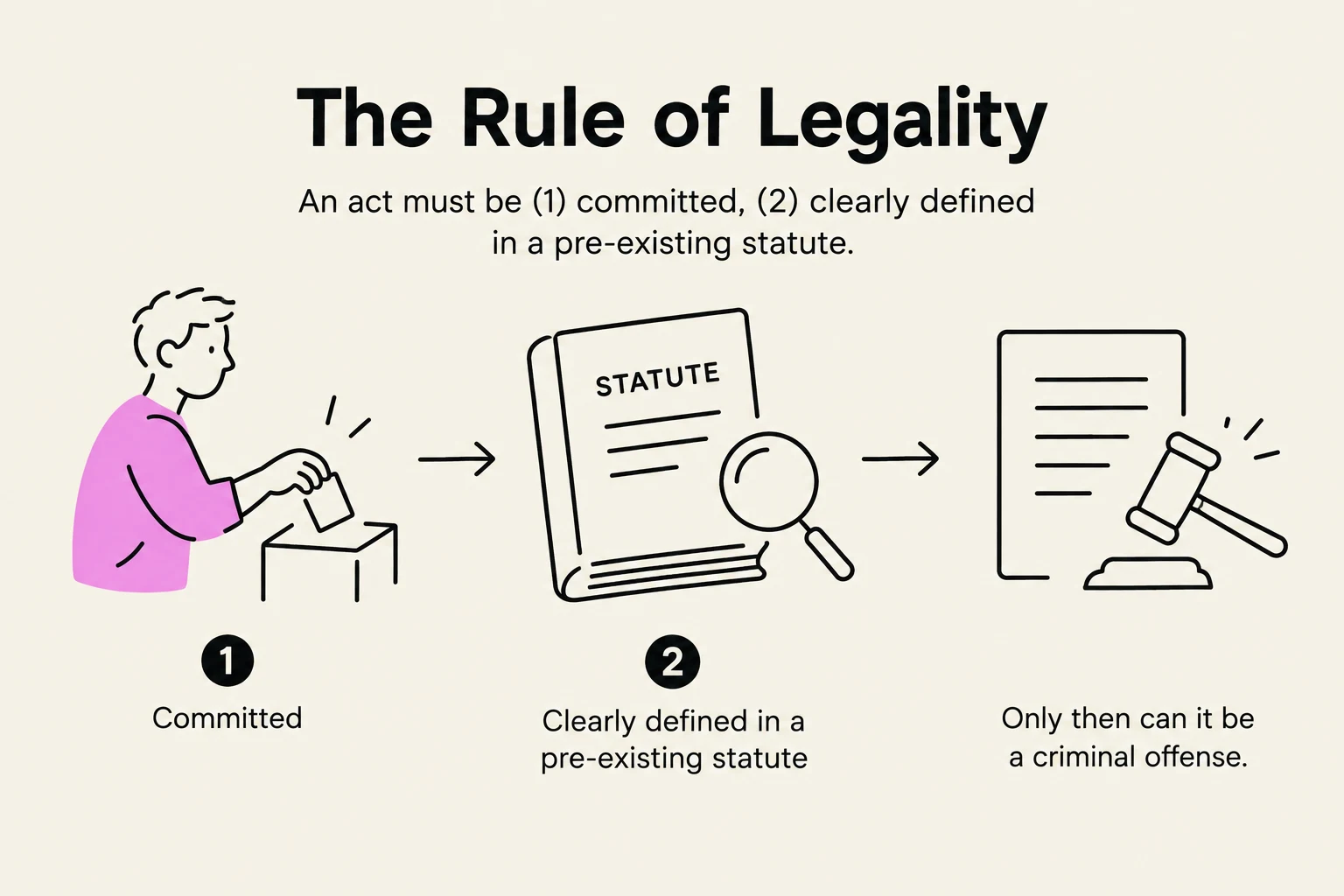
The "first principle of American criminal law and jurisprudence" is the rule of legality. This principle ensures that an individual cannot be criminally punished for an act that was not clearly condemned in a statute prior to the time the act was committed.
This doctrine is often summarized by the Latin maxim nullum crimen sine lege, nulla poena sine lege, which translates to "no crime without law, no punishment without law". The rule of legality is upheld through two primary constitutional mechanisms: the prohibition of certain types of retroactive or arbitrary laws, and the requirement for statutory clarity.
The Rule of Legality states that an act must be committed and clearly defined in a pre-existing statute to be considered a criminal offense.
Prohibitions on Arbitrary Legislation
To prevent the government from targeting specific individuals or punishing people for past behaviors that were once legal, the Constitution imposes two specific prohibitions.
Bills of Attainder
A bill of attainder is a legislative act that declares a person (or a specific group) guilty of a crime and imposes punishment without the benefit of a judicial trial. By requiring a trial in a court of law rather than allowing the legislature to act as judge and jury, the Constitution protects personal security and rights.
Ex Post Facto Laws
An ex post facto law is a law that punishes conduct that was not criminal at the time it was committed. This prevents the government from "moving the goalposts"—changing the rules of the game after the fact to catch individuals who were acting legally when they performed their actions.
Statutory Clarity
Even if a law is not a bill of attainder or an ex post facto law, it must still be written clearly. The principle of statutory clarity requires that laws be sufficiently precise so that individuals can understand which specific acts are prohibited.
If a statute is too vague, it fails to provide "fair notice" to the public and allows for unpredictable or arbitrary enforcement by police and prosecutors.
Exam Tip: If a question asks whether a law is constitutional based on its wording, look for "vagueness." A law that is so poorly defined that a reasonable person cannot tell if they are breaking it likely violates the requirement for statutory clarity.
The Equal Protection Clause and Levels of Scrutiny
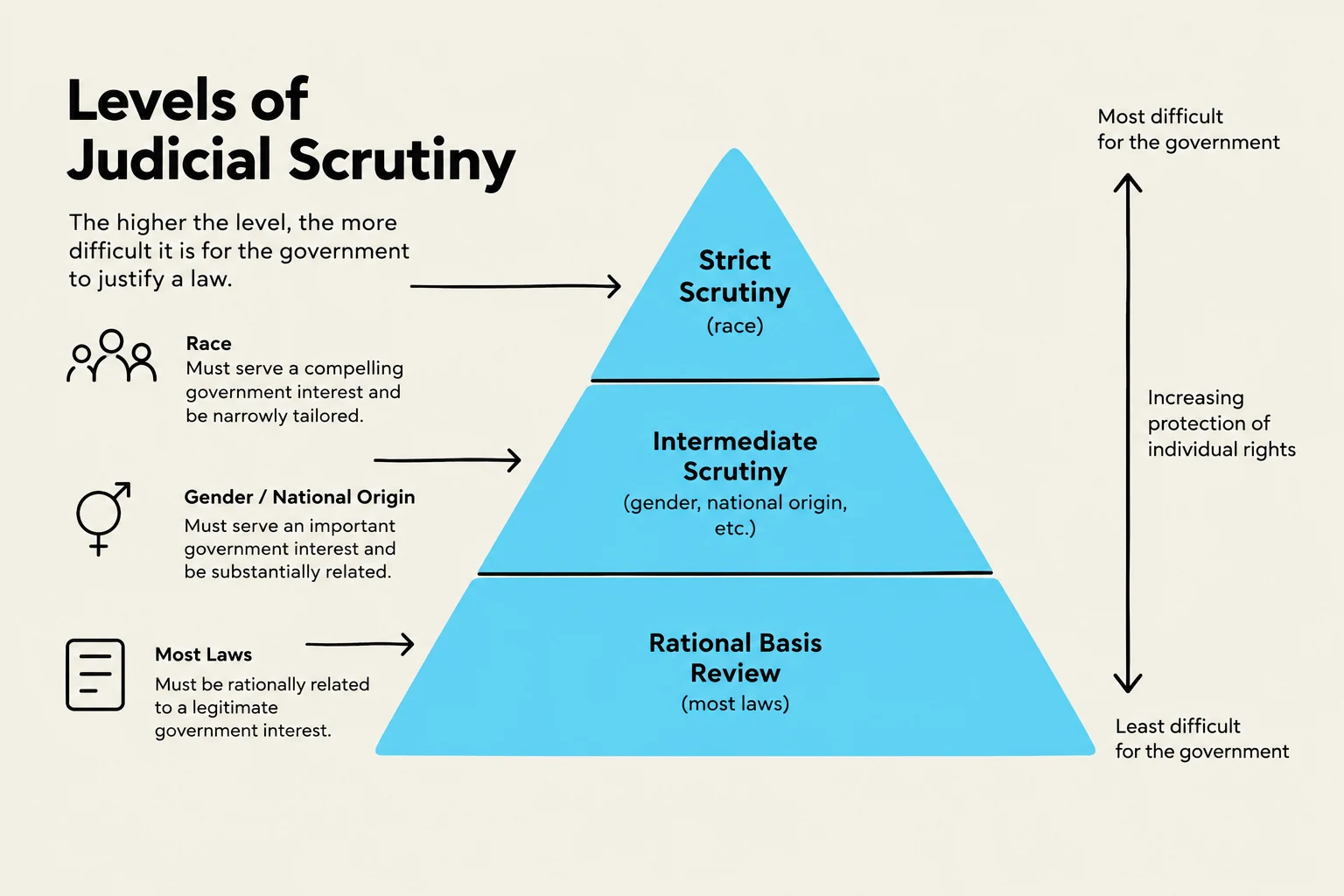
The Equal Protection Clause prohibits the government from enacting laws that unfairly distinguish between individuals based on certain classifications. When a law treats one group of people differently than another, courts do not simply strike it down; instead, they apply different "levels of scrutiny" to determine if the distinction is constitutional.
The level of scrutiny depends on the type of classification being used:
Strict Scrutiny: This is the highest level of review. It is typically applied to classifications based on race. Under strict scrutiny, the government must prove that the law is necessary to achieve a compelling state interest.
Intermediate Scrutiny: This level is often applied to classifications based on gender.
Rational Basis Test: This is the most lenient standard and is applied to most other classifications. The law must simply be rationally related to a legitimate government interest.
This diagram illustrates the three levels of judicial scrutiny used in the United States: Strict Scrutiny, Intermediate Scrutiny, and Rational Basis Review. Each level has different requirements for laws to be considered constitutional, with Strict Scrutiny being the most rigorous and Rational Basis Review being the least.
Case Study: Gender vs. Size
In People of the Virgin Islands v. Lake, the defendant challenged a statute that increased the penalty for assault when the victim was female and the accused was an adult male, noting there was no reciprocal enhancement for male victims. The defendant argued this violated the Equal Protection Clause by treating him differently based on gender. However, the court looked at whether the statute's purpose was to address gender disparities or physical size disparities to protect smaller individuals from larger ones.
Protected and Unprotected Liberties
Beyond the structure of the laws themselves, the Constitution protects specific areas of individual life from criminalization.
First Amendment Protections
The First Amendment protects freedom of expression, but it is not absolute. While the government generally cannot criminalize speech (such as a law prohibiting students from criticizing the government), there are certain "unprotected" categories of speech that remain subject to criminal regulation.
Right to Privacy
While the Constitution does not explicitly state a "right to privacy" in a single clause, the courts recognize constitutional protections for individual privacy. This limits the government's ability to criminalize certain personal activities that occur within the private sphere of an individual's life.
Second Amendment
The Second Amendment protects the individual right to keep and bear arms. This constitutional provision serves as a limit on the government's power to enact total bans on firearm ownership.
A diagram illustrating the balance between social order and stability, and individual rights and liberties, emphasizing that both are essential for constitutional balance.
Summary Table of Constitutional Limits
Principle
Core Function
Rule of Legality
Ensures no crime/punishment without pre-existing law.
Bills of Attainder
Prevents legislature from bypassing trials to punish individuals.
Ex Post Facto
Prevents retroactive criminalization of past actions.
Statutory Clarity
Prevents vague laws that fail to provide notice.
Equal Protection
Prevents unfair discrimination (subject to scrutiny levels).
First Amendment
Protects expression (subject to "unprotected" exceptions).
Privacy/Second Amendment
Protects specific personal spheres and rights from regulation.
Keep reading for free.
Create an account to finish this reading and make it part of your study routine.