Constitutional Limitations on Criminal Law and Due Process
This document explains constitutional limitations on government power in criminal law, focusing on the rule of legality, due process, statutory clarity, and equal protection principles.
In an American constitutional democracy, the power of the government to enact criminal statutes is not absolute. The Founding Fathers, influenced by the perceived tyranny of British rule, designed the Constitution to protect individual rights against the "political passions" of majorities and the arbitrary whims of government. One of the most critical ways the Constitution limits this power is through the principle of due process, which ensures that the legal system remains predictable, fair, and transparent.
The Rule of Legality
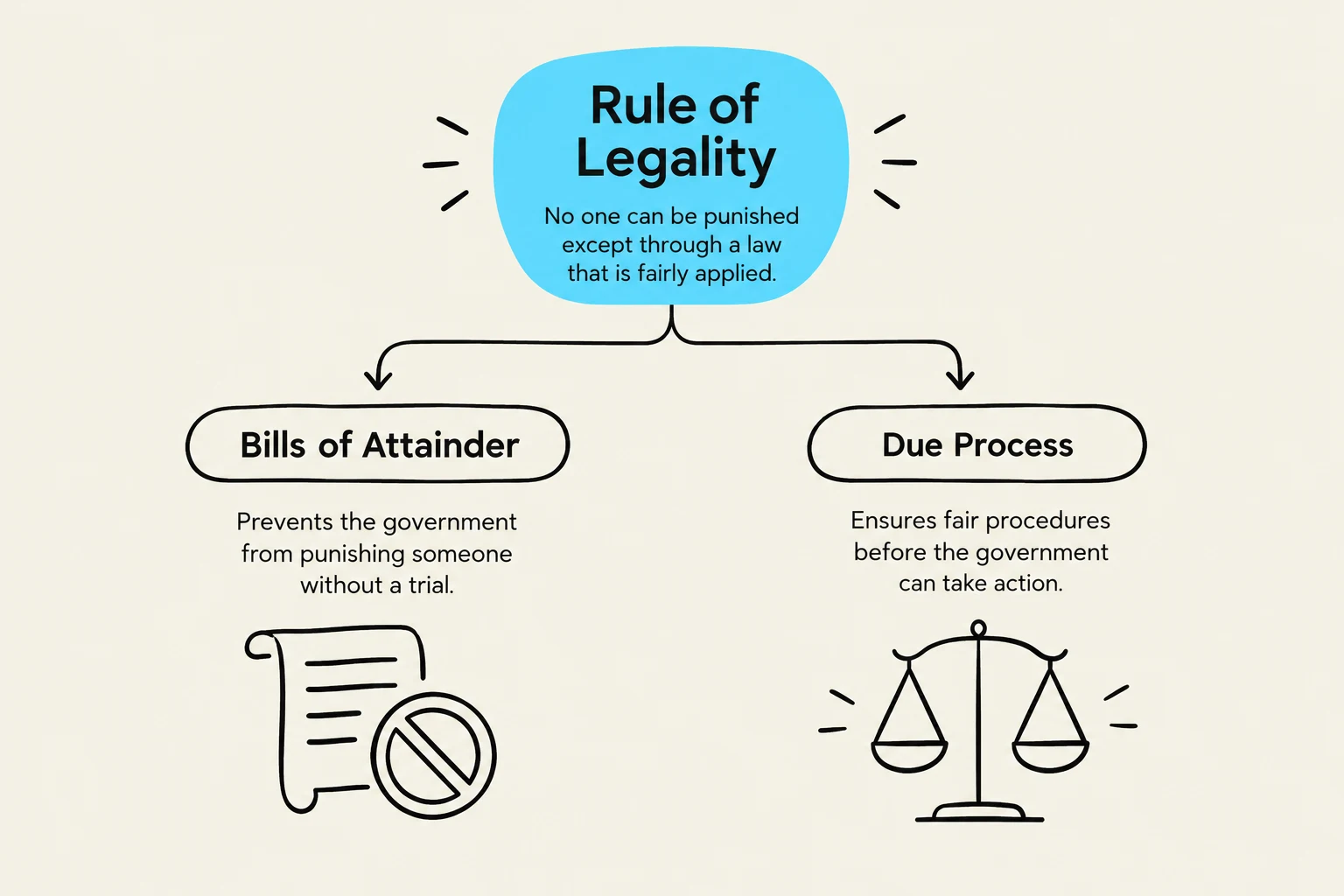
The foundation of American criminal jurisprudence is the "rule of legality". This principle is often summarized by the Latin maxim nullum crimen sine lege, nulla poena sine lege, meaning "no crime without law, no punishment without law". Essentially, an individual cannot be punished for an act that was not clearly defined as a crime by statute before the act was committed.
This rule is enforced through two primary constitutional mechanisms:
The prohibition of Bills of Attainder: Legislative acts that punish specific individuals or groups without a trial.
The prohibition of Ex Post Facto laws: Laws that retroactively criminalize actions that were legal when they were performed, or that increase the punishment for a crime after it was committed.
Exam Tip: Remember that the prohibition on ex post facto laws is designed to protect defendants from "after the fact" statutes that disadvantage them. However, legislatures are allowed to pass laws that retroactively benefit defendants, such as reducing a punishment.
This diagram illustrates the Rule of Legality, explaining that no one can be punished without a law that is fairly applied. It further breaks down this concept into 'Bills of Attainder,' which prevents punishment without a trial, and 'Due Process,' which ensures fair procedures before government action.
Due Process and Statutory Clarity
The Fifth and Fourteenth Amendments prohibit the government from depriving any person of "life, liberty, or property without due process of law". In the context of criminal law, due process mandates statutory clarity.
Statutory clarity serves two vital functions:
Notice of Criminal Conduct: Statutes must be drafted with enough clarity that an ordinary person can understand what behavior is prohibited.
Definite Standards for Law Enforcement: Laws must provide clear guidance to police, prosecutors, judges, and jurors to ensure the law is applied uniformly and non-discriminatorily.
The Void-for-Vagueness Doctrine
When a statute fails to meet these standards of clarity, it may be declared unconstitutional under the void-for-vagueness doctrine. A law is considered "vague" if it leaves citizens to "speculate" about its meaning or if it grants law enforcement "complete discretion" to decide what is or is not a crime.
For example, in Coates v. Cincinnati, the Supreme Court struck down an ordinance that criminalized behavior that was "annoying to persons passing by". The Court reasoned that because "annoyance" is subjective, the law failed to provide fair notice and allowed for arbitrary enforcement.
The Danger of Arbitrary Enforcement
A major concern regarding vague laws is that they allow for discriminatory enforcement. Without definite standards, police may use their "moment-to-moment judgment" to target marginalized groups, the economically insecure, or nonconformists.
In Kolender v. Lawson, the Supreme Court invalidated a California statute that required individuals to present "credible and reliable" identification upon request. Because the statute did not define what made identification "credible," it gave officers too much power to arrest people based on their appearance or race.
Case Study: State v. Stanko
In the case of State v. Stanko, the Montana Supreme Court addressed a statute that prohibited driving at a speed that was not "reasonable and proper under the conditions existing at the point of operation".
The Court found this statute unconstitutionally vague because:
It failed to give motorists notice of what a specific "reasonable" speed would be.
It delegated the creation of public policy (setting speed limits) to the subjective judgment of individual officers.
While the defendant was later arrested for reckless driving (which involved a "willful or wanton disregard" for safety), the Court held that he could not be punished for speeding alone under a statute that provided no numerical or clear standard.
Constitutional Protections and Scrutiny
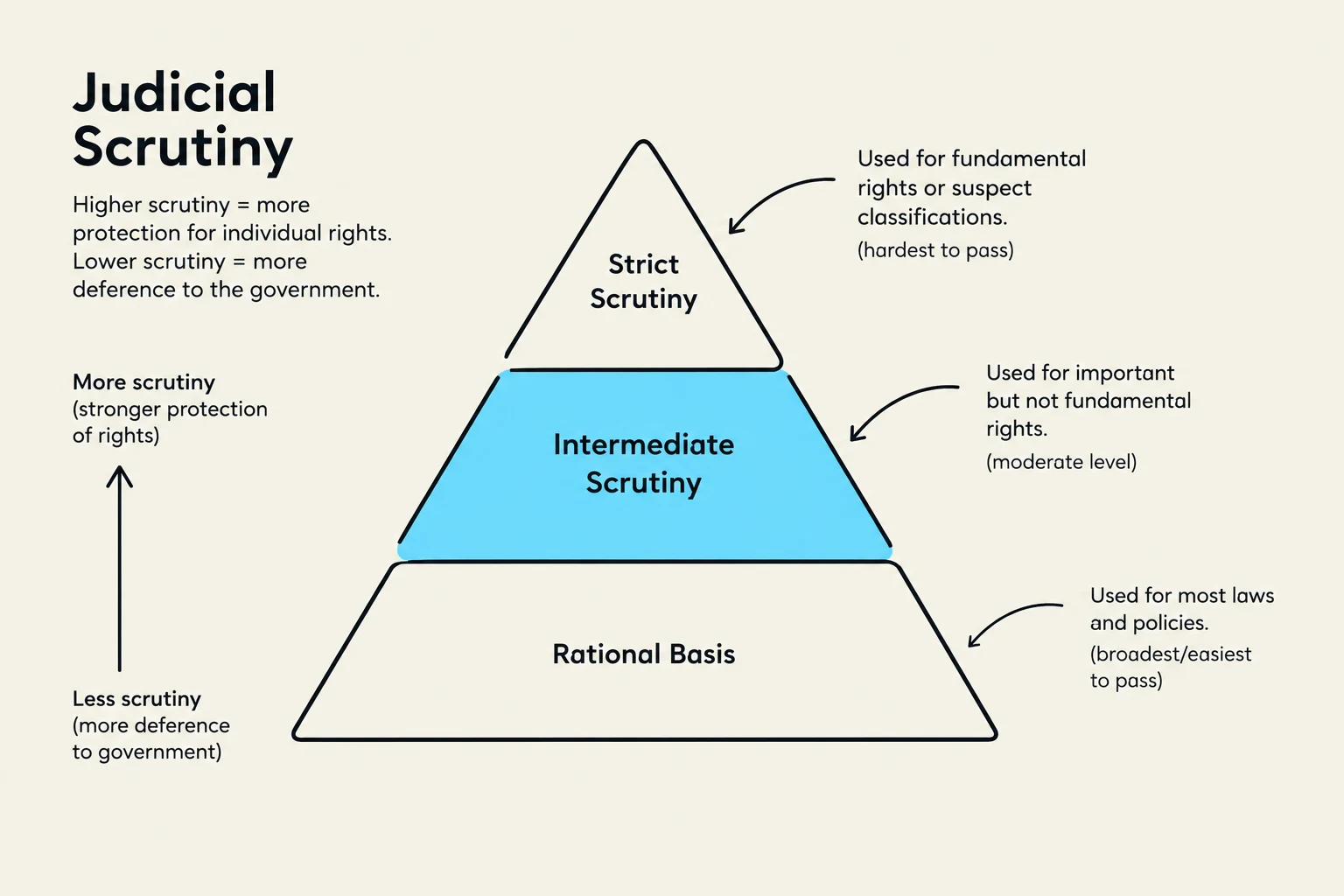
While due process focuses on clarity, the Equal Protection Clause ensures that criminal statutes do not create unjustifiable distinctions between people. Courts use different "levels of scrutiny" to determine if a distinction is constitutional:
Level of Scrutiny
Application
Requirement
Rational Basis
General classifications (e.g., age)
Must be rationally related to a legitimate government purpose.
Intermediate Scrutiny
Gender-based classifications
Must provide a meaningful justification and not rely on stereotypes.
Strict Scrutiny
Race, national origin, or fundamental rights
Must meet the "most rigid scrutiny" to serve a compelling interest.
This diagram illustrates the three tiers of judicial scrutiny used in legal analysis: Strict Scrutiny, Intermediate Scrutiny, and Rational Basis. Each level represents a different degree of review applied to laws and government actions, with Strict Scrutiny offering the highest protection for individual rights and Rational Basis offering the least.
Summary Note: The goal of these constitutional limitations is to strike a delicate balance between the government's need for social order and the individual's right to freedom and predictability.
Keep reading for free.
Create an account to finish this reading and make it part of your study routine.