Constitutional Executive Power: Models and Compromises
An exploration of the spectrum of executive power in constitutional design, from strong monarchies to parliamentary systems, and the role of the suspensive veto as a compromise mechanism. Discusses the paradox of liberty and order.
In the history of political science and constitutional design, few questions are as volatile as the distribution of executive power. How much authority should a single individual hold compared to a collective body of representatives? This tension is not merely academic; it is the central conflict that has shaped modern nation-states, particularly during periods of radical political transition like the French Revolution. The struggle to balance order with liberty often results in a spectrum of models, ranging from the absolute authority of a monarch to the collective governance of a parliament.
The Spectrum of Executive Authority
To understand constitutional design, one must view executive power as a sliding scale. On one end of the spectrum lies the model of strong, centralized authority. Historically, this was embodied by the monarch, whose power was often seen as divinely ordained or essential for maintaining social stability. In these systems, the executive is the primary driver of policy, and the legislative body serves largely to ratify the ruler's decisions.
On the opposite end is the parliamentary model. Here, executive power is derived from and accountable to the legislature. The "executive" is often a cabinet of ministers who must maintain the confidence of the parliament to remain in power. This model prioritizes representation and prevents the concentration of power in a single hand, but it can lead to instability if no clear majority exists to form a government.
This illustration depicts the spectrum of executive power, ranging from centralized monarchical authority to decentralized executive power, with examples of Monarchy, Authoritarian, Constitutional, Federal, and Decentralized systems.
Exam Tip: When analyzing a constitutional crisis, always identify where the executive sits on this spectrum. Is the crisis caused by an executive who is too strong (encroaching on rights) or an executive that is too weak (unable to maintain order)?
The Paradox of Liberty and Order
The transition from absolute rule to constitutional rule is rarely smooth. During transformative eras, such as the French Revolution, the attempt to implement new rights and reforms often collided with the practical need for an effective government. This creates a fundamental paradox: how can a state grant maximum liberty to its citizens while maintaining a strong enough executive to protect those very rights and enforce the law?
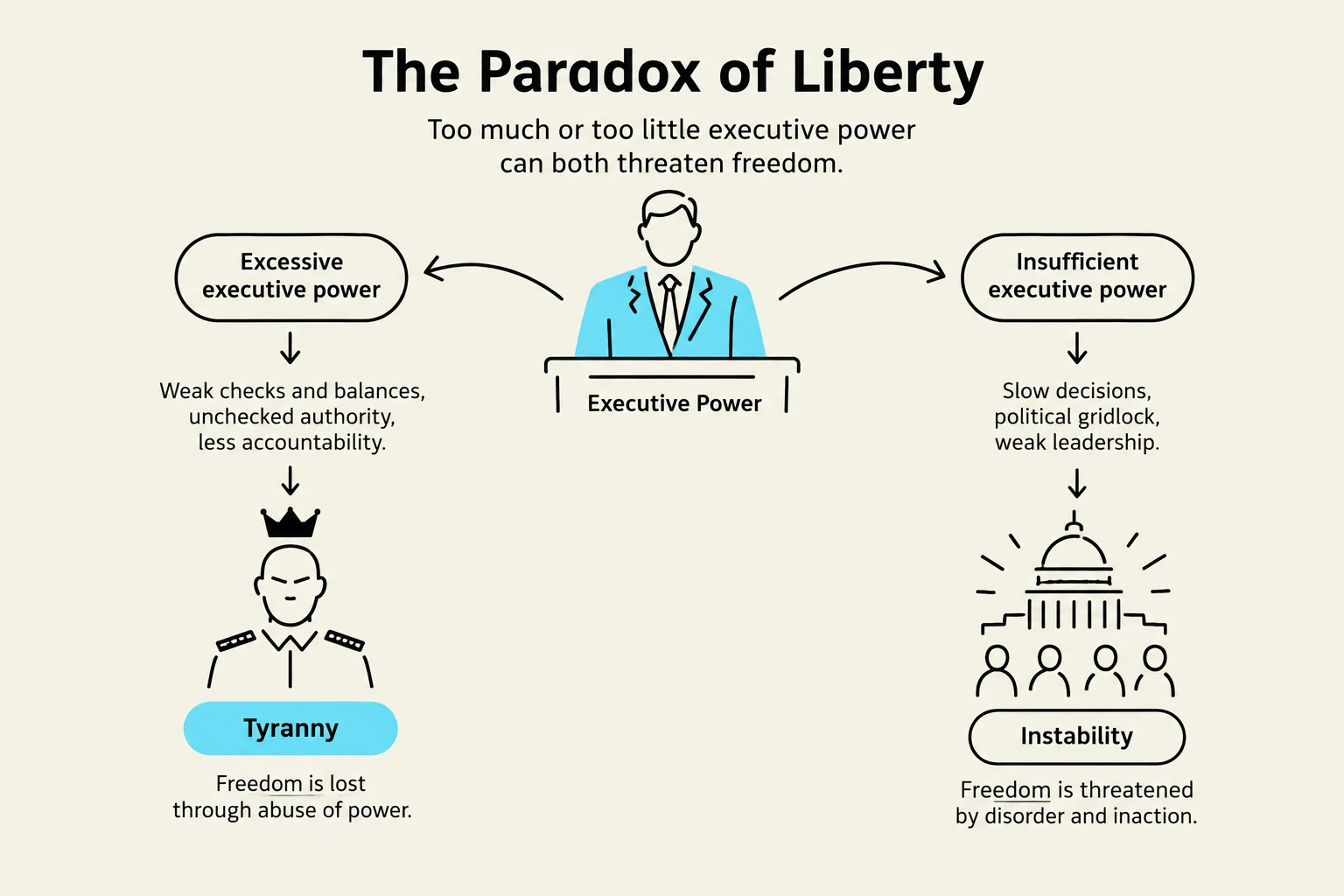
If the executive is too weak, the state may descend into chaos, where "liberty" becomes nothing more than the absence of law. If the executive is too strong, the state becomes a tyranny, where the "rights" of citizens are merely theoretical. This tension is a recurring theme in the study of constitutional law, as reformers attempt to codify protections that prevent the executive from overstepping while ensuring the state remains functional.
This diagram illustrates the paradox of liberty, explaining how both excessive and insufficient executive power can threaten freedom, leading to tyranny or instability respectively.
The Compromise: The Suspensive Veto
To resolve the deadlock between strong executives and dominant legislatures, many constitutional frameworks employ a middle-ground mechanism: the suspensive veto.
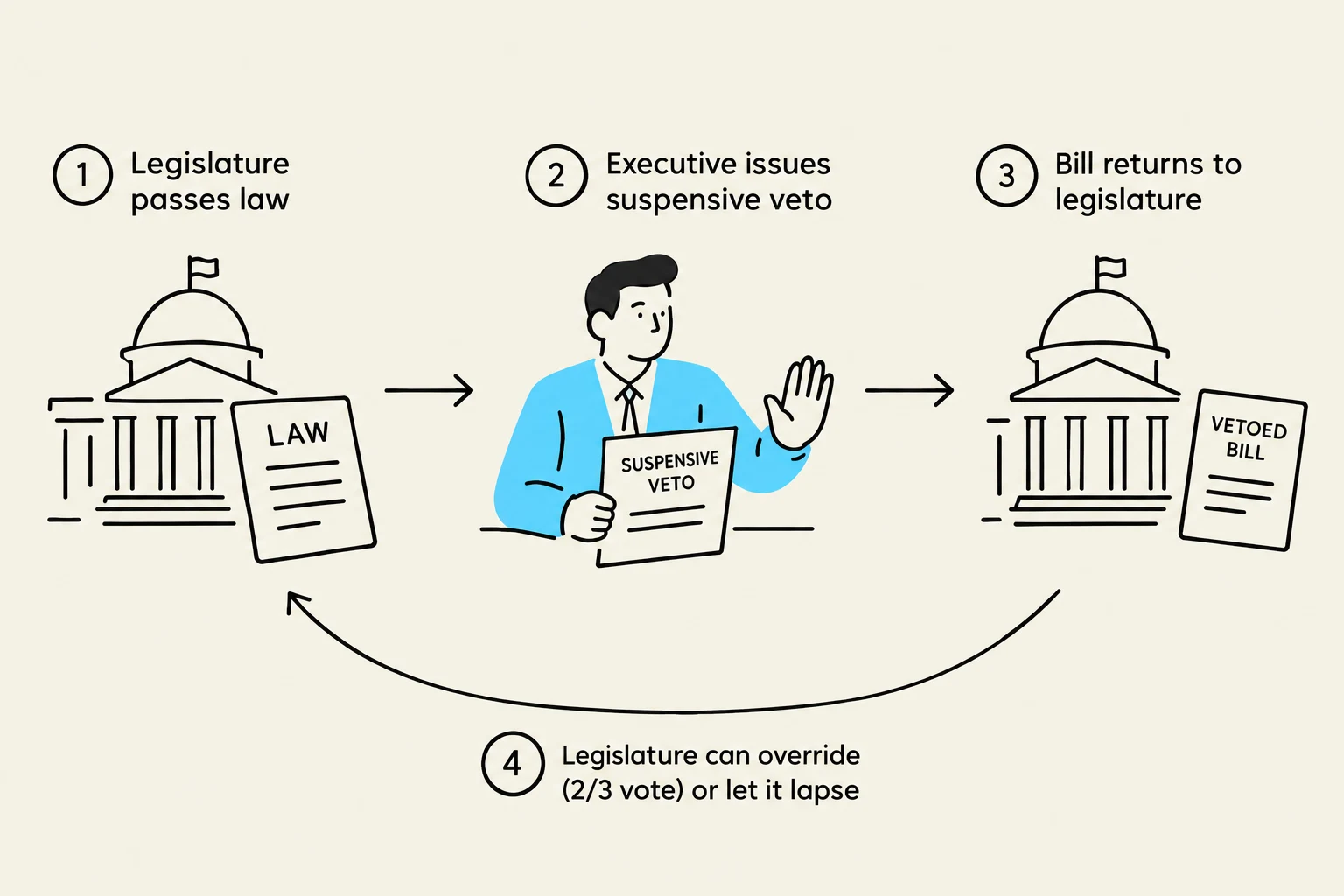
Unlike an absolute veto, which allows an executive to kill a piece of legislation indefinitely, a suspensive veto merely allows the executive to send a law back to the legislature for reconsideration. This forces a "second look" at the policy, acting as a cooling mechanism for impulsive legislative action.
The mathematical logic of this power can be viewed as a delay function rather than a termination function. If L represents the legislative intent and V represents the executive veto, an absolute veto results in:
V(L)=0
Whereas a suspensive veto functions as a temporal delay t:
f(L,t)=Lreconsideredwhere t>0
This mechanism serves several purposes:
Deliberation: It forces the legislature to debate the implications of a law more deeply.
Check and Balance: It prevents a "tyranny of the majority" in the legislature from passing radical laws without executive scrutiny.
Preservation of Sovereignty: It ensures that the legislature ultimately holds the final word, preserving the principle that the people's representatives are the supreme law-makers.
This diagram illustrates the legislative process, including how a bill becomes a law, the executive's power to issue a suspensive veto, and the legislature's ability to override a veto.
Summary of Models
Feature
Strong Monarchist/Executive
Parliamentary Model
Suspensive Veto Compromise
Primary Power Holder
Single Executive
Legislative Majority
Shared/Balanced
Stability Level
High (but prone to tyranny)
Variable (prone to instability)
Moderate/High
Accountability
Low
High
Moderate
Key Risk
Autocracy
Gridlock/Chaos
Procedural Delays
In conclusion, the design of executive power is a delicate balancing act. Whether through the direct authority of a leader or the nuanced checks of a suspensive veto, the goal of a constitution is to create a structure that is strong enough to govern, but too constrained to oppress.
Keep reading for free.
Create an account to finish this reading and make it part of your study routine.