Conservation of Momentum and Collisions in Classical Mechanics
Explore the fundamental principles of linear momentum, impulse, and energy conservation as applied to elastic and inelastic collisions in classical mechanics. This guide covers one-dimensional and multi-dimensional scenarios, including worked examples like the ballistic pendulum.
In the study of classical mechanics, understanding how objects interact during impacts is fundamental. Whether it is a car crash, a billiard ball strike, or a subatomic particle collision, the behavior of these objects is governed by a set of predictable physical laws. By focusing on the concepts of momentum, impulse, and energy, we can describe complex interactions without needing to track every single microscopic force occurring during the moment of impact.
Linear Momentum and the Inertial System
At the heart of these interactions is linear momentum (p), a vector quantity defined as the product of an object's mass (m) and its velocity (v):
p=mv
When we move from studying a single particle to a collection of particles, we talk about the momentum of a system. The total momentum of a system is simply the vector sum of the momenta of all individual particles within it:
ptotal=p1+p2+…
To predict how this momentum changes, we must define our boundaries. We use the concept of an inertial frame or an inertial system. We can define a system by drawing an imaginary "box" around it.
A closed system is one where no mass enters or leaves the box.
An isolated system is a closed system where no net external force acts upon it.
If a system is isolated (Fext, net=0), the total linear momentum remains constant over time. This is known as the conservation of momentum.
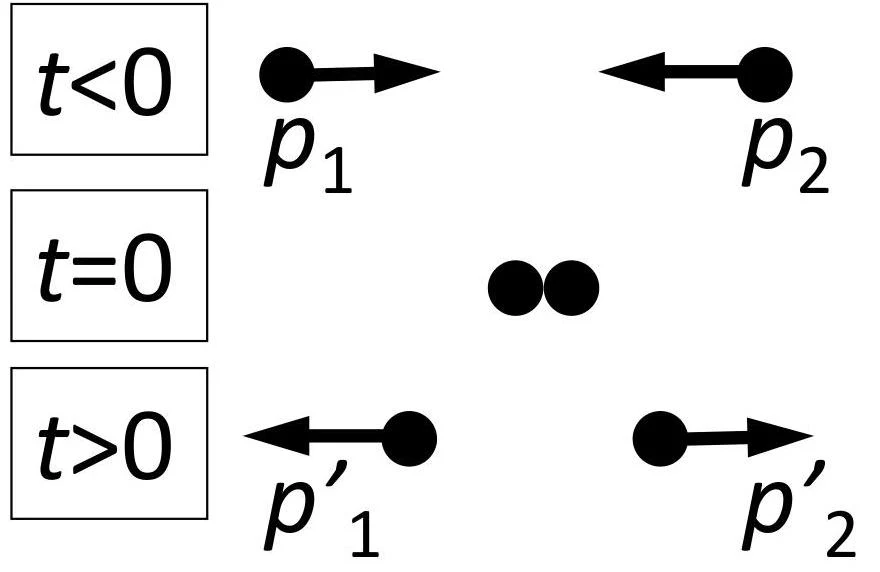
A diagram illustrating the concept of momentum conservation in a collision. Before the collision (t<0), two particles with momenta p1 and p2 are moving towards each other. At the moment of collision (t=0), they are in contact. After the collision (t>0), they move away with new momenta p'1 and p'2.
Exam Tip: When solving problems, always identify if the system is isolated. If you can draw a box around the objects and no external forces (like friction or gravity) are crossing that boundary, momentum is conserved.
Impulse: The Mechanism of Change
While momentum is conserved in an isolated system, it can change if an external force is applied. The relationship between force, time, and momentum is described by impulse. Impulse is defined as the change in momentum (Δp), which is equal to the average force (Favg) multiplied by the time interval (Δt) over which it acts:
Δp=FavgΔt
This is particularly useful in safety engineering. For example, when a car hits a bridge abutment, the force exerted on the passengers depends heavily on how long the collision lasts.
Types of Collisions
A collision is an event where two or more bodies exert relatively strong forces on each other for a short duration. While momentum is always conserved in an isolated system, the behavior of kinetic energy (K=21mv2) varies depending on the type of collision.
Elastic Collisions
In an elastic collision, both total linear momentum and total kinetic energy are conserved. These are often idealized scenarios, such as collisions between very hard spheres or gas molecules.
For a one-dimensional elastic collision between two masses (m1 and m2) where m2 is initially at rest, the final velocities can be calculated using:
v1′=(m1+m2m1−m2)v1v2′=(m1+m22m1)v1
Inelastic Collisions
In an inelastic collision, momentum is conserved, but kinetic energy is not conserved. Some of the kinetic energy is transformed into other forms of energy, such as heat, sound, or the internal energy required to deform the objects.
A special case is the completely inelastic collision (or perfectly inelastic collision), where the colliding objects stick together after the impact and move with a single common velocity ($v'$). The conservation equation for this is:
m1v1+m2v2=(m1+m2)v′
Momentum in Multiple Dimensions
In the real world, collisions rarely happen in a perfectly straight line. When objects collide at angles, we must use vector decomposition to analyze the motion in 2D or 3D. Because momentum is a vector, it must be conserved independently along each axis ($x, y,$ and z).
For a 2D collision, you would set up two separate equations:
X-axis:∑pi,x=∑pf,x
Y-axis:∑pi,y=∑pf,y
Energy and Mechanical Systems
While collisions focus on momentum, many physics problems require the simultaneous use of energy conservation. In systems involving spring forces or gravity, we look at the conservation of mechanical energy (the sum of kinetic and potential energy).
Worked Example: The Ballistic Pendulum
The ballistic pendulum is a classic experiment used to find the initial velocity of a projectile. It combines a perfectly inelastic collision with the conservation of mechanical energy.
Scenario: A bullet of mass m is fired into a wooden block of mass M suspended by a cord. The bullet embeds itself, and the system swings up to a height h.
During the collision (Inelastic): Momentum is conserved.
mvi=(m+M)V(Where V is the velocity of the block+bullet immediately after impact)
During the swing (Conservative): Mechanical energy is conserved as kinetic energy turns into gravitational potential energy.
21(m+M)V2=(m+M)gh
Solving for V gives: V=2gh
By measuring the height h, we can find V, and subsequently use the momentum equation to find the bullet's original speed vi.
Summary Table: Collision Comparison
Feature
Elastic Collision
Inelastic Collision
Completely Inelastic
Momentum
Conserved
Conserved
Conserved
Kinetic Energy
Conserved
Not Conserved
Not Conserved
Final State
Objects rebound
Objects separate
Objects stick together
Keep reading for free.
Create an account to finish this reading and make it part of your study routine.