Conservation of Energy and Non-Conservative Forces in Physics
Explore the fundamental principles of work, kinetic energy, potential energy, and their conservation in physics. This guide details how conservative and non-conservative forces, such as friction, affect energy transformations in mechanical systems, using examples like the loop-the-loop problem.
In physics, understanding how objects move requires more than just looking at the forces acting upon them; we must also understand how energy is transferred and transformed. While Newton's Second Law (a=F/m) describes the immediate push and pull of forces, the concepts of work and energy allow us to analyze complex systems over longer distances and time intervals. This article explores the relationship between work, kinetic energy, and potential energy, and how these principles apply to real-world scenarios like a bead sliding through a loop-the-loop.
Work and Kinetic Energy
Work is the mechanism by which energy is transferred. It is defined as the dot product of the net force vector and the displacement vector:
W=Fnet⋅d
Because it is a dot product, the efficiency of the work depends on the angle between the force and the direction of motion. If the force is in the same direction as the displacement, the work is positive; if it opposes the motion, the work is negative.
One of the most fundamental relationships in mechanics is the Work-Energy Theorem, which states that the net work done on an object is equal to its change in kinetic energy (K). Kinetic energy is the energy of motion, defined as:
K=21mv2
When a force varies over a path, we calculate the total work using an integral:
W=∫xixfF(x)⋅dx
The relationship can be summarized as follows:
W>0→ΔK>0: The object speeds up (energy is added).
W<0→ΔK<0: The object slows down (energy is deducted).
W=0→ΔK=0: The speed remains constant.
This diagram illustrates the concept of work done by a force, represented by the equation W = integral from x_f of F_x dx, showing three instances of a mass 'm' being acted upon by forces F1, F2, and F3 over displacements delta x1, delta x2, and delta x3 respectively.
Potential Energy and Conservative Forces
While kinetic energy describes motion, potential energy (U) describes the "potential" for motion stored within a system due to its position or configuration. For conservative systems, the total mechanical energy (the sum of kinetic and potential energy) remains constant:
K+U=constant
This means that energy is not lost, but merely transformed from one type to another.
Gravitational Potential Energy
When an object is lifted against gravity, it gains gravitational potential energy. This energy depends on the mass of the object, the acceleration due to gravity (g), and the height (h) above a reference point:
Ugravity=mgh
Elastic Potential Energy
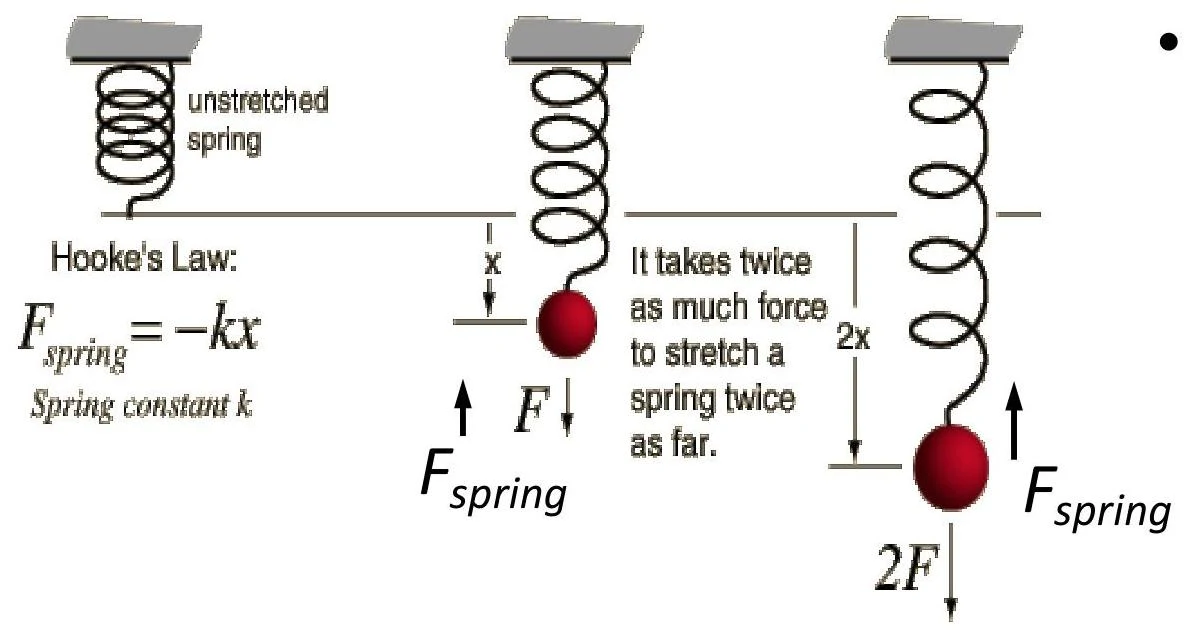
Objects like springs can also store energy when they are stretched or compressed. According to Hooke's Law, the force exerted by a spring is proportional to its displacement from equilibrium:
Fspring=−kx
The potential energy stored in such a spring is:
Uspring=21kx2
This diagram illustrates Hooke's Law, which states that the force exerted by a spring is proportional to its displacement from its equilibrium position. The formula F_spring = -kx is shown, where F_spring is the spring force, k is the spring constant, and x is the displacement. The diagram shows that stretching the spring twice as far requires twice the force.
Exam Tip: When solving problems involving springs, remember that x represents the displacement from the equilibrium position. A positive x indicates stretching, while a negative x indicates compression.
The Loop-the-Loop Analysis
A classic application of these concepts is the "loop-the-loop" problem, where a bead or a roller coaster car travels through a vertical circular track. To successfully complete the loop without falling off, the object must maintain a minimum speed at the highest point of the track.
Centripetal Force and Minimum Speed
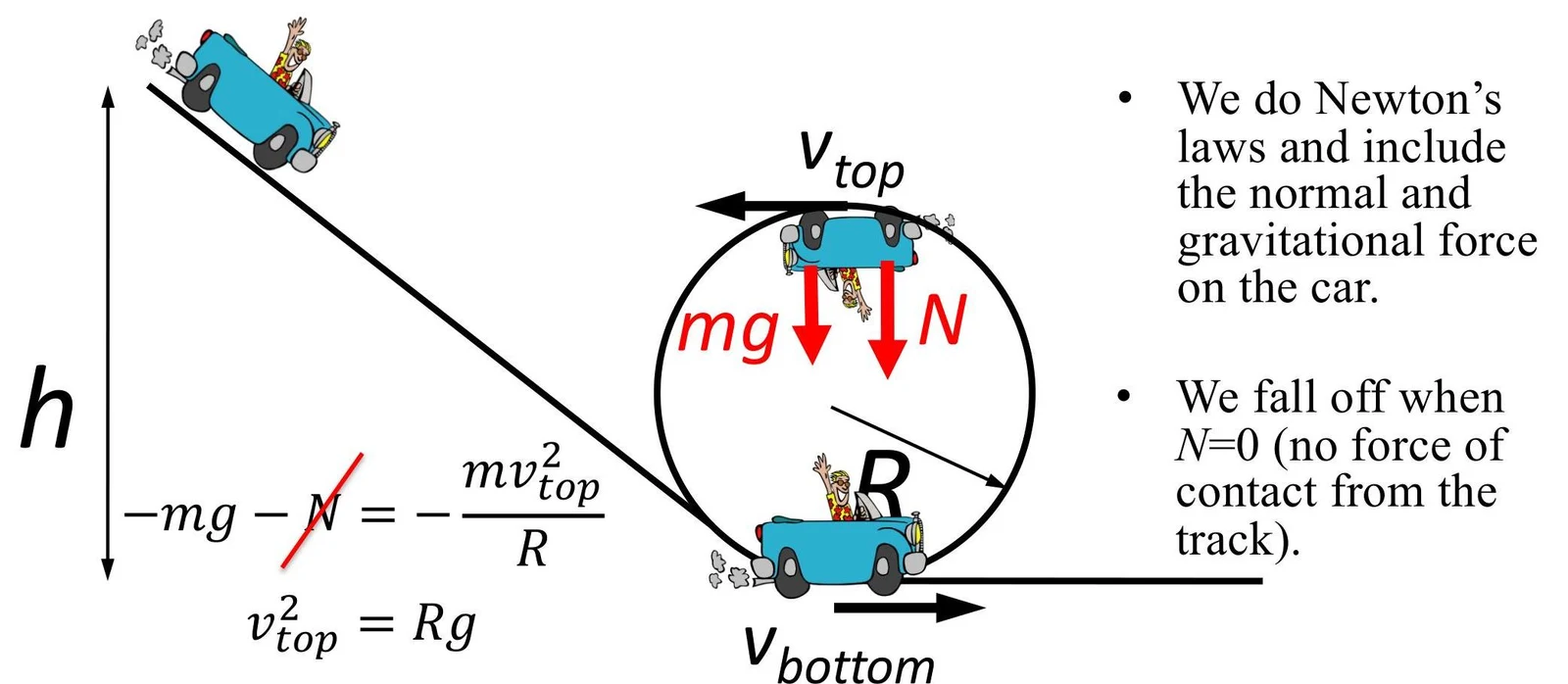
At the top of the loop, the object is subject to both gravity and the normal force from the track. To stay on the track, the net force must provide the necessary centripetal acceleration to keep the object moving in a circle. The "critical moment" occurs when the object is moving just fast enough that it is on the verge of losing contact with the track.
Diagram illustrating Newton's laws of motion applied to a car on a track, including forces like gravity and normal force, and conditions for falling off.
Solving for Height (h)
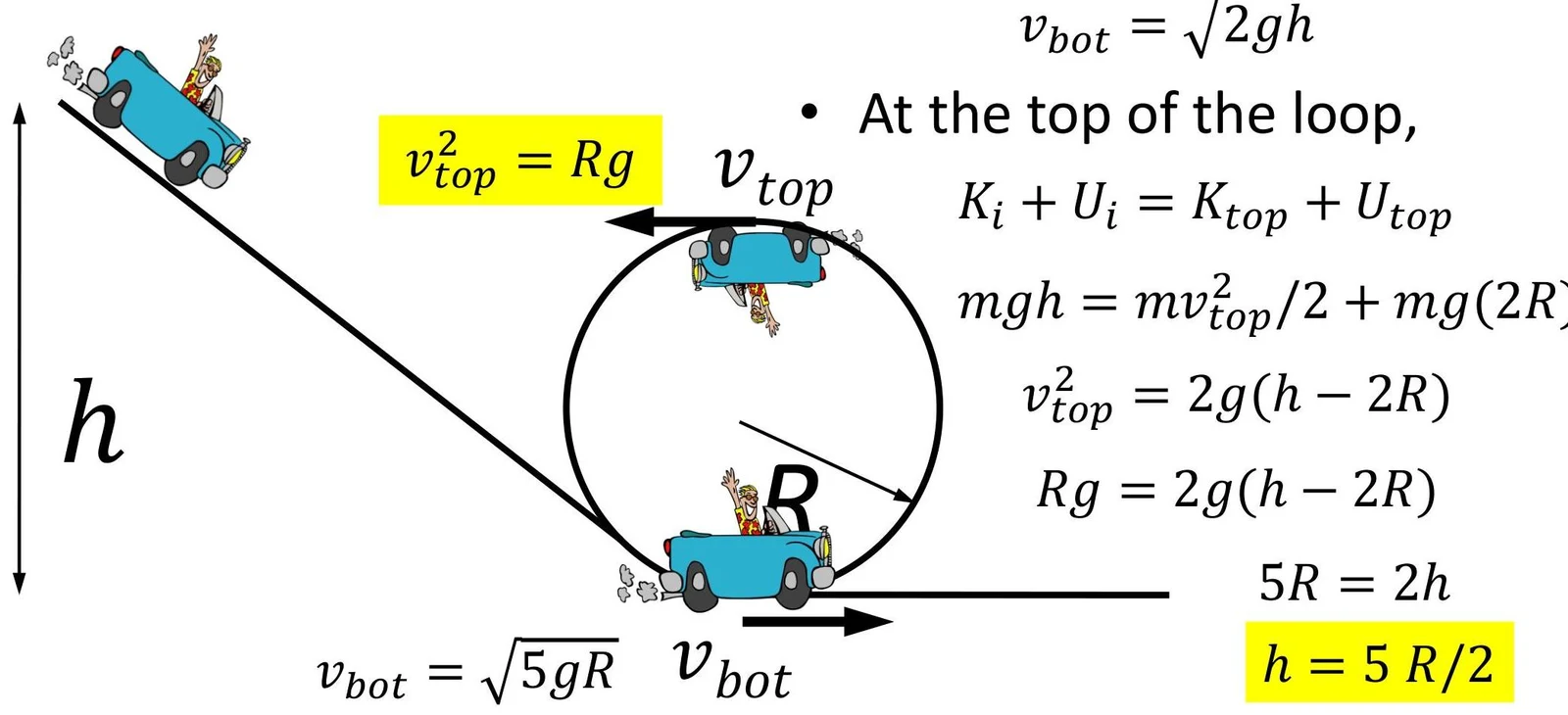
To find the minimum starting height (h) required to complete a loop of radius R, we use the conservation of energy between the starting point and the top of the loop:
At the start:Ki=0 and $U_i = mgh$.
At the top:Ktop=21mvtop2 and Utop=mg(2R).
Conservation:mgh=21mvtop2+mg(2R).
By applying the condition for centripetal force at the top (vtop2=gR), we can derive the required height:
mgh=21m(gR)+2mgRh=21R+2R=2.5Rorh=25R
A diagram illustrating the physics of a car going over a loop-the-loop, showing the relationship between height, radius, and velocity using equations.
Non-Conservative Forces and Energy Dissipation
In the real world, most systems are not perfectly conservative. Non-conservative forces, most notably friction, perform work that does not result in a change in potential energy.
Instead of being stored as potential energy, the mechanical energy (the sum of K+U) is "dissipated"—it is transformed into other forms of energy, typically heat. When friction is present, the total mechanical energy at the end of a motion will be less than the total mechanical energy at the beginning.
This diagram illustrates the physics of a car rolling down an incline, comparing two solutions for calculating its final velocity, one neglecting friction and the other accounting for it.
To account for this in energy equations, we use the relationship:
Wnc=ΔEmech=(Kf+Uf)−(Ki+Ui)
where Wnc is the work done by non-conservative forces like friction.
Keep reading for free.
Create an account to finish this reading and make it part of your study routine.