In political philosophy, the relationship between a ruler and the ruled is often viewed as a contract. This contract is built upon a fundamental purpose: the preservation of the people's "property," which includes their lives, liberties, and estates. When a monarch or a legislative body ceases to act in the interest of this preservation and instead begins to act against it, the very foundation of their authority begins to crumble.
A diagram illustrating the concept of the social contract, where people delegate power to the government for the protection of their life, liberty, and estate.
This article explores the specific legal and philosophical conditions under which a king or government loses its legitimacy, effectively "unking" themselves and returning to the status of a private citizen.
The Purpose of Government and the Breach of Trust
To understand how authority is lost, one must first understand why it is granted. In a "state of Nature," individuals possess absolute freedom but suffer from extreme insecurity because there is no settled law, no impartial judge, and no power to enforce justice. To remedy this, men enter into a political society, delegating their power to a government to ensure the protection of their property.
The legitimacy of the ruler is therefore conditional. The legislative and executive powers are held in "trust". When the ruler uses the tools of the state—such as the treasury, the military, or the law—to serve their own arbitrary will rather than the public good, they commit a breach of trust.
Key Concept: The Social Contract
Authority is not an inherent right of the ruler; it is a delegated power from the people. If the purpose of the delegation (the preservation of the people) is violated, the delegation is void.
Specific Conditions for the Loss of Regal Authority
Philosophers like John Locke and even more conservative thinkers like Barclay have identified specific scenarios where a monarch's authority is extinguished.
1. Overturning the Government
A monarch forfeits their power if they attempt to destroy the very framework of the commonwealth they were meant to protect. This is characterized by a design to ruin the kingdom through force or violence.
Historical examples often cited include:
Nero: Who allegedly sought to destroy the Senate and the people of Rome to establish a new seat of power.
Caligula: Who expressed a desire to eliminate the established orders of his people.
When a ruler pursues such designs, they effectively "abandon" their subjects, much like a master abandons his slaves, thereby losing the right to govern them.
2. Transfer of Kingdom to Alien Dominion
A second, distinct way a king loses his crown is through the alienation of the kingdom to a foreign power. Even if the king does not intend to harm his people, the act of making the kingdom dependent on another nation's dominion strips the monarch of the "principal part of regal dignity".
Because the king's primary role is to be the supreme authority under God within his own realm, handing that sovereignty to a foreign power means he is no longer the sovereign. In this instance, the king "divests himself of his crown and dignity" and returns to the status of a private individual.
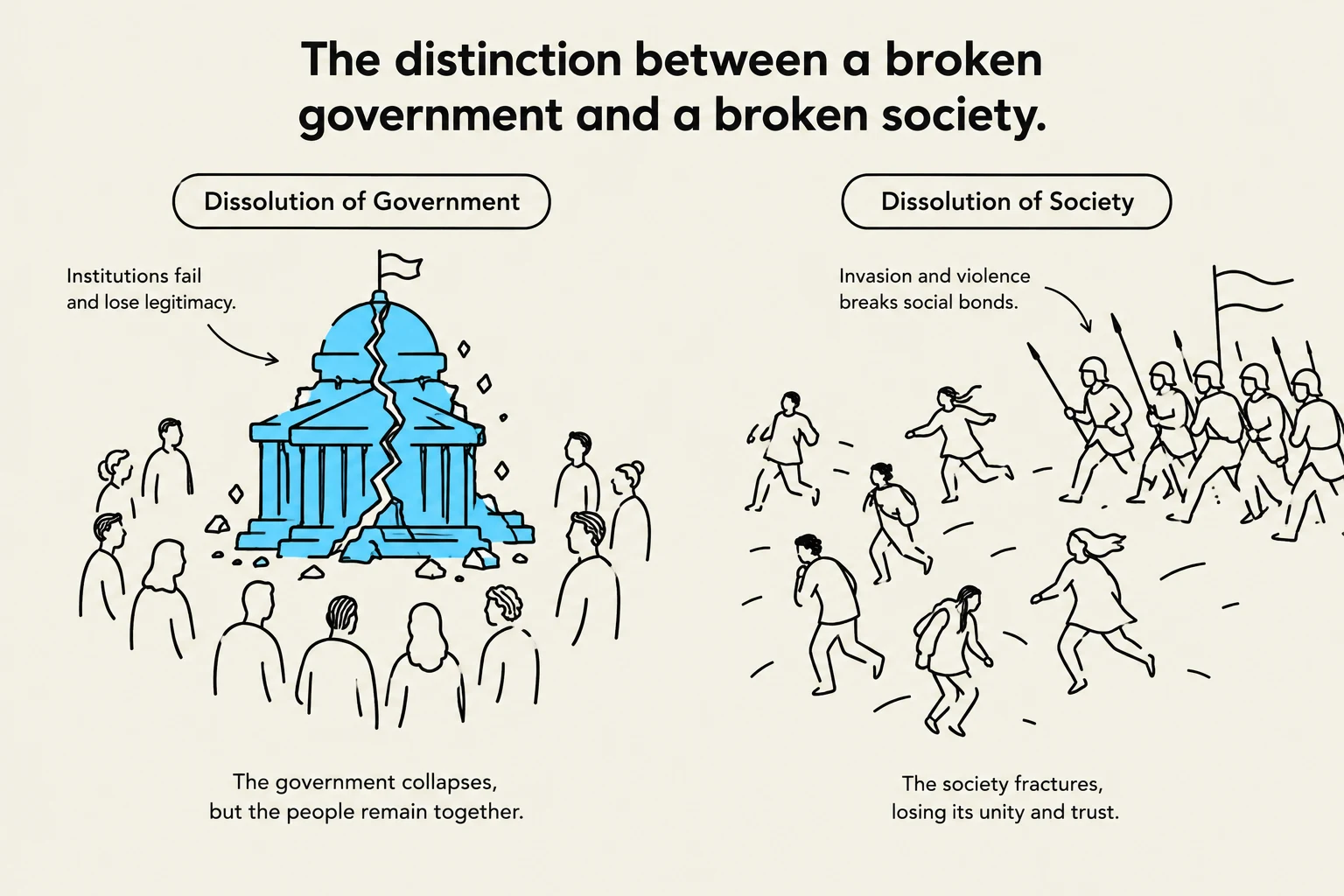
The Dissolution of Government vs. The Dissolution of Society
This illustration contrasts the dissolution of government, where institutions fail but people remain united, with the dissolution of society, where social bonds break due to invasion and violence, leading to societal fracture.
It is vital to distinguish between the end of a specific government and the end of the society itself.
Dissolution of Society: This usually occurs through foreign conquest. When a society is conquered, the union of the people is broken, and they return to a state of nature where they must fend for themselves.
Dissolution of Government: This can happen from within. If the legislative is altered (for example, if a prince prevents the assembly from meeting or changes the rules of election), the government is effectively dissolved even if the people remain a cohesive society.
The Rights of the People in an Interregnum
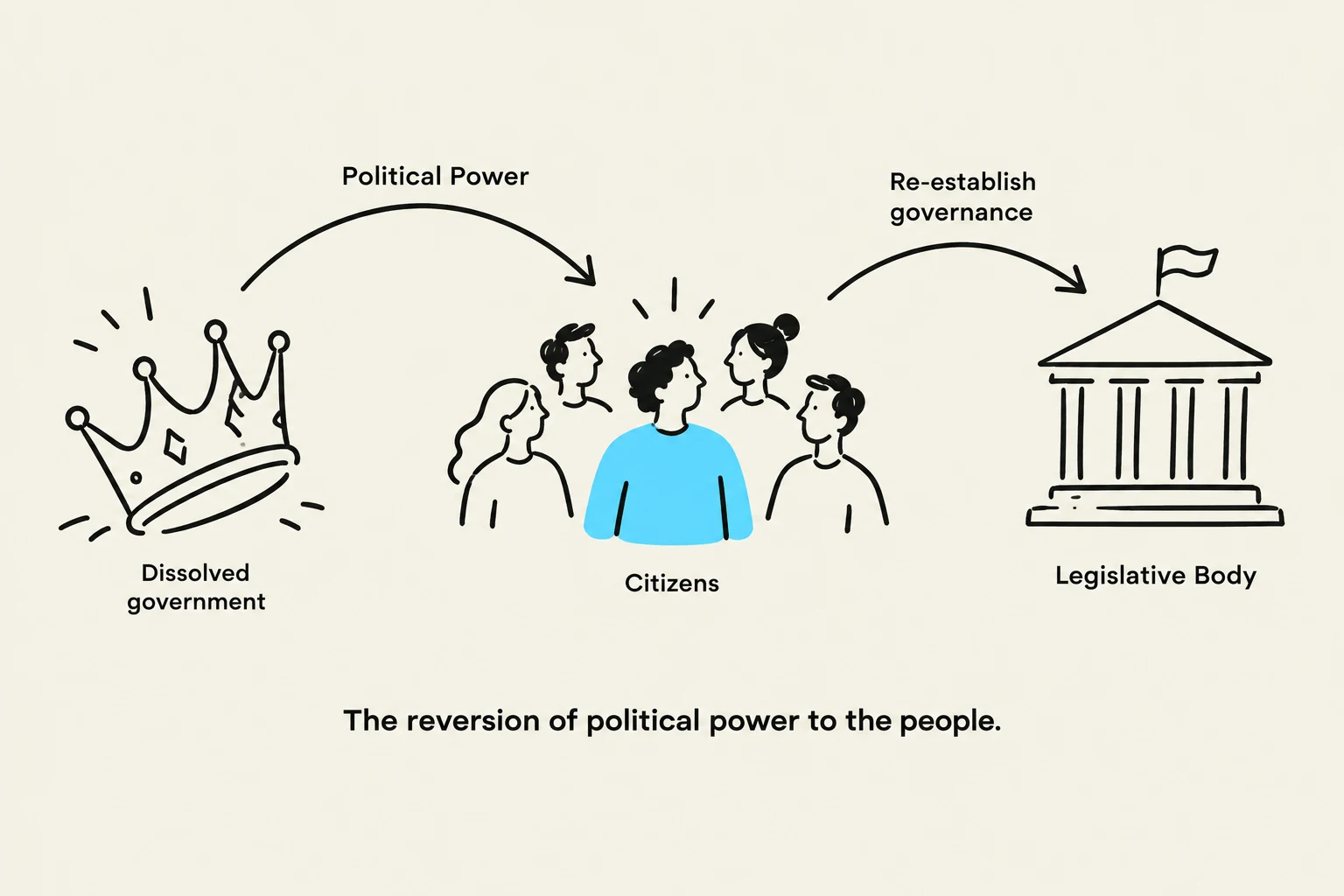
A diagram illustrating the reversion of political power from a dissolved government to citizens, who then re-establish governance through a legislative body.
When a government is dissolved due to the misconduct of its rulers, what happens to the people? They do not lose their natural rights; rather, their political power "reverts" to them.
During this period—often referred to as an interregnum—the people are at liberty to provide for their own safety by establishing a new legislative body. This might involve changing the persons in power, the form of government, or both.
Exam Tip: The "Judge" Question
A common counter-argument is: "Who shall be the judge of whether the prince has acted contrary to his trust?"
The answer is twofold:
The People: As the ones who delegated the power, they are the natural judges of whether their trust has been betrayed.
Heaven: If there is no earthly judge to resolve the dispute, the matter becomes a "state of war," and the appeal lies to God.
Summary Table: Forfeiture of Power
Condition
Action of the Ruler
Resulting Status
Breach of Trust
Using power to invade the property, liberty, or lives of the subjects.
The ruler enters a "state of war" with the people.
Subversion of Law
Setting up arbitrary will in place of established, standing laws.
The legislative is considered "changed" or "broken".
Alienation
Subjecting the kingdom to the dominion of a foreign power.
The king divests himself of his crown and becomes a private man.
Abandonment
Neglecting the charge of government so that laws can no longer be executed.
The government ceases to exist, reducing the state to anarchy.
In conclusion, the authority of a king is not an absolute shield against accountability. It is a functional tool intended for the public good. When that tool is turned against the people, the legal and moral bonds of obedience are severed, and the people regain their original liberty to govern themselves.
Keep reading for free.
Create an account to finish this reading and make it part of your study routine.