Condensate, Feedwater, and Water Treatment Systems in Steam Plants
This document explains the critical role of water management in steam plants, detailing the challenges posed by water impurities, various treatment methods like demineralization and condensate polishing, and the distinct functions of condensate and feedwater systems. It also covers deaeration for dissolved gas removal
In a modern steam plant, the production of energy is not solely dependent on the combustion of fuel or the movement of turbines; it relies heavily on the sophisticated management of water. While the main heating and energy-converting components are the stars of the show, the "additional" systems—specifically water preparation, treatment, preheating, and pressurizing—are essential for efficient and safe operation. Without precise control over water chemistry and temperature, a plant faces the constant threats of equipment failure, inefficiency, and catastrophic damage.
The Challenge of Water Impurities
Natural water sources, such as rivers, lakes, or wells, are rarely pure. They contain various substances that can hinder boiler performance or damage vital components if not properly managed. These impurities generally fall into several categories:
Suspended Solids: These are undissolved materials, such as mud or silt, that can be removed through filtration.
Dissolved Solids: These are minerals in solution that cannot be filtered out, such as silica, iron, calcium, magnesium, and sodium.
Dissolved Gases: Atmospheric gases like O2, N2, and CO2 dissolve into the water supply.
The presence of these impurities leads to several critical issues. Hard-water, caused by dissolved calcium and magnesium, leads to scaling—the precipitation of minerals that adhere to boiler tubes. Scaling is particularly dangerous in high-pressure boilers because it causes overheating of the tubes and loss of heat-transfer surfaces, eventually leading to tube failure. Furthermore, dissolved gases like oxygen cause corrosion in water lines and heat exchangers, while high conductivity (resulting from ionized solids) increases the risk of further corrosive damage.
Exam Tip: If you are asked about the primary cause of scale in heat exchangers, remember that hardness (calcium and magnesium) is the chief source.
Water Treatment and Polishing
To combat these impurities, plants employ a combination of external treatment (in reservoirs) and internal treatment (integrated filtration and polishing loops).
Demineralization and Condensate Polishing
Demineralization involves chemical treatments to remove dissolved salts and minerals. A common method is ion exchange, which uses resins to swap unwanted ions for others. For example, cation resins may use acids like HCl or H2SO4, while anion resins use sodium hydroxide (NaOH), also known as lye.
In many plants, a condensate polishing system acts as an overall demineralization system for the condensate loop. This continuously looped system uses filtration and chemical ion exchange to remove silica, iron oxides, and other contaminants. The advantages of using a polisher rather than relying solely on natural settling include reduced startup time, less wasted water/heat due to reduced blowdown, and improved overall efficiency.
Boiler Blowdown
When polishing or chemical treatment is insufficient, plants must use boiler blowdown. This process involves discharging a portion of the boiler water to remove accumulated solids and replacing it with high-quality makeup or feedwater. This maintains the concentration of solids at an acceptable level, measured in parts per million (ppm).
The Condensate and Feedwater Systems
It is vital to distinguish between the two primary water loops in a steam plant: the Condensate System and the Feedwater System.
The Condensate System
Condensate is the water formed by the condensation of steam in the condenser, which then collects in the condenser hotwell. Using condensate is highly economical because it is extremely pure (having recently been steam) and retains much of its thermal energy.
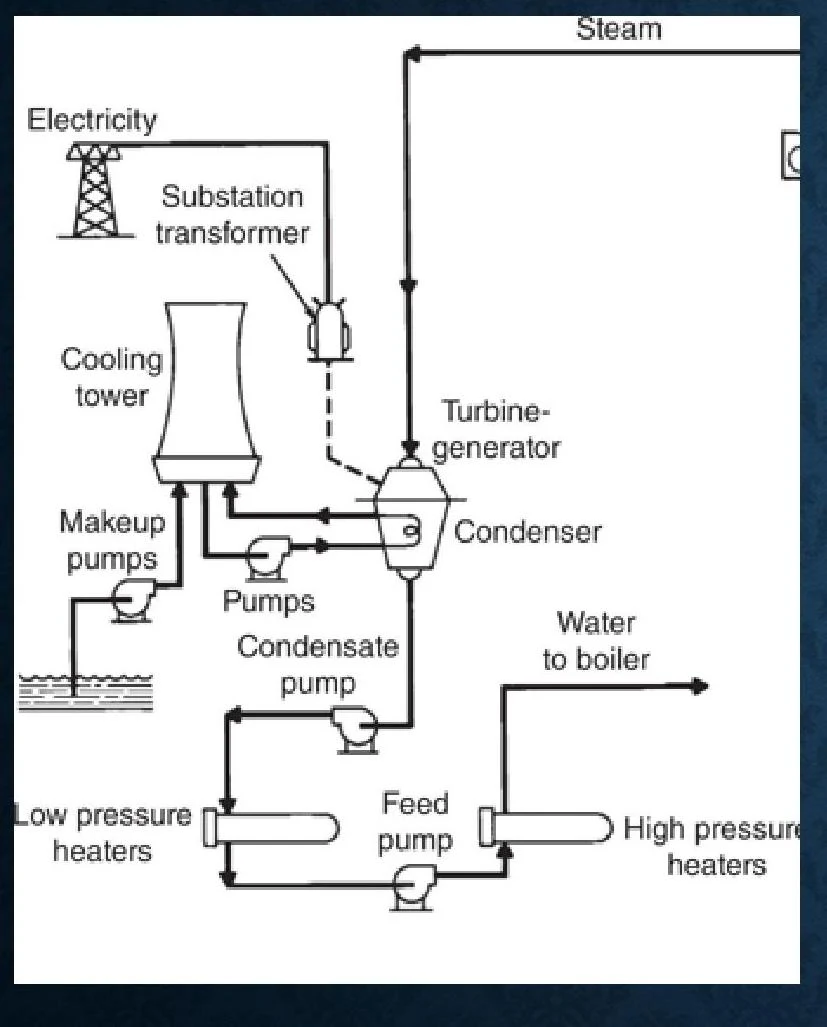
The condensate flowpath typically follows this sequence:
Condenser Hotwell: The main source of condensate.
Condensate Pumps: These pressurize the water to drive flow.
Polishing/Chemical Treatment: To ensure purity.
Low Pressure (LP) Feedwater Heaters: To preheat the water.
Deaerator: The final stage of the condensate system.
Diagram of a steam power plant showing the flow of steam, water, and electricity through various components like the turbine-generator, condenser, cooling tower, and heaters.
The Feedwater System
Once the water passes through the deaerator, it becomes feedwater. The feedwater system is a high-pressure environment.
The feedwater flowpath follows this sequence:
Deaerator Storage Tank: Provides the water for the pumps.
Boiler Feed Pumps (BFPs): These powerful pumps greatly pressurize the water. They are the main control point for plant output; increasing feedwater flow via the BFPs generally increases power output.
High Pressure (HP) Feedwater Heaters: The final preheating stages before the water reaches the boiler economizer.
A technical schematic diagram illustrating the components and flow of a power plant feedwater system.
Deaeration: Dissolved Gas Removal
One of the most critical functions in water preparation is deaeration. This is a form of evaporation treatment used to remove non-condensable gases, specifically oxygen, which is a primary driver of corrosion.
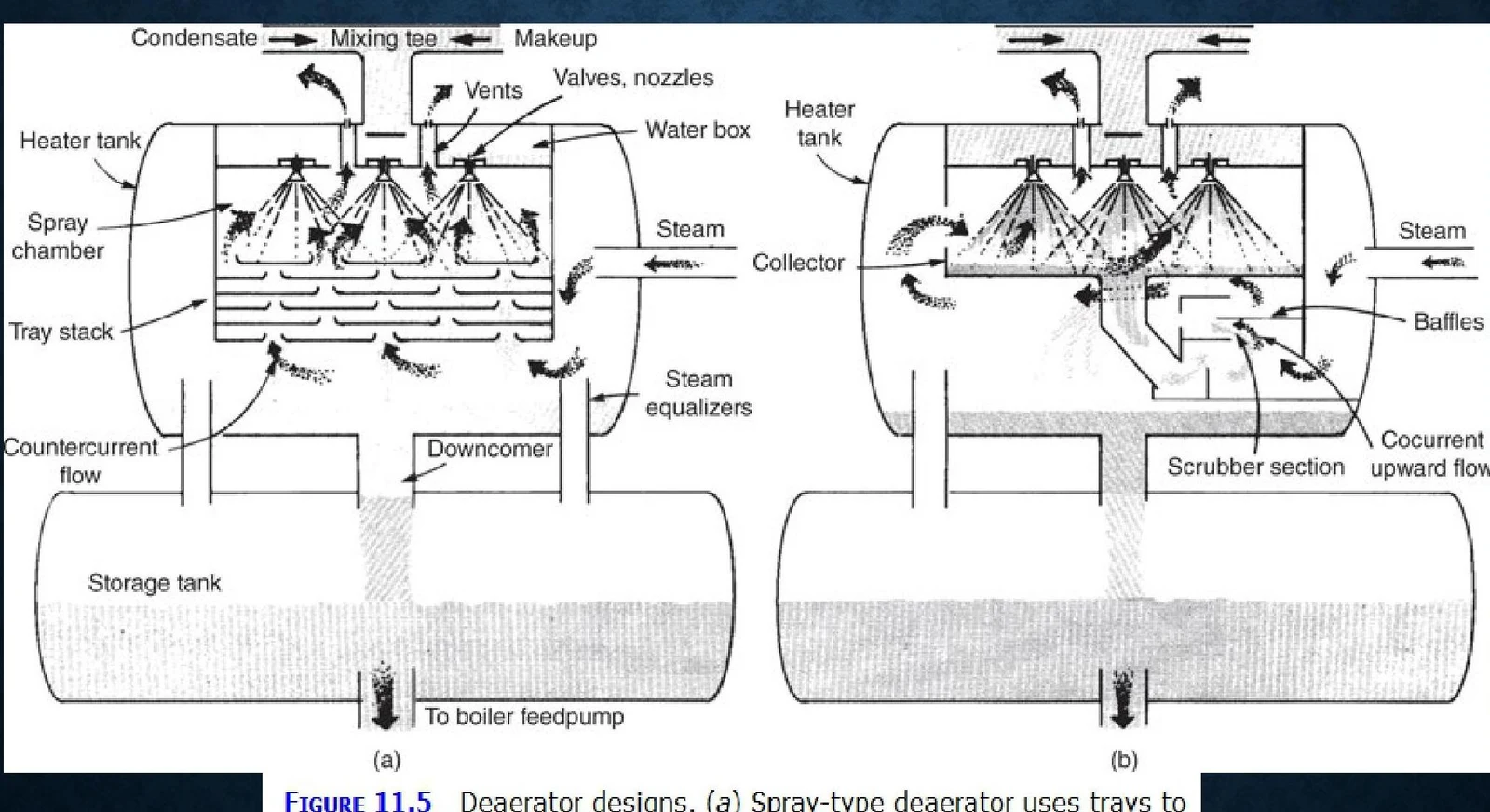
A deaerator is an "open" heater, meaning the steam and water are in direct contact. There are several common designs:
Spray-type: Water is sprayed through nozzles to create droplets that fall through perforated trays.
Spray-scrubber type: This design produces a turbulent upward flow of steam and water in a scrubber section to strip away oxygen.
Diagrams illustrating two types of deaerator designs: (a) a spray-type deaerator utilizing trays, and (b) a deaerator with a scrubber section.
Beyond gas removal, the deaerator serves as a storage tank for the Boiler Feed Pumps. Because it is usually located above the pumps, it provides the necessary suction head (acting like a water tower) to ensure the pumps operate correctly.
Feedwater Heating (FWH)
To improve thermal efficiency, plants use Feedwater Heaters (FWH) to preheat water using steam extracted from the turbine. Most plants utilize a series of 5 to 8 heating stages.
Closed Shell and Tube Heat Exchangers
Most FWHs are closed systems using shell and tube heat exchangers. In this arrangement, the feedwater flows through the tubes, while the extracted steam flows through the shell surrounding the tubes. This allows for efficient thermal energy transfer without the steam and feedwater ever touching.
Low Pressure (LP) FWH: Located in the condensate system, upstream of the Boiler Feed Pumps. They typically operate at pressures below 900 psig.
High Pressure (HP) FWH: Located in the feedwater system, downstream of the Boiler Feed Pumps. These often use a counter-flow arrangement to pair the hottest steam with the latest stage of water for maximum efficiency.
Note on Maintenance: FWH damage is frequently caused by tube failures resulting from steam impingement (erosion), tube vibration, or oxygen pitting.
Summary of Water Quality Management
Because water treatment has become such a sophisticated science, continuous water quality testing is mandatory. Operators must monitor:
Conductivity: A measure of ionized solids in solution (the opposite of electrical resistance).
pH: A measure of the acidity or alkalinity of the water.
By integrating condensate polishing, deaeration, and multi-stage feedwater heating, modern steam plants can maintain high efficiency while protecting their most expensive assets from the destructive forces of scale and corrosion.
Keep reading for free.
Create an account to finish this reading and make it part of your study routine.