Concentration Units and Mixture Types in Chemistry
This content explains the fundamental concepts of mixtures in chemistry, including solutions, colloids, and suspensions. It details various concentration units such as percentage, parts per million, molarity, and equivalents, and discusses solubility, saturation, and dilution. The biological implications of diffusion a
In chemistry, understanding how substances are mixed is fundamental to everything from cooking to life-saving medical treatments. When we talk about mixtures, we are describing how different substances—such as a solid salt and a liquid water—interact with one another. The way we quantify these interactions is through the concept of concentration, which measures the amount of a solute dissolved within a solvent.
Understanding Mixtures: Solutions, Colloids, and Suspensions
Not all mixtures are created equal. Depending on the size of the particles involved, a mixture can be classified into one of three main categories: solutions, colloids, or suspensions.
Solutions
A solution is a homogeneous mixture, meaning the substances are uniformly distributed throughout. It consists of two parts: the solvent (the component present in the greatest amount) and the solute (the component being dissolved).
Colloids and Suspensions
If the particles are larger than those in a solution, the mixture becomes more complex:
Colloids: These contain intermediate-sized particles (1 nm to 1μm). They usually appear cloudy and do not settle over time. Examples include milk and soapy water.
Suspensions: These contain large particles (>1μm) that are often visible to the naked eye. Unlike solutions or colloids, the particles in a suspension will eventually settle due to gravity. An example is Pepto Bismol.
Mixture
Particle Size
Appearance
Particle Settling?
Solution
Small (<1 nm)
Clear
No
Colloid
Intermediate (1 nm−1μm)
Usually cloudy
No
Suspension
Large (>1μm)
Cloudy
Yes
Solubility and Saturation
The ability of a solute to dissolve in a solvent is known as solubility. This process is often guided by the principle "like dissolves like," where polar substances dissolve in polar solvents (like sugar in water), and nonpolar substances dissolve in nonpolar solvents.
The amount of solute that can dissolve is limited by temperature and the nature of the substances. We categorize solutions based on how much solute they hold:
Unsaturated solution: A solution that contains less than the maximum amount of solute possible at a given temperature.
Saturated solution: A solution that contains the maximum amount of solute that can be dissolved at that temperature.
Exam Tip: Temperature affects solubility differently depending on the state of matter. In water, as temperature increases, most solids and liquids become more soluble, but gases become less soluble.
Common Concentration Units
To communicate how "strong" or "weak" a solution is, scientists use various reporting units. These can be grouped by how they relate mass and volume.
Percentage and Parts Units
These units are often used in clinical or industrial settings to describe concentrations of trace elements or common mixtures.
Weight/Weight Percent (w/w %): The mass of solute divided by the total mass of the solution, multiplied by 100.
w/w %=g of solutiong of solute×100
Volume/Volume Percent (v/v %): Used when both solute and solvent are liquids.
Weight/Volume Percent (w/v %): Often used in medicine to describe how many grams of a drug are in a specific volume of liquid.
Parts per Thousand (ppt), Million (ppm), and Billion (ppb): These are used for very dilute solutions.
ppt=mL of solutiong of solute×103
ppm=mL of solutiong of solute×106
ppb=mL of solutiong of solute×109
Molarity and Equivalents
In laboratory chemistry, two units are most prevalent:
Molarity (M): This is the most common way to report concentration in chemistry. It represents the moles of solute per liter of solution.
M=liters of solutionmoles of solute
Equivalents (Eq): Used frequently in medicine, particularly for electrolytes like Na+ or Ca2+. An equivalent is the number of moles of charge that one mole of a solute contributes to a solution. For example, 1 mol of Na+ is 1 Eq, but 1 mol of Ca2+ is 2 Eq.
Dilution: Reducing Concentration
Dilution is the process of reducing the concentration of a solution by adding more solvent. When you dilute a solution, the amount of solute stays the same, but the total volume increases. This relationship is expressed by the following equation:
Voriginal×Coriginal=Vfinal×Cfinal
Where V is volume and C is concentration.
Biological Implications: Diffusion and Osmosis
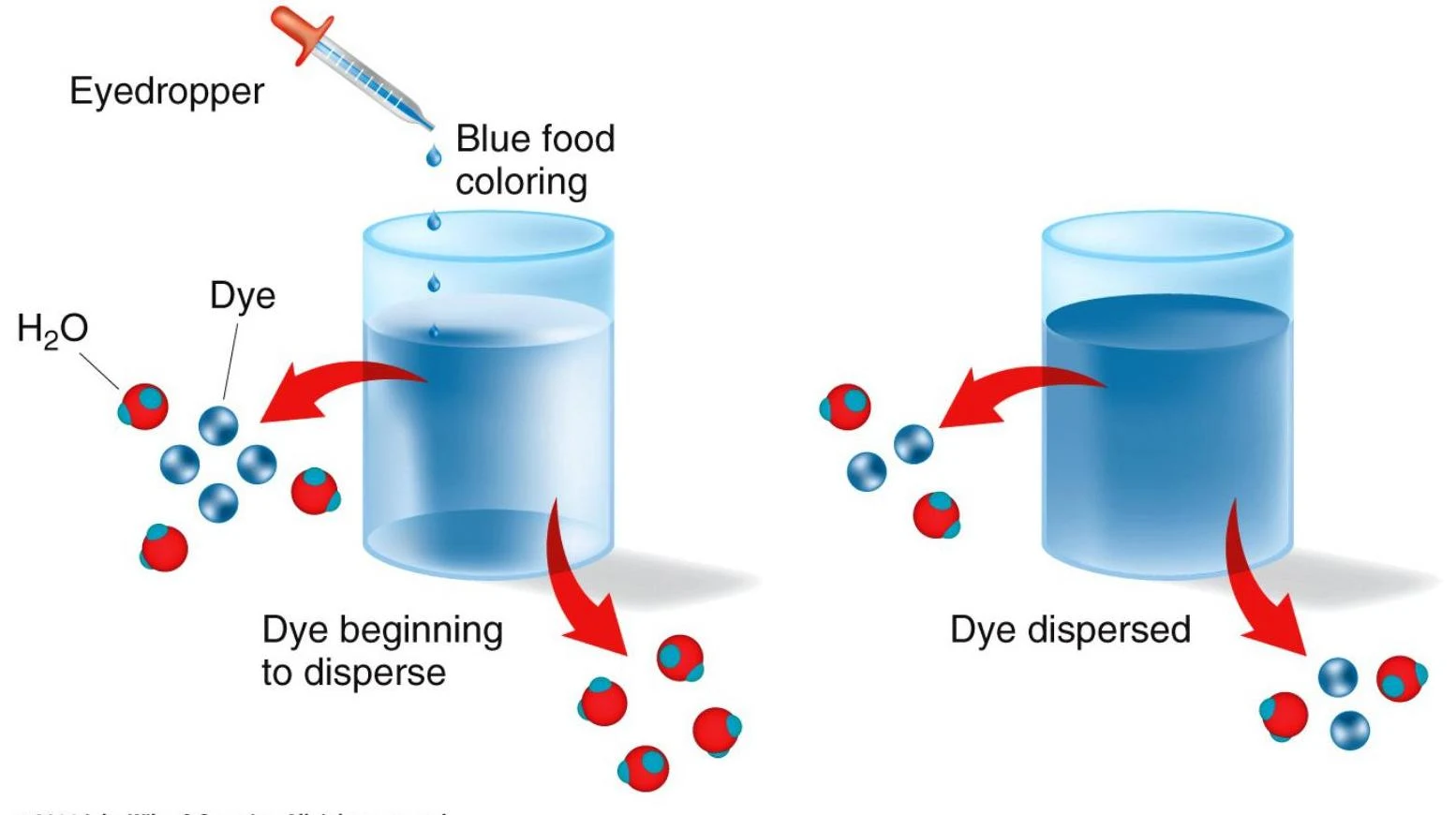
Concentration gradients drive essential biological processes. Diffusion is the movement of substances from an area of higher concentration to an area of lower concentration.
Illustration showing the dispersion of dye molecules in water.
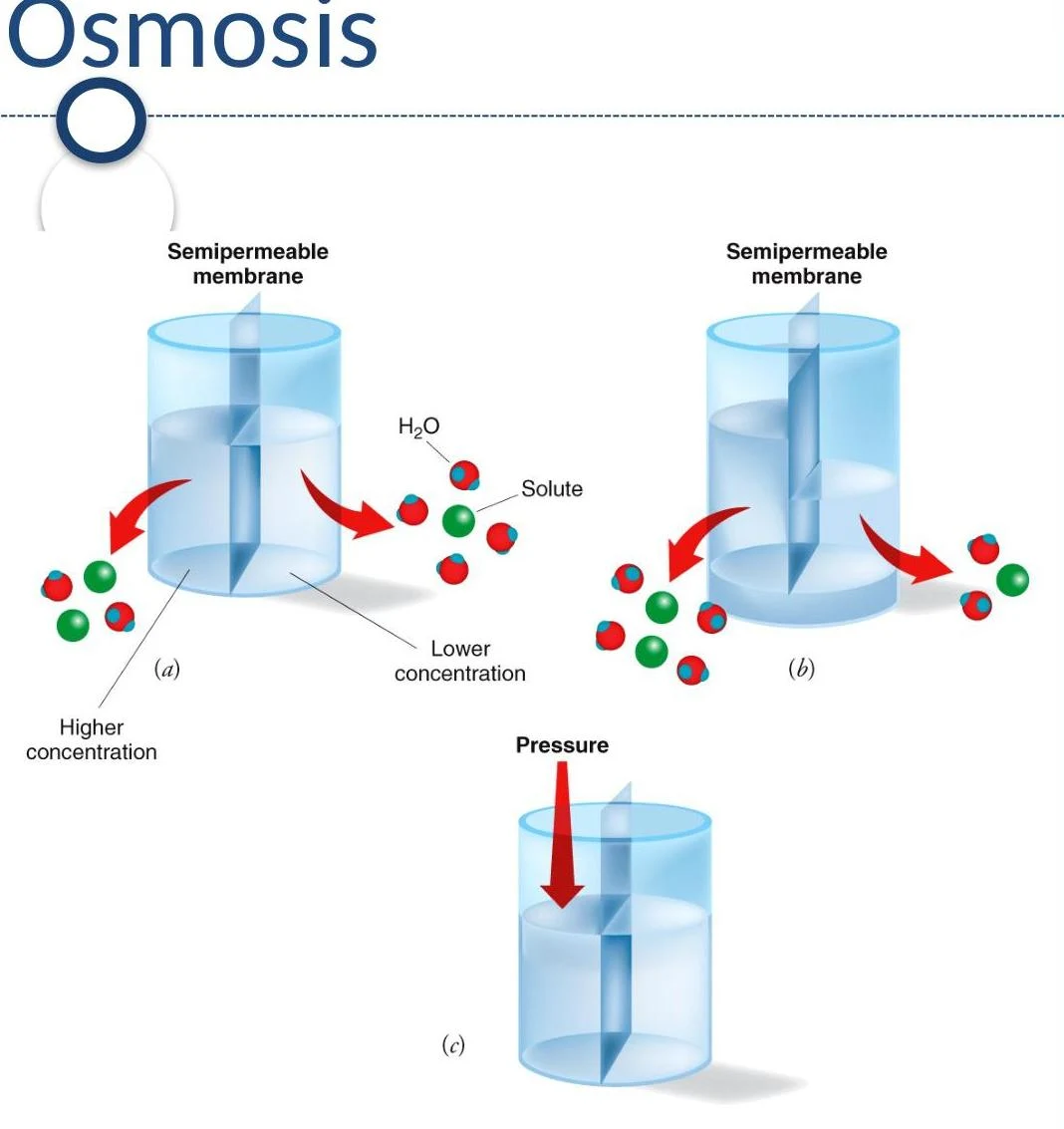
When dealing with semipermeable membranes (like cell membranes), we observe osmosis. This is the net movement of water from a side of lower solute concentration to a side of higher solute concentration.
This illustration depicts the process of osmosis, where water molecules move across a semipermeable membrane from an area of lower solute concentration to an area of higher solute concentration. Part (c) shows that pressure can be applied to oppose this movement.
The concentration of the surrounding fluid is critical for cell health:
Isotonic solution: The concentration is the same inside and outside the cell; the cell maintains its shape.
Hypertonic solution: The surrounding solution has a higher concentration. Water flows out of the cell, causing it to shrink (crenation).
Hypotonic solution: The surrounding solution has a lower concentration. Water flows into the cell, causing it to swell and potentially burst (hemolysis).
Keep reading for free.
Create an account to finish this reading and make it part of your study routine.