Concentrated Costs vs. Dispersed Benefits in Political Economy
Explains the political economy principle where small groups with significant losses (concentrated costs) have more influence than large groups with small gains (dispersed benefits), using agricultural trade liberalization as a case study.
Have you ever wondered why governments often struggle to pass policies that clearly benefit the majority of the population, yet find it remarkably easy to protect small, specific industries? This phenomenon is not a coincidence or a failure of logic; it is a fundamental principle of political economy known as the tension between concentrated costs and dispersed benefits.
In the context of agricultural trade, this explains why a small group of farmers can effectively resist trade liberalization (opening markets to foreign competition) even when the vast majority of consumers would benefit from lower food prices. Understanding this imbalance is crucial for anyone studying international trade governance or public policy.
The Core Concept: Concentration vs. Dispersion
At the heart of this issue lies the distribution of economic impact. When a policy is implemented, the "winners" and "losers" are rarely distributed evenly.
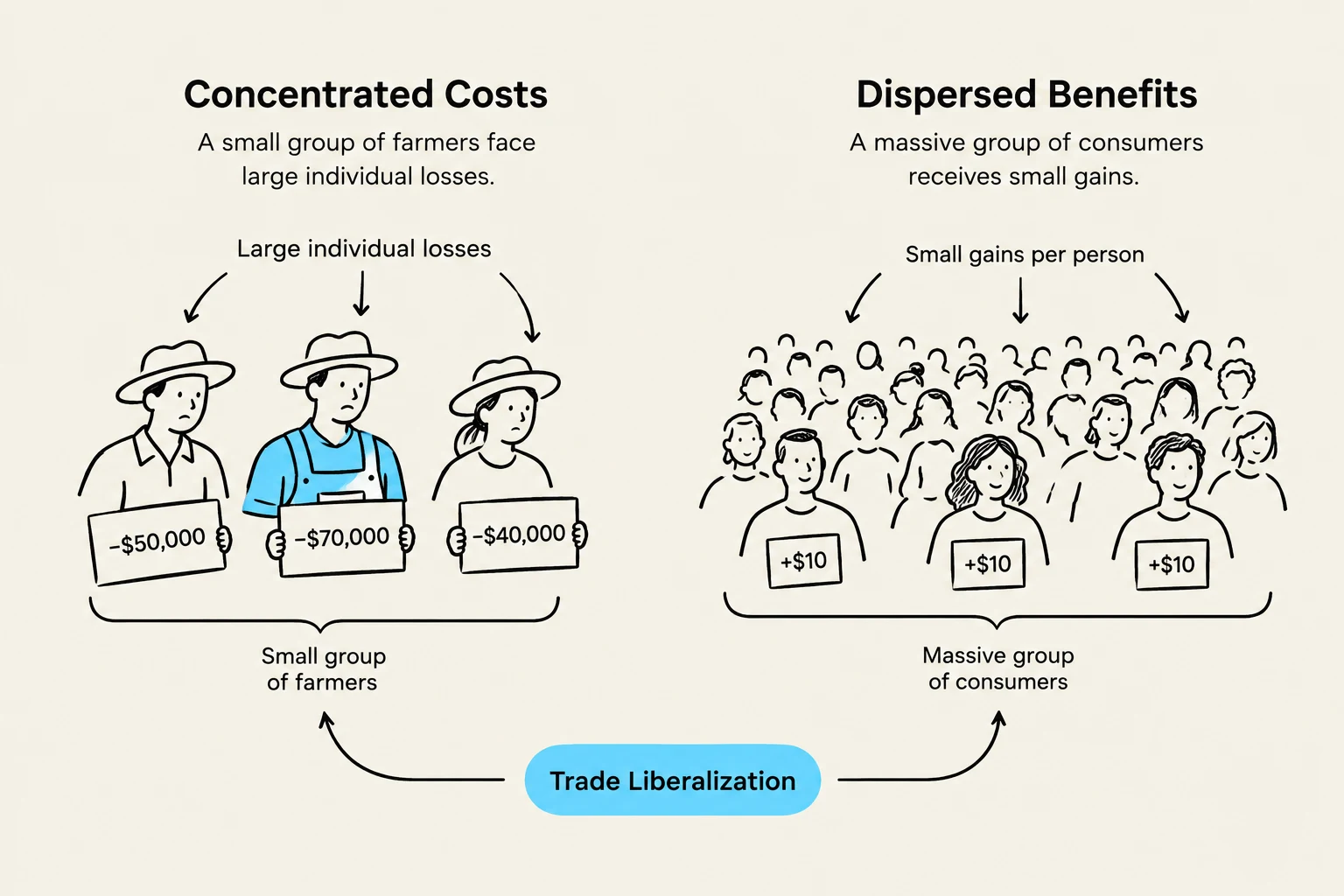
Concentrated Costs: These occur when a policy negatively impacts a small, specific group of people. Because the group is small, each individual member suffers a significant loss. This creates a powerful incentive for them to organize, lobby, and protest.
Dispersed Benefits: These occur when a policy positively impacts a very large group of people. However, because the group is so massive, the benefit to any single individual is often negligible—perhaps just a few cents saved on a loaf of bread or a gallon of milk.
Exam Tip: When analyzing a policy, always ask: "Who loses the most, and how many people are they?" and "Who gains the most, and how many people are they?" The group with the highest per capita impact is usually the most politically active.
This diagram illustrates the economic concept of concentrated costs and dispersed benefits, often associated with trade liberalization. It shows how a small group (farmers) can experience large individual losses, while a massive group (consumers) receives small individual gains.
The Logic of Collective Action
Why don't the consumers fight back? The answer lies in the "Logic of Collective Action." For a group to influence political outcomes, it must overcome the costs of organizing.
For a farmer, the cost of joining a farmers' union or hiring a lobbyist is relatively low compared to the massive loss they would face if their market were opened to cheap imports. The "return on investment" for their political activism is high.
For a consumer, the math is different. If liberalization saves the average citizen $5.00 a year on groceries, that individual is unlikely to spend $50.00 in time and effort to join a consumer advocacy group to fight for that saving. The cost of organizing exceeds the personal benefit.
We can express the incentive to act (I) as a function of the individual benefit (B) minus the cost of organizing (C):
I=B−C
In the case of farmers, B (the loss avoided) is large, making I positive. In the case of consumers, B is so small that I becomes negative, leading to political apathy.
Case Study: Agricultural Trade Liberalization
Agricultural trade is one of the most contentious areas in global governance, such as within the World Trade Organization (WTO).
When a country decides to liberalize its agricultural sector, it essentially removes protections like tariffs or subsidies that keep domestic food prices higher than the global market rate.
The Losers (Farmers): They face direct competition from lower-priced foreign goods. This can threaten their livelihoods, their land, and their entire way of life. Because they are a visible, organized, and concentrated group, they can exert immense pressure on lawmakers through voting blocs and political donations.
The Winners (Consumers): They enjoy cheaper food, which increases their purchasing power. However, because this benefit is spread across millions of citizens, no single consumer feels a "win" significant enough to trigger political mobilization.
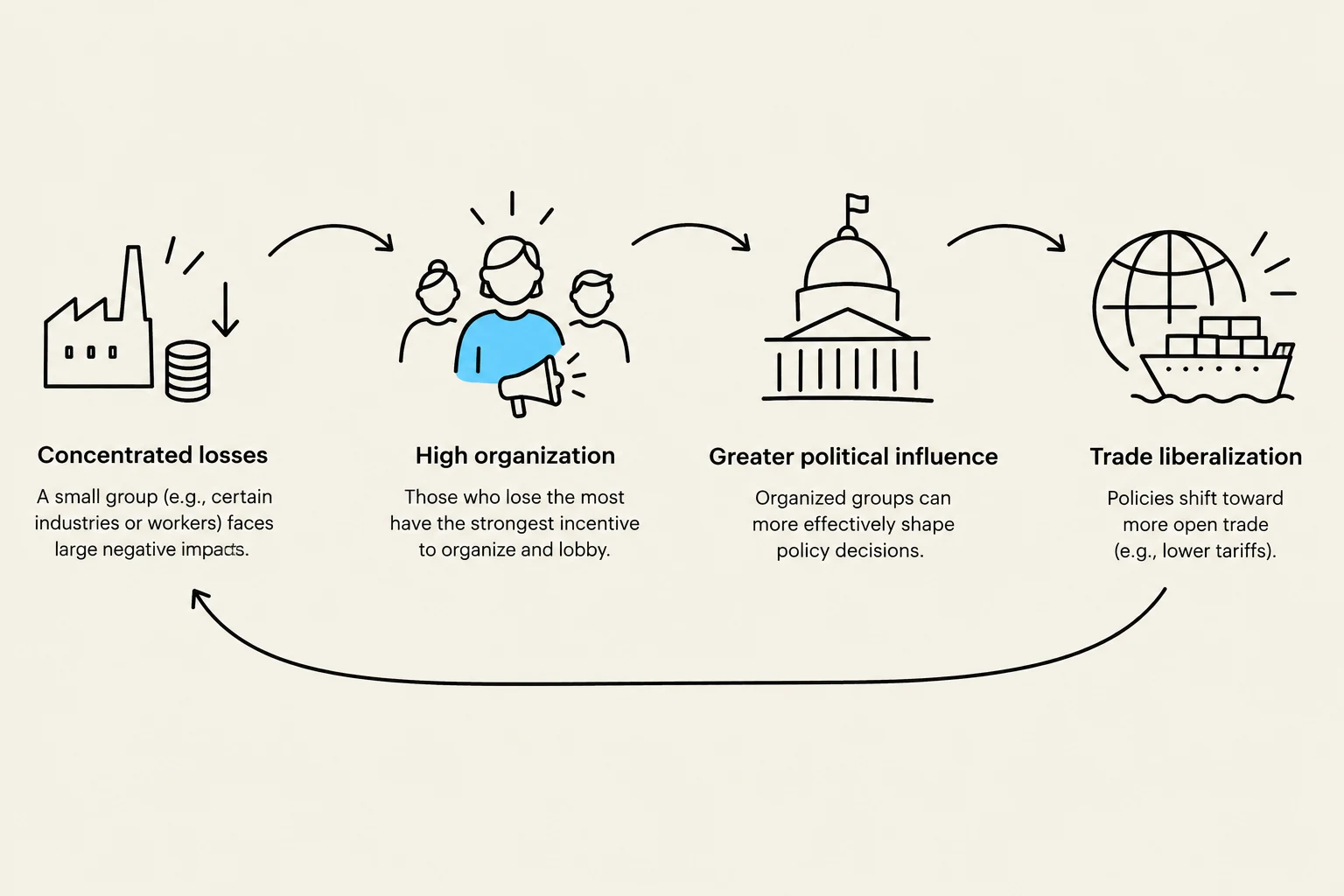
This diagram illustrates the process by which concentrated losses can lead to high organization, greater political influence, and ultimately trade liberalization.
Implications for Global Governance
This imbalance creates a "status quo bias" in international trade. Even when economists agree that liberalization increases overall global welfare, the political reality is often a stalemate.
In the realm of the WTO, the difficulty of reaching agreements often stems from the fact that different nations have different "concentrated" interest groups. A country might be willing to open its service sector but will fight tooth and nail to protect its specific agricultural products to satisfy domestic political pressures.
This tension contributes to the decline of certain multilateral approaches, as nations find it easier to negotiate smaller, more specific deals rather than the "Single Undertaking" model, where everything is negotiated at once.
Summary Table: Comparison of Interest Groups
Feature
Concentrated Group (e.g., Farmers)
Dispersed Group (e.g., Consumers)
Per Capita Impact
High (Significant loss/gain)
Low (Negligible loss/gain)
Organization Cost
Low relative to impact
High relative to impact
Political Power
High (Lobbying, voting blocs)
Low (Apathetic)
Policy Preference
Protectionism / Subsidies
Liberalization / Free Trade
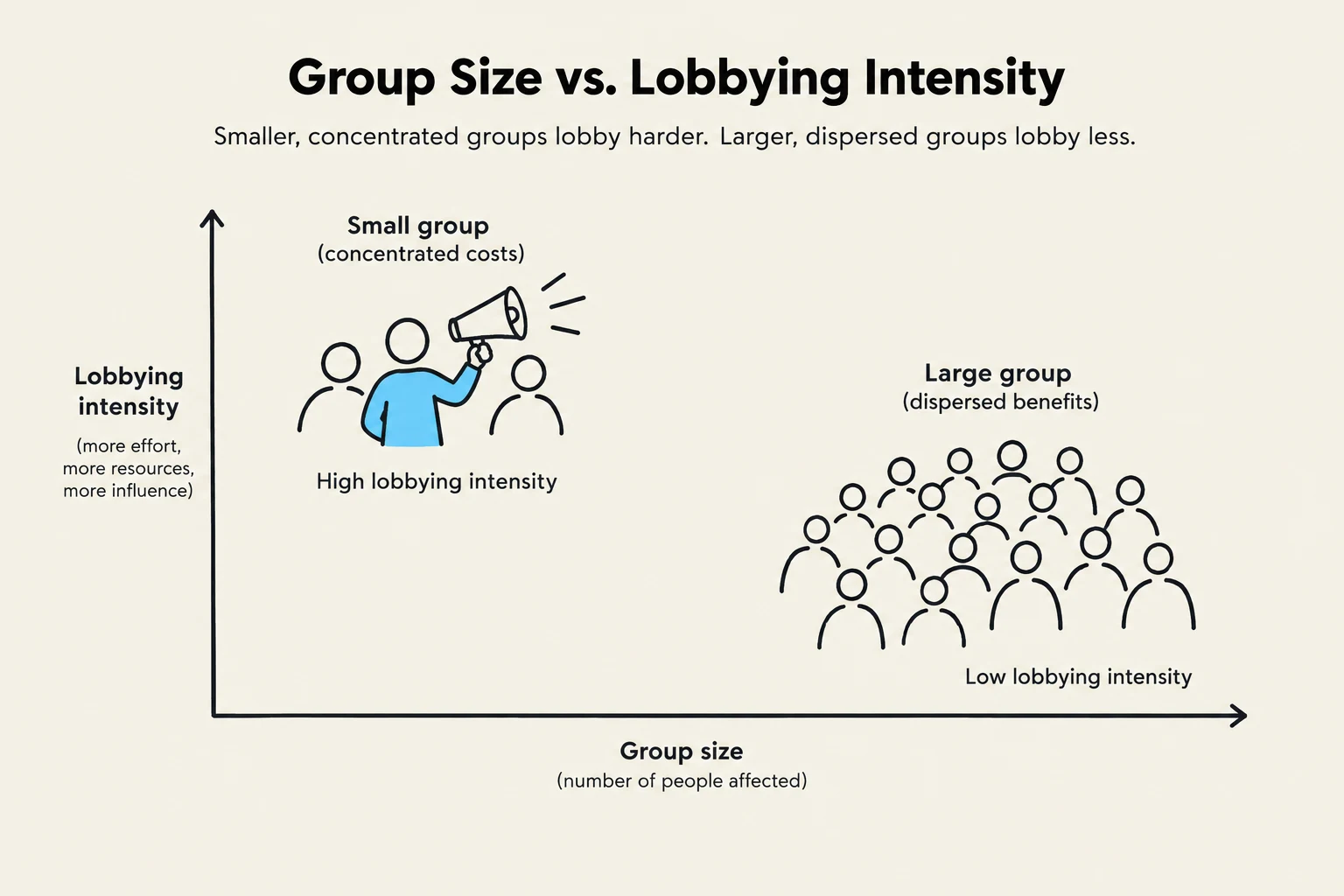
This graph illustrates the relationship between group size and lobbying intensity, showing that smaller, concentrated groups tend to lobby with higher intensity due to concentrated costs, while larger, dispersed groups lobby with lower intensity because of dispersed benefits.
By understanding the mechanics of concentrated costs and dispersed benefits, we can better interpret why the political landscape often seems to move in directions that contradict general economic efficiency.
Keep reading for free.
Create an account to finish this reading and make it part of your study routine.