This content explains how the Bureau of Labor Statistics computes the Consumer Price Index (CPI) to measure inflation, detailing the process, its challenges, and the macroeconomic costs of inflation. It also covers the Equation of Exchange as the cause of inflation.
Inflation is more than just the rising price of a gallon of milk or a movie ticket; it is the growth in the overall level of prices in an economy. When inflation occurs, the purchasing power of your money decreases, meaning each dollar buys fewer goods and services than it did previously. While small amounts of inflation are common, extreme cases known as hyperinflation can be incredibly destructive. To manage an economy, policymakers must be able to measure this phenomenon accurately.
Measuring Inflation: The Consumer Price Index (CPI)
In the United States, the Bureau of Labor Statistics (BLS) is responsible for measuring and reporting inflation. The primary tool they use is the Consumer Price Index (CPI).
The CPI measures the cost of living for a typical consumer by tracking the price of a "basket" of goods and services. Because different people have different spending habits—for example, a college student's basket looks very different from a retiree's—the CPI reflects the average price changes for a representative consumer.
To compute the CPI, the BLS follows a specific process:
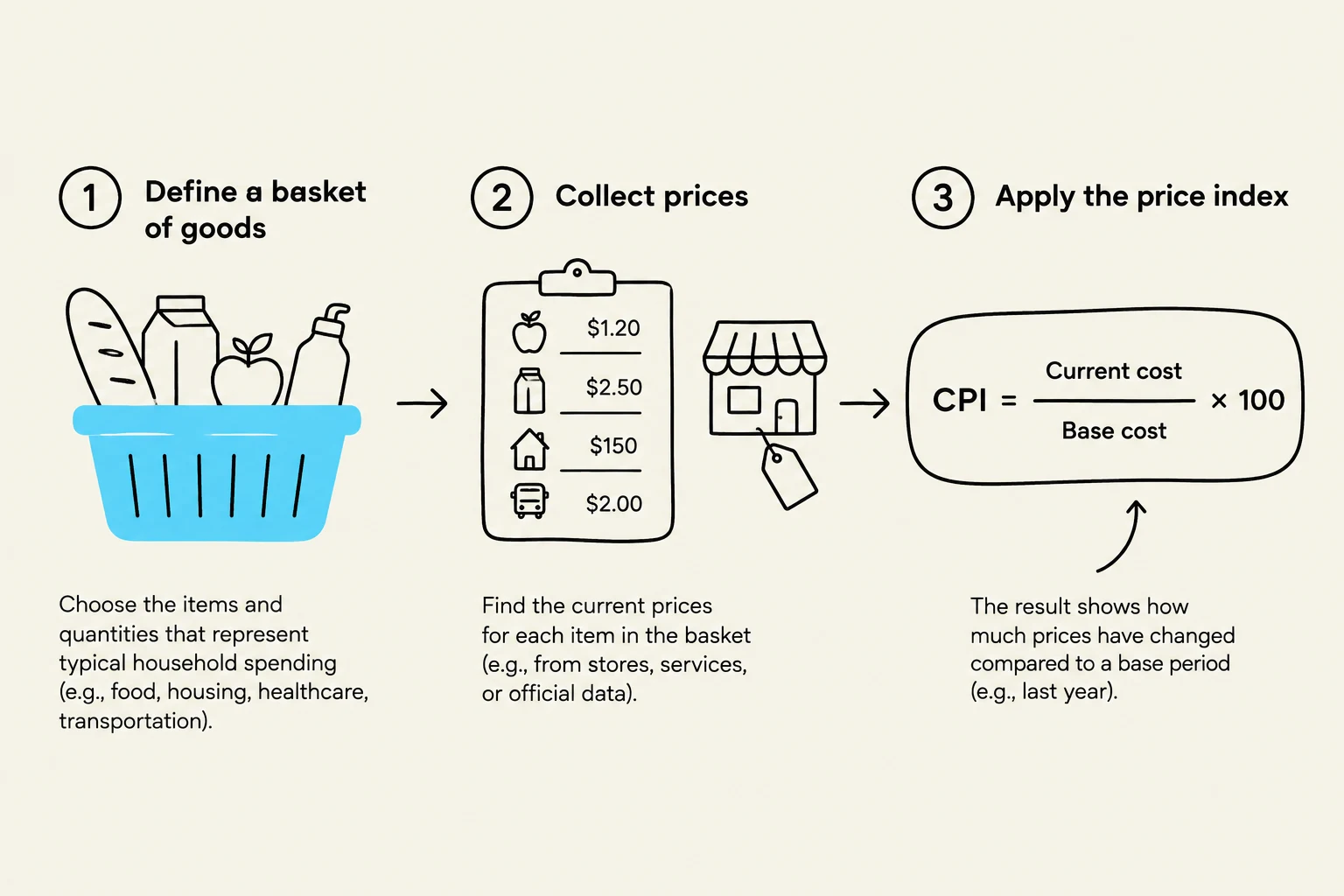
Define the basket: Identify which goods and services to track and assign them "weights" based on how much of a typical budget they consume.
Determine prices: Collect price data across various periods.
Calculate the index: Use the following formula:
price index=basket price in base yearbasket price×100
Once we have the CPI, we can calculate the inflation rate (i), which is the percentage change in the price level (P) over a specific period:
inflation rate(i)=P1P2−P1×100
This diagram illustrates the three steps to calculate the Consumer Price Index (CPI): defining a basket of goods, collecting prices for those goods, and applying the price index formula. The CPI measures changes in the cost of a basket of goods and services over time, reflecting inflation or deflation.
Comparing Values Across Time
Because prices change constantly, comparing a price from 1942 to a price in 2024 is difficult without adjusting for inflation. We can convert past prices into "today's dollars" using the ratio of the current CPI to the past CPI:
While the CPI is a vital tool, it is not perfect. Economists often argue that the CPI suffers from an upward bias, meaning it may overstate the true rate of inflation. There are three primary reasons for this:
Substitution Bias: If the price of a specific good (like popcorn) rises significantly, consumers will likely switch to a cheaper alternative (like chips). If the CPI's fixed basket doesn't account for this shift, it will overstate how much the cost of living has actually increased for the consumer.
Quality Changes: Sometimes a price increase reflects an improvement in the product rather than pure inflation. For example, if a movie ticket price rises because the theater upgraded to 3D technology, the consumer is getting more value for their money.
New Goods and Locations: In a dynamic economy, new products (like smartphones) and new ways to shop (like Amazon) emerge constantly. If the BLS is slow to include these cheaper or more efficient options in the basket, the index will appear higher than reality.
To combat these issues, the BLS introduced the Chained CPI in 2000, which updates the consumer basket monthly to better reflect actual consumption shifts.
The Macroeconomic Costs of Inflation
Inflation is not a "victimless crime." It imposes several significant costs on the economy:
Shoe-leather Costs: As money loses value, people spend more time and resources (like fuel or time spent at ATMs) trying to minimize the amount of cash they hold.
Money Illusion: This occurs when people mistake nominal changes (the number of dollars they have) for real changes (their actual purchasing power). For instance, if your boss gives you a 5% raise but inflation is 10%, your nominal wage went up, but your real wage actually decreased.
Menu Costs: These are the tangible costs firms face when they must update their prices, such as reprinting menus or changing price tags in a store.
Future Price Level Uncertainty: High or unpredictable inflation makes long-term contracts (like salaries or loans) much riskier for both workers and lenders.
Wealth Redistribution: Unexpected inflation can unfairly shift wealth. If inflation rises unexpectedly, borrowers benefit because they pay back loans with "cheaper" dollars, while lenders lose value.
Price Confusion: Prices act as signals. If a producer sees prices rising, they might think demand for their specific product is increasing and produce more, only to realize later that the rise was just general inflation.
Tax Distortions: Tax laws often fail to account for inflation. For example, you might pay capital gains taxes on a profit that only exists because of inflation, even though your "real" wealth hasn't increased.
Exam Tip: Remember the difference between Nominal and Real. Nominal refers to the face value in current dollars, while Real refers to the value adjusted for inflation (purchasing power).
The Cause of Inflation: The Equation of Exchange
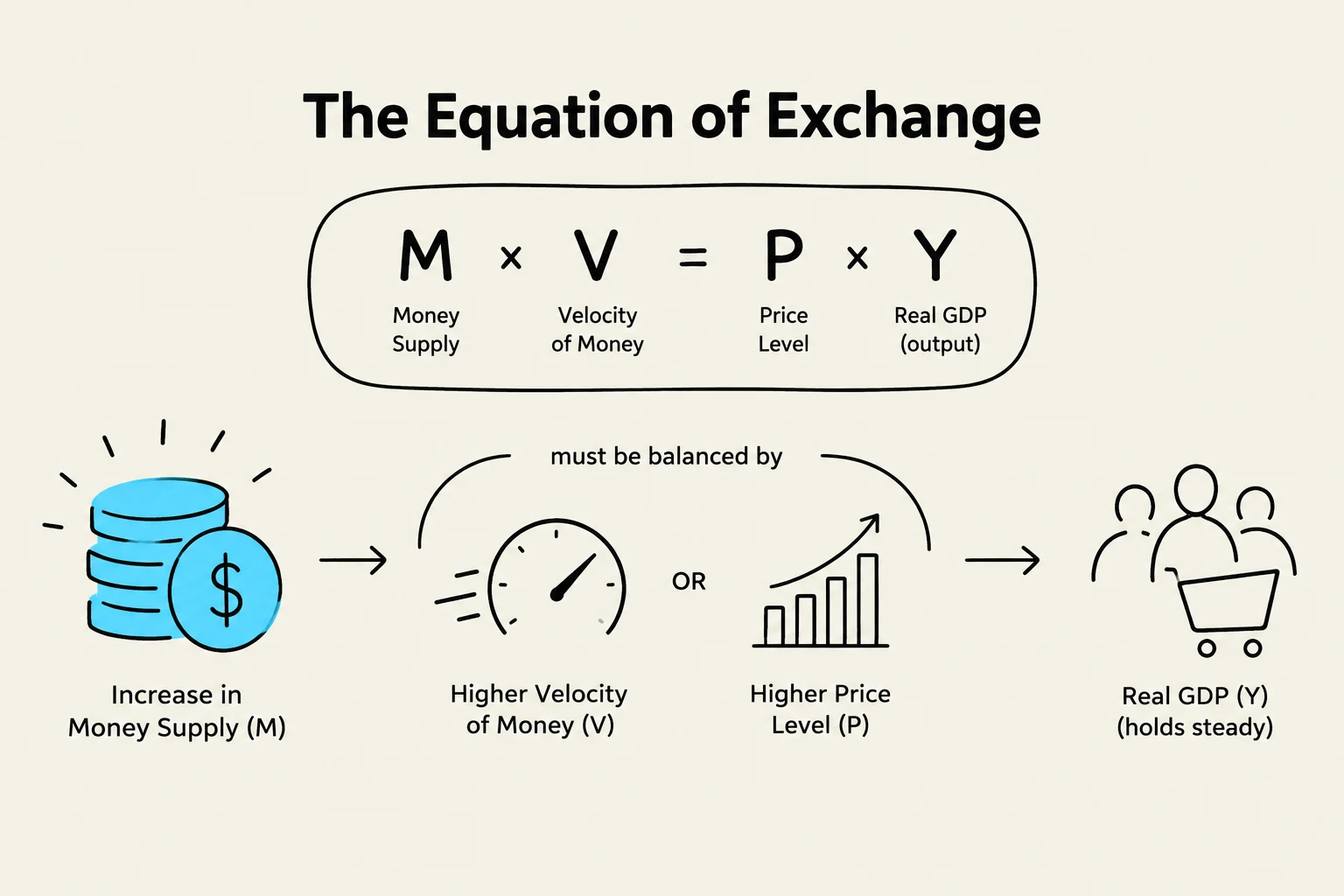
Economists generally agree that inflation is a monetary phenomenon caused by expansions in the money supply (M). This relationship is defined by the Equation of Exchange:
M×V=P×Y
Where:
M = Quantity of money.
V = Velocity of money (the speed at which money circulates).
P = Price level.
Y = Real GDP.
The product P×Y represents the Nominal GDP. To understand how inflation occurs, we can look at the relationship in terms of growth rates:
%ΔM+%ΔV≈%ΔP+%ΔY
If we assume the velocity of money is constant (%ΔV=0), then inflation (%ΔP) will occur whenever the growth rate of the money supply exceeds the growth rate of real GDP (%ΔM>%ΔY).
The Equation of Exchange illustrates the relationship between money supply (M), velocity of money (V), price level (P), and real GDP (Y).
Governments may sometimes choose to inflate the money supply to pay off large national debts or to seek short-term economic stimulation, but these actions often lead to long-term instability.
Keep reading for free.
Create an account to finish this reading and make it part of your study routine.