An overview of nutrients, their classification into organic and inorganic, and macronutrients versus micronutrients. It details their functions in providing energy, forming structures, and regulating body processes, including a mathematical example for calculating energy content.
Nutrition is the science that explores the complex interactions between living organisms and the food they consume. At the heart of this science are nutrients: chemical substances found in food that are essential for the body to function, grow, and maintain health. While we often think of food simply as something we eat for pleasure, it is actually a sophisticated delivery system for the chemical building blocks required to sustain life.
The Classification of Nutrients
Nutrients are categorized based on their chemical structure and the quantity required by the body. The most fundamental distinction is between organic and inorganic substances.
Organic Nutrients
Organic nutrients are those that contain the element carbon. This group includes the primary energy providers and structural components of the body:
Carbohydrates: These include simple sugars (found in fruits and milk) and complex starches (found in grains and vegetables), as well as fiber, which does not provide energy but is vital for digestion.
Lipids: Often referred to as fats and oils, these are essential for long-term energy storage and cell structure.
Proteins: These are the primary building blocks for tissues and enzymes.
Vitamins: These are organic compounds that do not provide energy themselves but are crucial for regulating body processes.
Inorganic Nutrients
Inorganic nutrients do not contain carbon. This category consists of two main groups:
Water (H2O): The most abundant component of the human body, water is required in large amounts daily to support countless biological functions, though it provides no energy (kilocalories).
Minerals: These include both major minerals and trace elements required for various physiological roles.
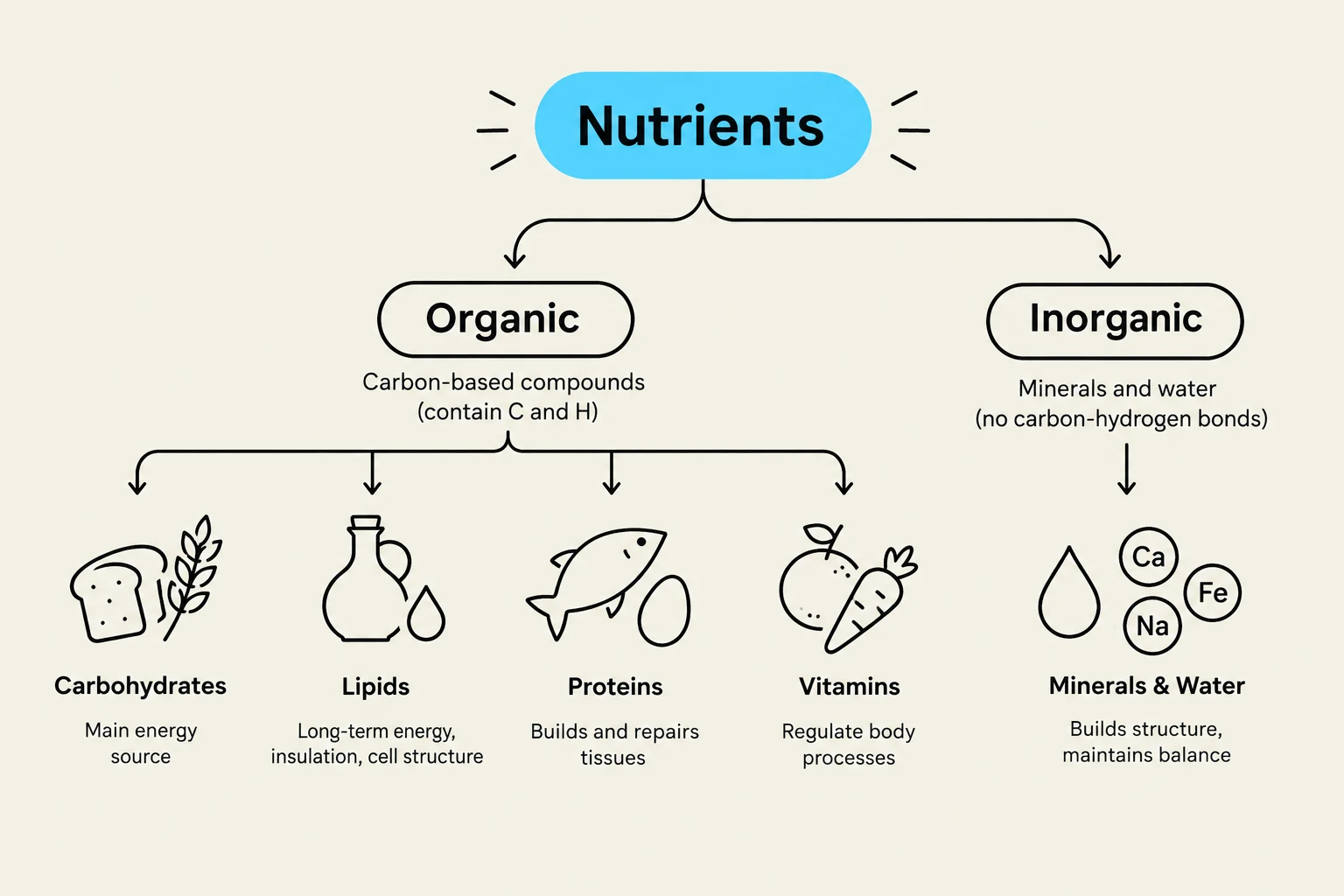
This diagram illustrates the classification of nutrients into organic and inorganic categories, with examples and their primary functions.
Macronutrients vs. Micronutrients
To understand how much of a nutrient we need, scientists divide them into two broader groups: macronutrients and micronutrients.
Macronutrients are required in large amounts and serve as the primary source of energy. These include carbohydrates, lipids, and proteins. Because they provide energy, they are measured in kilocalories (kcal).
Micronutrients are required in much smaller amounts. This group includes vitamins and minerals. While they do not provide energy (calories) directly, they are indispensable for the biochemical reactions that allow the body to use energy effectively.
Exam Tip: If a question asks which nutrients provide energy, look for the macronutrients (Carbs, Fats, Proteins). If it asks which nutrients are essential for regulation but provide zero calories, look for the micronutrients (Vitamins, Minerals) and Water.
Nutrient Functions: Energy, Structure, and Regulation
Nutrients do not just sit in the body; they perform specific, vital roles that allow us to interact with our environment.
1. Providing Energy
The energy in food is a form of chemical energy. This energy is measured in kilocalories (kcal), which is the amount of heat needed to raise the temperature of 1 kg of water by 1°C. When we consume food, our body undergoes metabolism—a series of biochemical reactions that release this stored chemical energy to fuel physical work and maintain body functions.
2. Forming Structures
Nutrients act as the "building materials" for the body.
Proteins form the basis of muscles, ligaments, tendons, and bones.
Lipids and Proteins work together to create the membranes of our cells.
Water is a fundamental structural component of the human body.
3. Regulating Body Processes
To stay alive, the body must maintain homeostasis, a state of internal balance. Nutrients regulate the various metabolic reactions that speed up or slow down to keep the body functioning within healthy limits.
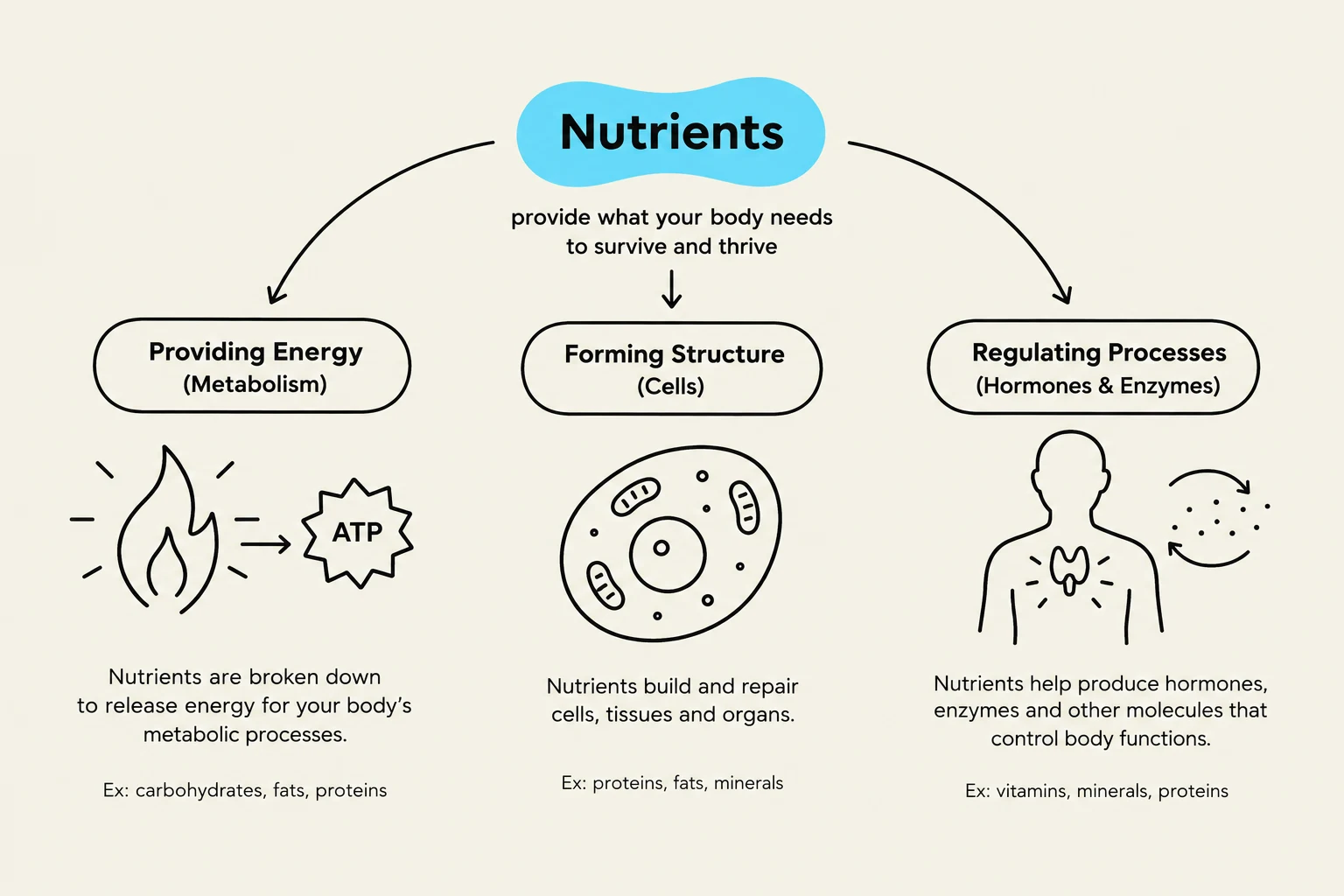
This diagram illustrates the three main functions of nutrients in the human body: providing energy through metabolism, forming cellular structure, and regulating bodily processes via hormones and enzymes.
Mathematical Application: Calculating Energy Content
In nutrition science, it is essential to understand how much energy is contained in different types of macronutrients. Different molecules yield different amounts of energy per gram.
The standard energy values are:
Carbohydrates:4 kcal/g
Proteins:4 kcal/g
Lipids (Fats):9 kcal/g
Worked Example: Calculating Total Calories
Imagine you are looking at a nutritional bar with the following composition:
Carbohydrates: 30 g
Protein: 20 g
Fat: 8 g
To find the total caloric content, we use the following calculation:
Energy from CHOEnergy from ProteinEnergy from FatTotal Energy=30 g×4 kcal/g=120 kcal=20 g×4 kcal/g=80 kcal=8 g×9 kcal/g=72 kcal=120+80+72=272 kcal
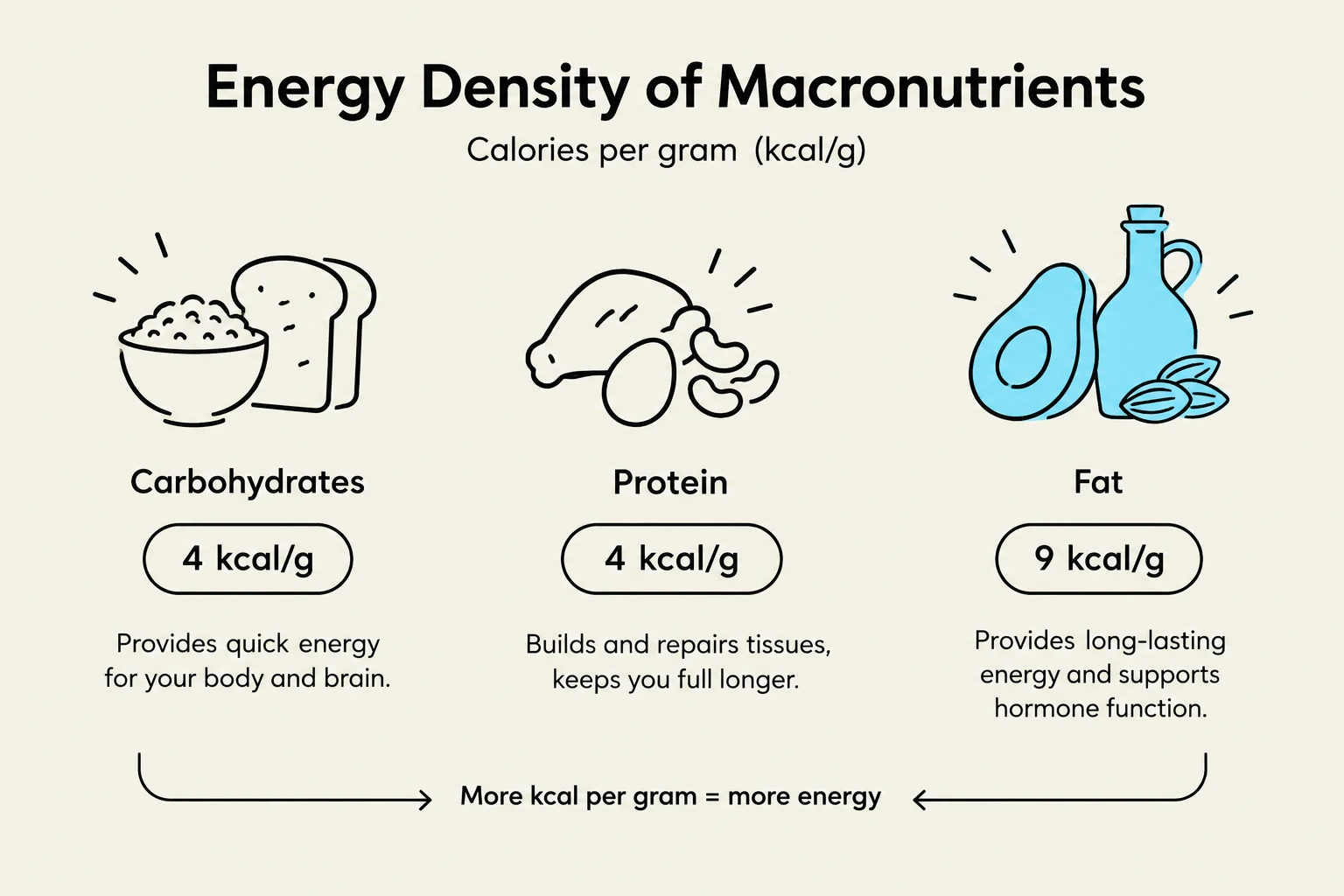
The energy density of macronutrients (carbohydrates, protein, and fat) is measured in kilocalories per gram (kcal/g). Carbohydrates and protein provide 4 kcal/g, while fat provides 9 kcal/g, indicating that fat is more energy-dense.
Summary Table of Nutrients
Nutrient Class
Organic/Inorganic
Macronutrient/Micronutrient
Primary Function
Carbohydrates
Organic
Macro
Energy, Fiber
Lipids
Organic
Macro
Energy, Structure
Proteins
Organic
Macro
Structure, Repair
Vitamins
Organic
Micro
Regulation
Minerals
Inorganic
Micro
Regulation, Structure
Water
Inorganic
Macro
Structure, Regulation
Keep reading for free.
Create an account to finish this reading and make it part of your study routine.