Explore the chemical makeup of celestial bodies in our solar system, from rocky terrestrial planets to gas giants, and understand the geological processes like volcanism, tectonics, and tidal forces that reshape their surfaces. Learn about crater counting as a method for determining relative age.
When we look at the planets and moons in our solar system, we are looking at a diverse collection of worlds, each with its own unique "personality" defined by what it is made of and how its surface changes over time. From the rocky, cratered landscapes of the Moon to the swirling gas clouds of Jupiter, the solar system is a complex laboratory of chemical diversity and geological energy. Understanding these bodies requires us to look at two fundamental pillars: composition (the chemical "ingredients") and dynamics (the processes that reshape the surface).
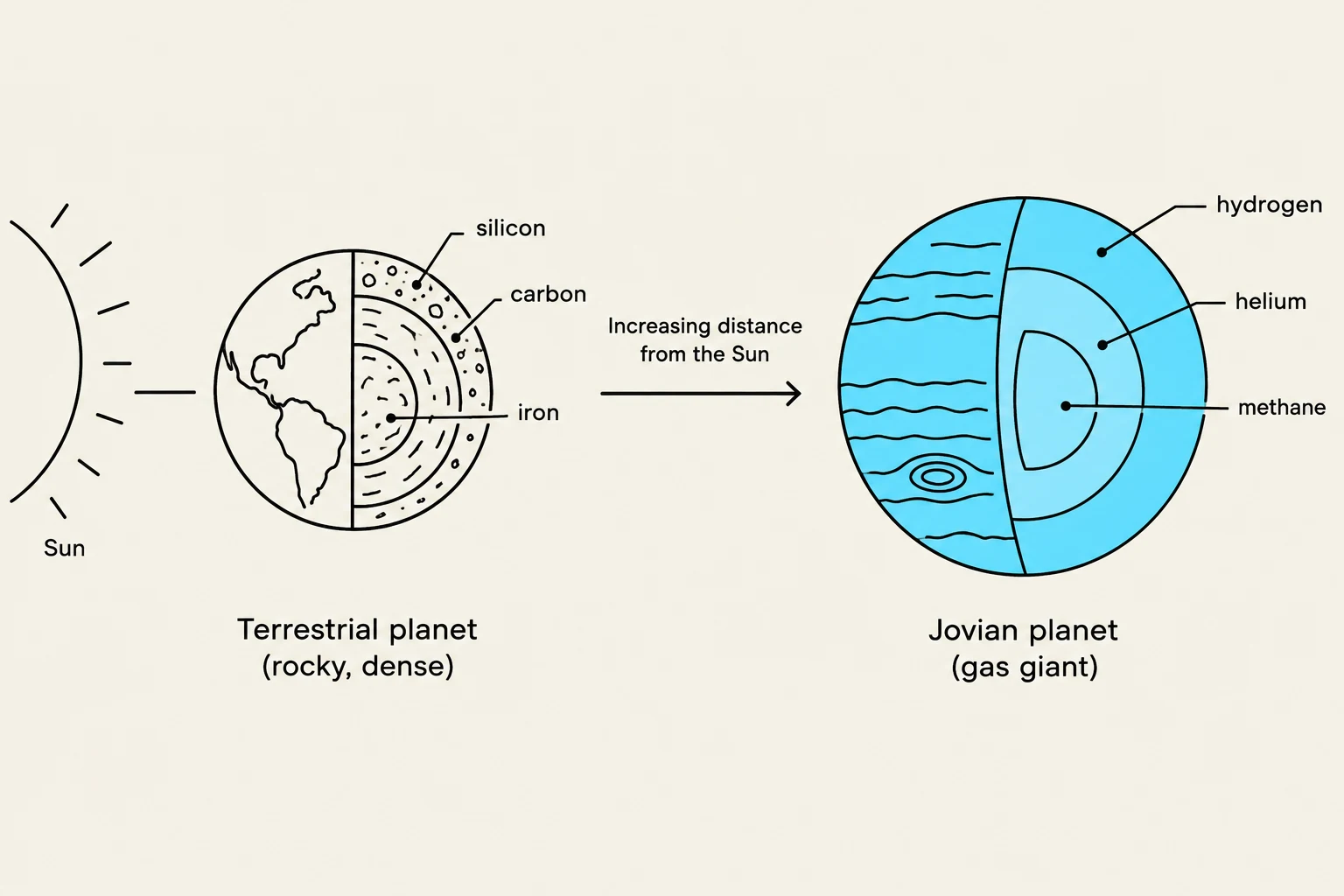
Diagram illustrating the internal structure of a terrestrial planet and a Jovian planet, showing their composition and relation to distance from the Sun.
The Chemical Makeup of Celestial Bodies
The material makeup of objects in our solar system varies significantly based on their distance from the Sun and their specific classification.
Terrestrial and Jovian Bodies
The solar system is broadly divided into two main regions: the inner terrestrial region and the outer Jovian region.
Terrestrial/Rocky Bodies: Located close to the Sun, these include the inner planets (like Earth and Mars), many moons, and asteroids. They are composed primarily of heavy elements such as silicon, carbon, and iron.
Jovian Planets: These are the "gas giants" located in the outer solar system, such as Jupiter, Saturn, Uranus, and Neptune. They are much larger than terrestrial planets and consist primarily of gases like hydrogen, helium, and methane.
Ices, Volatiles, and Small Bodies
As we move further from the Sun, the temperature drops, allowing different materials to remain stable.
Dwarf Planets: These objects, such as Pluto, Eris, and Makemake, represent a mixture of rock and ices.
Comets: Often described as "dirty snowballs," comets consist of rock mixed with volatiles. Volatiles are substances—such as frozen water, methane, or cyanide gas—that are ready to evaporate into gas but remain frozen due to the extreme cold of the outer solar system.
Dust: This consists of small molecules typically derived from rocky material.
Surface Dynamics and Resurfacing
This diagram illustrates three geological processes that contribute to surface resurfacing: volcanism, tectonics, and tidal forces.
A common misconception in astronomy is that a heavily cratered surface is automatically an "old" surface. While high crater density often suggests a surface has been exposed to space for a long time, many celestial bodies undergo resurfacing—geological processes that "erase" old features and make the surface appear younger.
Mechanisms of Change
Several internal and external forces drive these changes:
Volcanism: Lava flows can erupt from a planet's interior, filling in existing craters and smoothing out the landscape.
Tectonic Activity: The movement of a planet's crust or internal layers can reshape the surface through fracturing and shifting.
Tidal Forces: Massive objects exert intense gravitational pulls on nearby moons. For example, Jupiter's massive gravity creates extreme tidal forces on its moon Io, driving intense volcanic activity. Similarly, on Europa, tidal forces may maintain a liquid ocean beneath an icy crust, where tectonic openings allow water to reach the surface and resurface the moon.
Atmospheric Protection: On Earth, our atmosphere acts as a shield, burning up many meteoroids (small pieces of debris traveling through space) before they can impact the surface.
Determining Relative Age: Crater Counting
This diagram illustrates how crater density can be used to determine the relative age of planetary surfaces. An older surface, like the one on the left, has a high crater density, while a younger surface, shown on the right, has a low crater density.
Because surfaces are dynamic, scientists cannot always determine an object's absolute age just by looking at it. Instead, they use a method called crater counting to determine relative age.
By comparing two different surfaces that have had similar exposure to space, scientists can rank them. The surface with the higher density of craters is considered older, as it has had more time to accumulate impacts. This is similar to how footprints in fresh snow indicate how much time has passed since the last snowfall; a surface with no footprints (or no craters) suggests a recent "resurfacing" event has occurred.
Exam Tip: Relative vs. Absolute Age
Remember that crater counting only provides relative age (which surface is older than another). To find the absolute age (the actual number of years), scientists must use different methods, such as radioactive dating, which measures the decay of unstable isotopes like Carbon-14.
Summary Table: Solar System Composition
Body Type
Primary Composition
Key Characteristics
Terrestrial Planets
Silicon, Carbon, Iron
Rocky, dense, close to Sun
Jovian Planets
Hydrogen, Helium, Methane
Gaseous, very large, many moons
Dwarf Planets
Rock and Ices
Often found in the Kuiper Belt
Comets
Rock and Volatiles
"Dirty snowballs" with frozen gases
Keep reading for free.
Create an account to finish this reading and make it part of your study routine.