Explores the complex process of postural control, detailing the fundamental biomechanical concepts, the systems framework (individual, task, and environmental), sensory integration, and cognitive load. It also outlines clinical assessment strategies for evaluating postural stability.
Postural control is the complex process of managing the body's position in space to maintain stability and orientation. It is not a single action but rather a dynamic interaction between various individual systems, the specific functional tasks being performed, and the constraints of the environment. Understanding how these components integrate is essential for clinical assessment and the development of effective rehabilitation strategies.
Fundamental Biomechanical Concepts
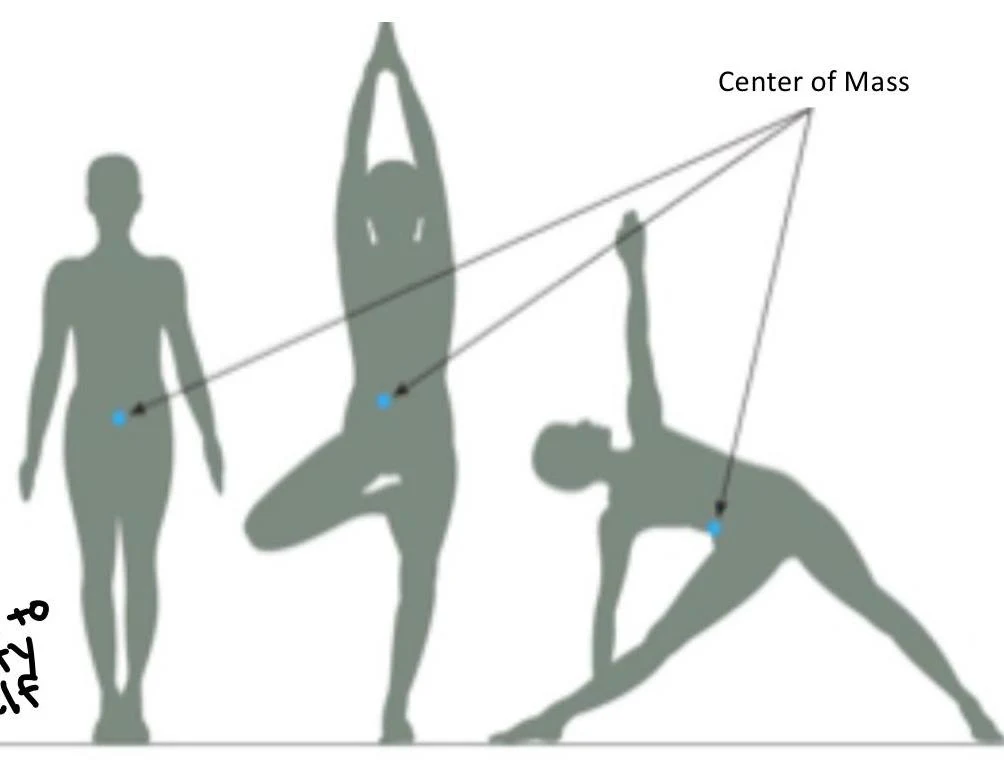
To understand postural control, one must first define the relationship between the body's mass and its contact with the ground. The Center of Mass (COM) is the central point of the total body mass. The vertical projection of this COM is known as the Center of Gravity. Stability is largely determined by the relationship between the COM and the Base of Support (BOS), which is the area of the body in contact with the support surface.
The primary goal of postural control is to maintain the individual COM within the boundaries of the BOS.
Diagram illustrating the concept of the center of mass in different human body poses.
Effective control involves:
Postural Orientation: Maintaining appropriate biomechanical alignment relative to the environment and the task.
Limits of Stability: The ability to control the COM in relation to the BOS.
Postural Sway: The normal, minimal movement around the ankle and hip joints used to keep the COM within the BOS.
Clinical Note: While some postural sway is normal, excessive sway may indicate impaired stability. If the COM moves posteriorly (e.g., during slouching), the individual may be more stable in the anterior direction.
The Systems Framework
Postural control operates through a "systems framework" involving the interaction of three primary domains:
1. Individual Systems
Motor Systems: Includes muscle properties, joint range of motion (ROM), and the biomechanical relationships between body segments.
Neural Systems: Responsible for motor processes and the integration of sensory inputs to control body orientation.
Cognitive Systems: Provides the resources and strategies needed to map sensation to action.
2. Functional Task Demands
Depending on the task, the body utilizes different control strategies:
Steady State Control: Maintaining the COM within the BOS during predictable, non-changing conditions, such as sitting, standing, or walking at a constant velocity. This relies heavily on feedforward control.
Anticipatory Control: The ability to proactively activate muscles in advance of a potentially destabilizing voluntary movement. For example, stepping over a known obstacle requires pre-planning (feedforward) to stabilize the body before the movement occurs.
Reactive Control: The ability to recover a stable position following an unexpected external force or perturbation, such as tripping. This requires rapid feedback motor activation to recover the COM relative to the BOS.
3. Environmental Constraints
The environment provides the context for balance, including the type of support surface, available visual references, auditory inputs, and the level of cognitive load.
Sensory Integration and Reweighting
The neural system maintains orientation by integrating three primary sensory inputs:
Visual Inputs: Provides vertical references and information about the environment. This includes focal vision (localizing features) and ambient vision (using the entire visual field for gaze stabilization).
Vestibular Inputs: Acts as a gravitational sensor, detecting head and neck motion to orient the upper body to gravity and stabilize gaze.
Somatosensory Inputs: Provides information regarding the position and motion of body segments in relation to the support surface.
Sensory Interaction is the ability to process these inputs to produce accurate motor output. Because no single sense is perfect, the brain performs sensory reweighting—adjusting its reliance on specific inputs based on the task or environmental changes. For example, a person may rely more heavily on visual inputs when learning a new motor task, but shift toward somatosensory inputs as the task becomes automatic.
This diagram illustrates the neural pathways involved in maintaining posture, integrating sensory input from vision, the vestibular system, and somatosensation with processing in the cortex, thalamus, basal ganglia, brainstem/cerebellum, and spinal cord.
Cognitive Load and Dual Task Interference
Postural control requires attentional resources. When a task is complex, it demands more cognitive processing.
In clinical practice, we distinguish between a single task condition (performing one task alone) and dual task conditions (performing two tasks simultaneously). Dual task interference occurs when the simultaneous performance of two tasks leads to a decrease in performance in one or both tasks.
Example: A patient walking normally (single task) may perform well, but when asked to walk while counting backward by 3s (dual task), they may experience increased gait errors or instability.
Clinical Assessment Strategies
Assessment of postural control must be tailored to the specific domain being tested:
Berg Balance Scale: A core outcome measure for steady state and anticipatory balance; a score <45/56 indicates a risk for falls post-stroke.
Functional Reach Test: Screens anticipatory control in standing; a reach of <6" is considered a significant fall risk.
mCTSIB: Used to identify sensory dependencies. For instance, instability during conditions where the surface is foam and eyes are closed suggests vestibular dysfunction.
Mini-BESTest: A shortened version of the BESTest that covers five domains, including steady state, anticipatory, reactive, sensory orientation, and dual task.
Keep reading for free.
Create an account to finish this reading and make it part of your study routine.