Compensatory Mechanisms in the Initial Stage of Shock
Explains the body's physiological response to a sudden drop in blood pressure or oxygen delivery, focusing on the compensatory stage of shock. It details the roles of baroreceptors, the sympathetic nervous system, catecholamines, and their effects on heart rate and vascular tone to maintain vital organ perfusion.
When the body encounters a sudden drop in blood pressure or a decrease in oxygen delivery to the tissues, it does not simply collapse immediately. Instead, it enters a sophisticated "defense mode" known as the compensatory stage of shock. During this phase, the body utilizes rapid-fire physiological adjustments to stabilize hemodynamics and protect the most vital organs, such as the brain and the heart. Understanding this stage is critical for clinicians, as the patient may appear relatively stable even while a life-threatening underlying process is unfolding.
The Trigger: Baroreceptors and the Detection of Deficit
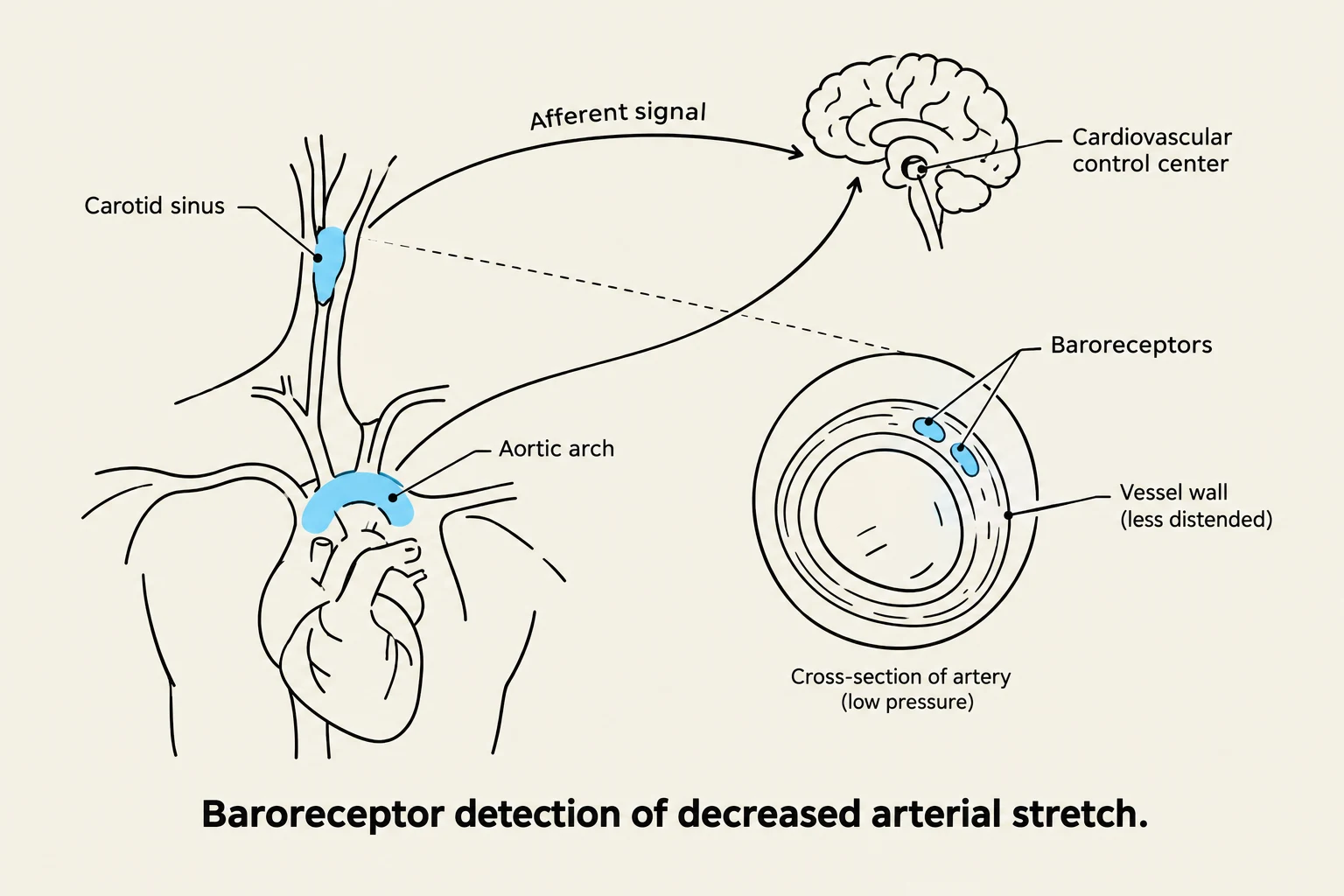
Diagram illustrating the baroreceptor reflex, which detects decreased arterial stretch and signals the cardiovascular control center in the brain.
The transition into the compensatory stage is triggered by a fundamental hemodynamic deficit: a drop in mean arterial pressure (MAP) and a subsequent decline in tissue perfusion.
The body monitors these changes through specialized sensory neurons called baroreceptors. Located primarily in the carotid sinuses and the aortic arch, these receptors are sensitive to the stretch of the vessel walls. When blood pressure falls, the stretch decreases, signaling the cardiovascular control centers in the brain that the systemic pressure is insufficient to meet metabolic demands.
The Effector: Sympathetic Nervous System Activation
Once the baroreceptors detect a drop in pressure, the brain initiates a massive response via the Sympathetic Nervous System (SNS). This is essentially the body's "fight or flight" mechanism being repurposed to maintain survival during circulatory failure.
The activation of the SNS leads to the rapid release of catecholamines, specifically epinephrine and norepinephrine, into the bloodstream. These hormones act as chemical messengers that bind to various receptors throughout the cardiovascular system to achieve two primary goals: increasing the volume of blood pumped and increasing the resistance against which that blood flows.
Maintaining Cardiac Output
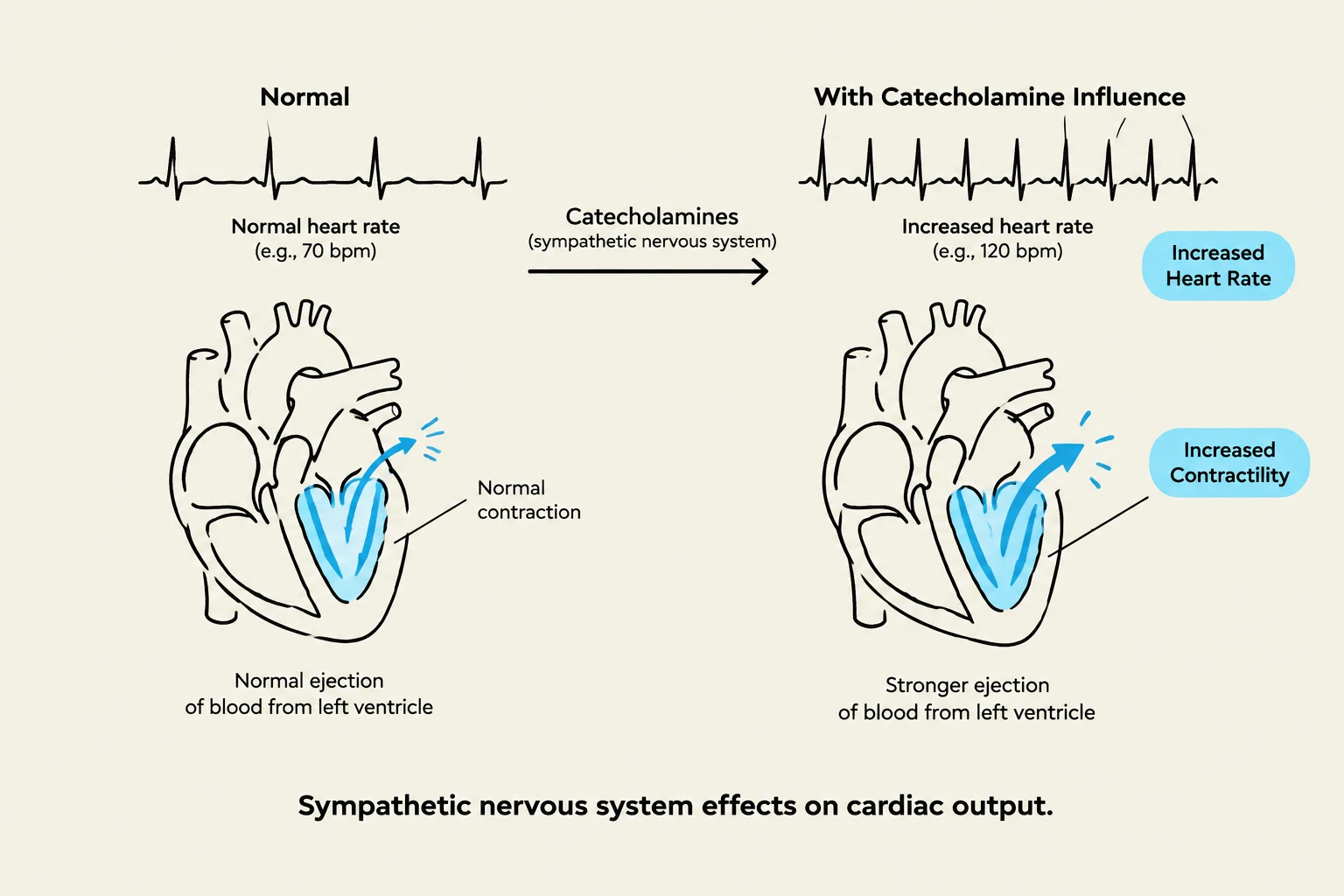
This diagram illustrates the effects of catecholamines, released by the sympathetic nervous system, on cardiac output. It shows that these hormones increase heart rate and contractility, leading to a stronger ejection of blood from the left ventricle.
One of the most critical mathematical relationships in shock management is the formula for Cardiac Output (CO). To prevent a total collapse of perfusion, the body must attempt to keep CO as high as possible despite a potential drop in stroke volume (the amount of blood ejected per beat).
The relationship is expressed as:
CO=HR⋅SV
In the compensatory stage, the catecholamine surge targets the heart to drive this equation upward through two mechanisms:
Tachycardia (Increased Heart Rate): By increasing the frequency of contractions (HR), the body attempts to compensate for a lower stroke volume. This is often the first clinical sign a nurse or physician will observe.
Increased Contractility: Catecholamines increase the force with which the heart muscle contracts, helping to squeeze more blood out of the ventricles with each beat.
Clinical Pearl: The "Hidden" Shock
In the early compensatory stage, a patient's blood pressure might still appear within a "normal" range. However, a rising heart rate (tachycardia) is often the earliest warning sign that the body is working overtime to compensate for an underlying deficit.
Vasoconstriction and Systemic Vascular Resistance
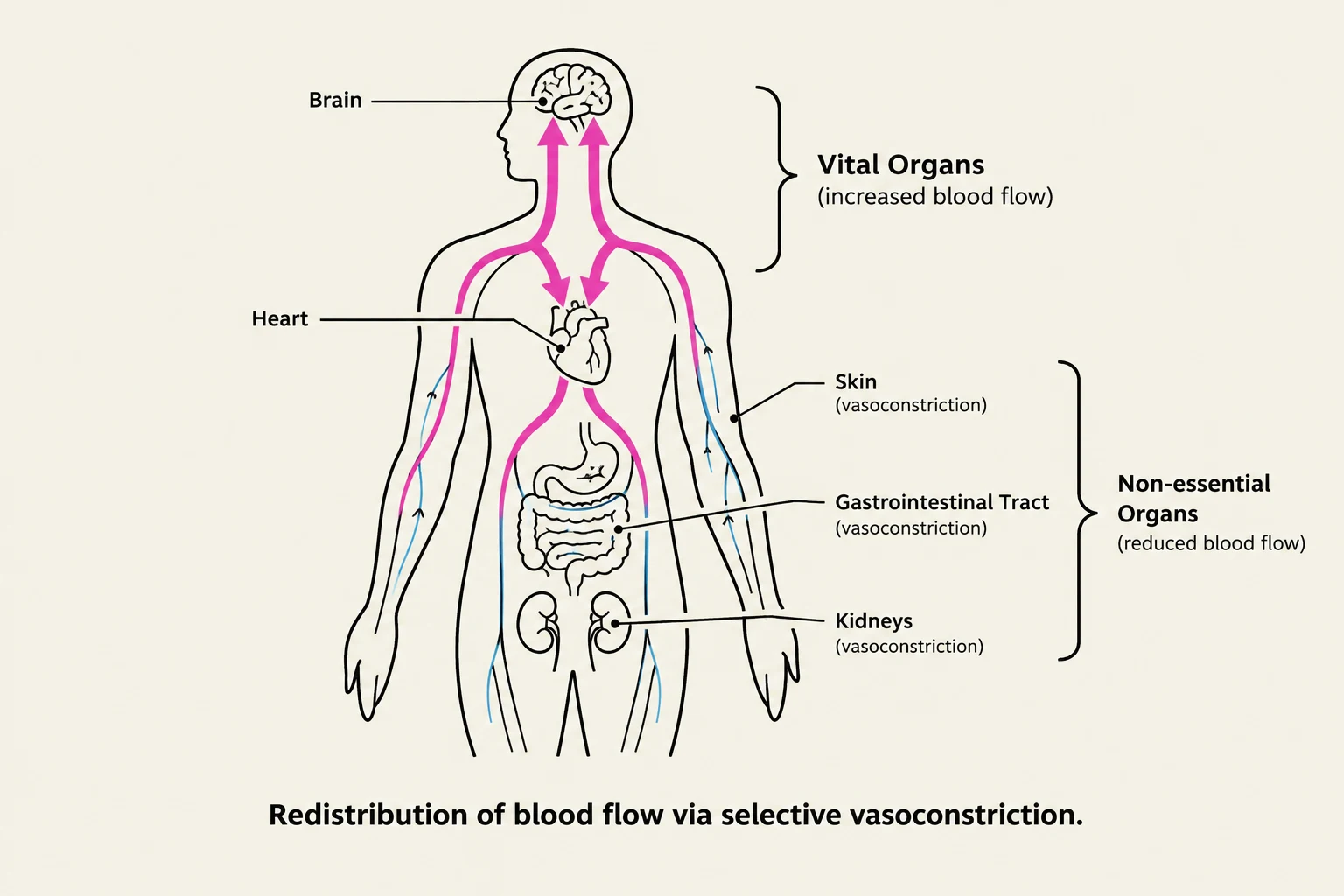
Diagram illustrating the redistribution of blood flow in the human body during selective vasoconstriction, prioritizing vital organs like the brain while reducing flow to non-essential organs such as the skin, gastrointestinal tract, and kidneys.
While the heart works to pump more blood, the blood vessels work to ensure that blood is directed where it is needed most. The SNS triggers vasoconstriction—the narrowing of the blood vessels—primarily through the stimulation of alpha-1 receptors.
This vasoconstriction serves a dual purpose:
Increasing Systemic Vascular Resistance (SVR): By narrowing the vessels, the body increases the pressure within the system, helping to prop up the falling mean arterial pressure.
Redistribution of Flow: Vasoconstriction occurs more intensely in "non-essential" areas like the skin, gastrointestinal tract, and kidneys. This shunts the limited blood supply toward the "vital" organs—the brain and the heart.
Summary of Clinical Manifestations
To distinguish the compensatory stage from other stages of shock or other medical conditions, it is helpful to review what is occurring versus what is not occurring.
Manifestation
Status in Compensatory Stage
Rationale
Heart Rate
Increased (Tachycardia)
To maintain Cardiac Output (CO = HR ⋅ SV).
Blood Pressure
May be normal or slightly low
The body is actively working to prevent a significant drop in MAP.
Vascular Tone
Vasoconstriction
Driven by SNS/alpha-1 receptors to increase resistance.
Body Temperature
Normal
Elevated temperature is usually a sign of infection/hyperthermia, not compensation.
Vascular Tone
Vasodilation (Incorrect)
Vasodilation would lower resistance and worsen the shock.
Exam Tip: Distinguishing Incorrect Options
When testing on shock pathophysiology, remember that vasodilation and decreased mean arterial pressure are signs of the failure or the cause of shock, rather than the body's compensatory response. The body's goal in the compensatory stage is to fight against vasodilation and falling pressure.
Conclusion
The compensatory stage is a high-stakes balancing act. Through the activation of the baroreceptors, the sympathetic nervous system, and the release of catecholamines, the body employs tachycardia and vasoconstriction to preserve tissue perfusion. While these mechanisms are effective in the short term, they are energetically expensive and cannot be sustained indefinitely. If the underlying cause of the shock is not addressed, the compensatory mechanisms will eventually fail, leading to the progressive and irreversible stages of shock.
Keep reading for free.
Create an account to finish this reading and make it part of your study routine.