An overview of the compartmentalization within eukaryotic cells, detailing the structure and function of key organelles such as the nucleus, nucleolus, cytoplasm, mitochondria, and cytoskeleton. Explains how this organization is essential for cellular processes and efficiency.
In the study of biology, the distinction between prokaryotic and eukaryotic organisms is defined largely by structural complexity. The eukaryotic cell is characterized by a high degree of internal organization known as compartmentalization. Rather than being a single, open bag of enzymes and substrates, the eukaryotic cell is divided into distinct, membrane-bound regions.
This structural arrangement is not merely for organization; it is a functional necessity. Compartmentalization allows the cell to:
Separate biochemical processes: Different reactions can occur simultaneously without interference.
Optimize metabolic efficiency: Specific environments (pH, ion concentration, enzyme density) can be maintained within individual compartments.
Protect the cell: High-energy or degradative reactions (like those involving digestive enzymes) can be localized to prevent damage to the rest of the cell.
Diagram of an animal cell showing various organelles including the nucleus, mitochondria, Golgi apparatus, endoplasmic reticulum, ribosomes, lysosomes, peroxisomes, and centrosome.
The Nucleus: The Genetic Control Center
The nucleus serves as the central control center of the eukaryotic cell. It houses the genetic material (DNA) and is the primary site for transcription and much of the cell's replication processes.
Chromatin Organization
Within the nucleus, DNA is packaged into chromatin. The functional state of the nucleus is determined by the distribution of two types of chromatin:
Euchromatin: Less condensed, transcriptionally active chromatin with longer linker lengths between nucleosomes.
Heterochromatin: Highly condensed, transcriptionally inactive chromatin with a regular, condensed array of nucleosomes.
The proportion of heterochromatin to euchromatin varies significantly between different cell types.
The Nucleolus and Ribosome Biogenesis
A critical sub-compartment within the nucleus is the nucleolus. The nucleolus is a tripartite structure consisting of three distinct sub-compartments:
Fibrillar Center (FC): The site where 45S rRNA is transcribed from rDNA.
Dense Fibrillar Component (DFC): The site of rRNA processing.
Granular Component (GC): The site of pre-ribosomal subunit assembly.
The final products, the 40S and 60S ribosome subunits, are then exported out of the nucleus into the cytoplasm to begin protein synthesis.
Exam Tip: The nucleolus is not just a structural component; it functions as a stress sensor. Changes in cellular health—such as DNA damage, oxidative stress, or viral infection—can cause the nucleolus to undergo enlargement (increased ribosomal activity) or disruption (fragmentation and segregation of its components).
The Cytoplasm: Fluid and Structure
The cytoplasm refers to the entire region of the cell located between the plasma membrane and the nuclear envelope. It is composed of two main elements: the cytosol and the cytoplasmic organelles.
Cytosol
The cytosol is the aqueous, jelly-like fluid component of the cytoplasm. It serves as the medium where many metabolic pathways and molecular interactions occur. In a typical liver cell (hepatocyte), the cytosol occupies approximately 54% of the total cell volume.
Cytoplasmic Organelles
Organelles are specialized, membrane-bound structures distributed throughout the cytoplasm, each performing a specific "division of labor".
Mitochondria: The Powerhouse
Mitochondria are responsible for energy production through cellular respiration. They are particularly numerous in tissues with high energy demands, such as nerve, skeletal muscle, and heart tissue.
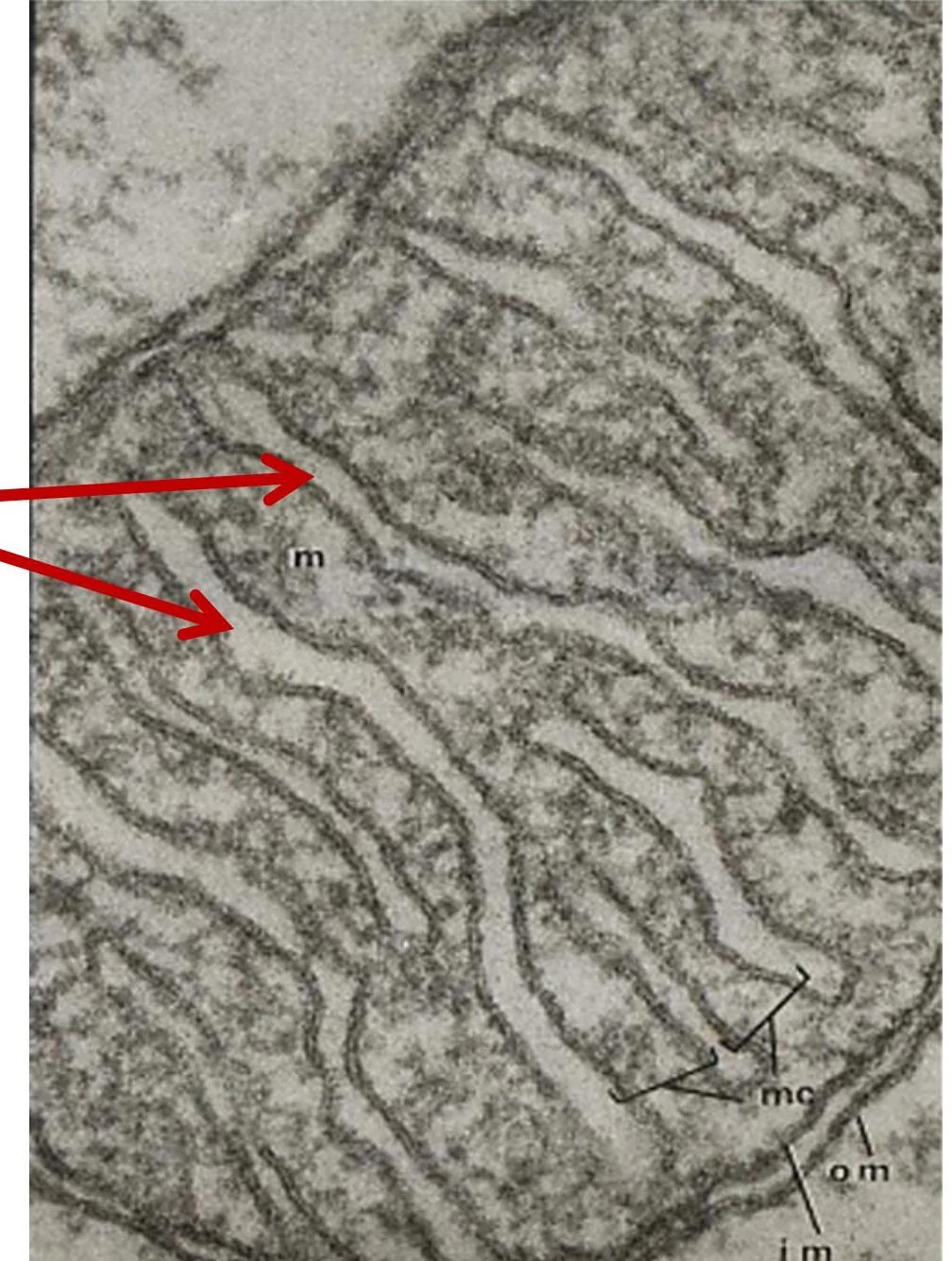
A mitochondrion consists of four primary regions:
Outer Membrane: Contains transport proteins and proteins involved in lipid synthesis.
Intermembrane Space: Contains enzymes that use ATP passing out of the matrix to phosphorylate other nucleotides.
Inner Membrane: Folded into structures called cristae to increase surface area; it contains the enzymes of the respiratory chain.
Matrix: Contains hundreds of enzymes for the citric acid cycle and fatty acid oxidation, as well as mitochondrial DNA, ribosomes, and tRNAs.
This is a transmission electron micrograph showing the structure of a mitochondrion, a key organelle in eukaryotic cells responsible for cellular respiration. The image labels the outer membrane, inner membrane (with its characteristic folds called cristae), the intermembrane space between the two membranes, and the matrix, the innermost compartment.
Electron micrograph of mitochondria showing inner and outer membranes and cristae.
Clinical Correlation: Mitochondrial Dysfunction
Because mitochondria are central to energy production, defects in mitochondrial DNA (mtDNA) or nuclear genes encoding mitochondrial proteins can lead to severe diseases.
Spinal Muscular Atrophy (SMA): Caused by mutations in the SMN1 gene, leading to fragmented mitochondria and reduced ATP production in motor neurons.
Sarcopenia: Age-related loss of muscle mass often linked to mtDNA deletions that cause energy deficits and muscle fiber atrophy.
Other Key Organelles
Endoplasmic Reticulum (ER): Involved in protein and lipid synthesis.
Golgi Apparatus: Functions in the modification, sorting, and packaging of proteins and lipids.
Lysosomes: Contain digestive enzymes for breaking down macromolecules and cellular debris.
The Cytoskeleton: The Cellular Framework
The cytoskeleton is a network of protein filaments that provides structural support, facilitates intracellular transport, and aids in cell movement. It is composed of three main types of filaments:
Microtubules
Microfilaments
Intermediate filaments
The cytoskeleton is also integrated with the nucleus through the LINC complex, which couples the nucleoskeleton to the rest of the cell, ensuring structural integrity across the entire eukaryotic unit.
Summary Table: Compartmentalization at a Glance
Component
Primary Function
Key Feature
Nucleus
Genetic control & transcription
Contains chromatin and nucleolus
Nucleolus
Ribosome biogenesis
Tripartite structure (FC, DFC, GC)
Cytosol
Metabolic medium
Aqueous fluid within the cytoplasm
Mitochondria
ATP production
Double membrane with cristae
Cytoskeleton
Support & transport
Network of protein filaments
Keep reading for free.
Create an account to finish this reading and make it part of your study routine.