Comparing Single-Session and Multi-Session Exposure Therapy for Specific Phobias
This article synthesizes meta-analytic evidence to compare the efficacy and efficiency of single-session versus multi-session exposure therapy for treating specific phobias. It discusses the mechanisms, outcomes, and moderators of treatment success.
Specific phobia (SP) is characterized by an excessive, persistent fear of a specific object or situation, leading to active avoidance or intense distress. Because these phobias can predict the onset of other anxiety disorders like panic disorder or OCD, effective treatment is a clinical priority. For decades, exposure therapy has been the gold standard for treatment, helping individuals confront feared stimuli to learn that feared consequences do not occur.
Comparison of single-session versus multi-session exposure delivery formats.
However, a practical question remains for clinicians and patients: Is it better to undergo a single, intense session of exposure, or a series of multiple, spaced sessions? This article synthesizes recent meta-analytic evidence to compare the efficacy and efficiency of these two approaches.
Understanding the Two Approaches
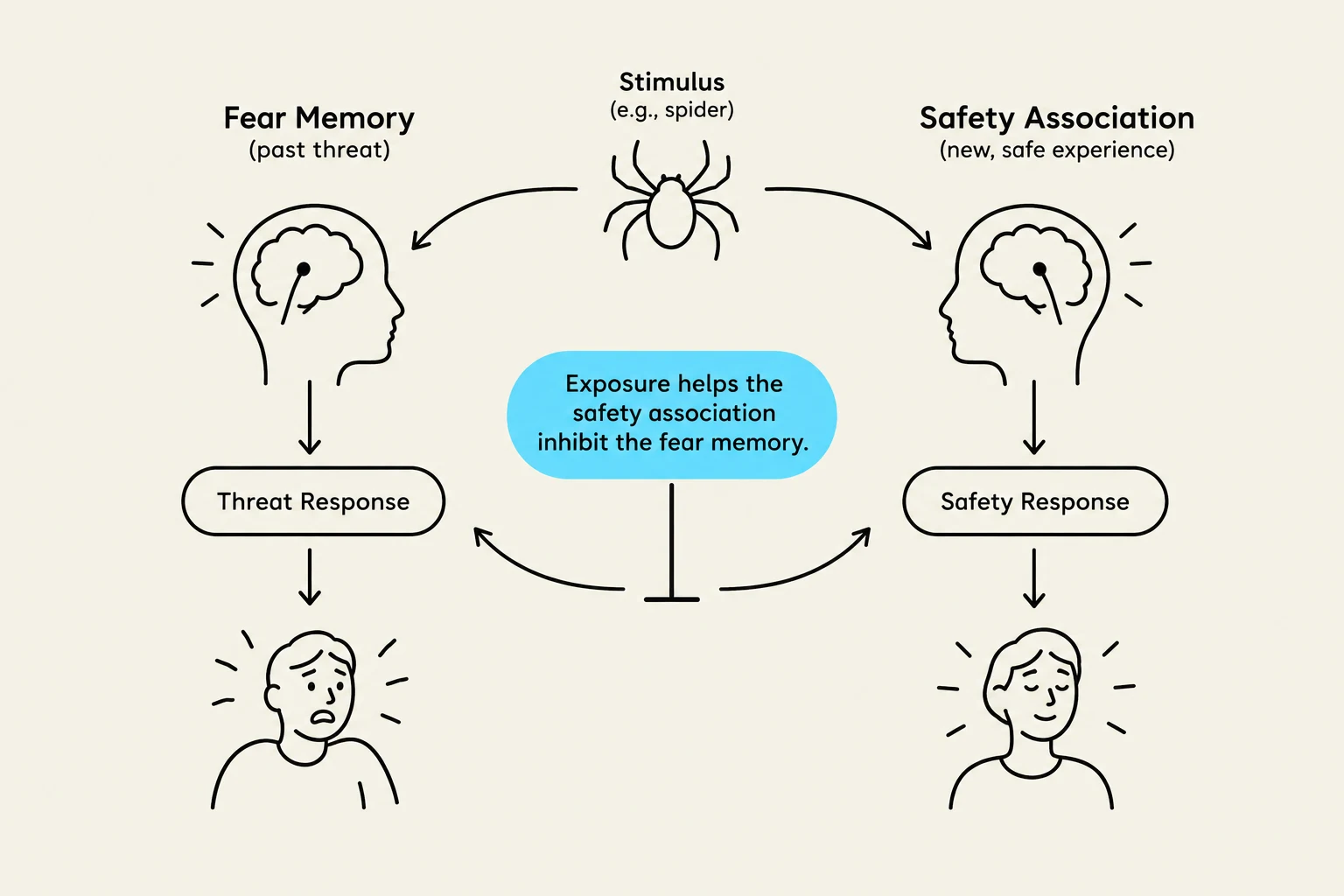
This diagram illustrates how exposure to a stimulus, like a spider, can help create a safety association that inhibits a fear memory, leading to a safety response instead of a threat response.
To compare these treatments, we must first distinguish between their delivery formats:
Single-Session Exposure: This involves a single, prolonged treatment session, often lasting up to three hours. A prominent example is One-Session Treatment (OST), which utilizes intensive exposure tasks to achieve rapid symptom reduction.
Multi-Session Exposure: This follows a more traditional Cognitive Behavioral Therapy (CBT) structure, where exposure is delivered gradually over several spaced sessions. This is often referred to as spaced exposure, whereas single-session approaches can be viewed as a form of massed exposure.
Both methods aim to facilitate fear extinction learning—the process by which the brain learns that a previously feared stimulus is no longer a threat. Modern protocols often incorporate the inhibitory learning model, which focuses on creating new, safety-oriented associations that compete with the original fear memory.
Efficacy: Does One Session Work as Well as Many?
When evaluating "efficacy," we are looking at how well the treatment works to reduce symptoms. Researchers typically measure this through two primary lenses:
Self-reported symptoms (SPS): Subjective measures where the patient reports their level of fear or distress via questionnaires.
Approach behaviour (BAT): Objective measures, such as the Behavioral Approach Task, which track how closely a person can approach the feared object.
According to a large-scale meta-analysis of 67 studies involving 1,758 participants, both single-session and multi-session exposure therapies produce large and significant beneficial effects.
Crucially, there was no significant difference in the effectiveness of the two approaches at post-treatment or during follow-up assessments (ranging from 4 weeks to 14 months). Whether a patient undergoes one intensive session or several shorter ones, the reduction in fear and the improvement in approach behavior are statistically comparable.
Study Tip: In meta-analyses, "efficacy" refers to the magnitude of the effect (how much the symptom decreases), while "efficiency" refers to the resources (time, money, sessions) required to achieve that effect.
Efficiency: The Time Advantage
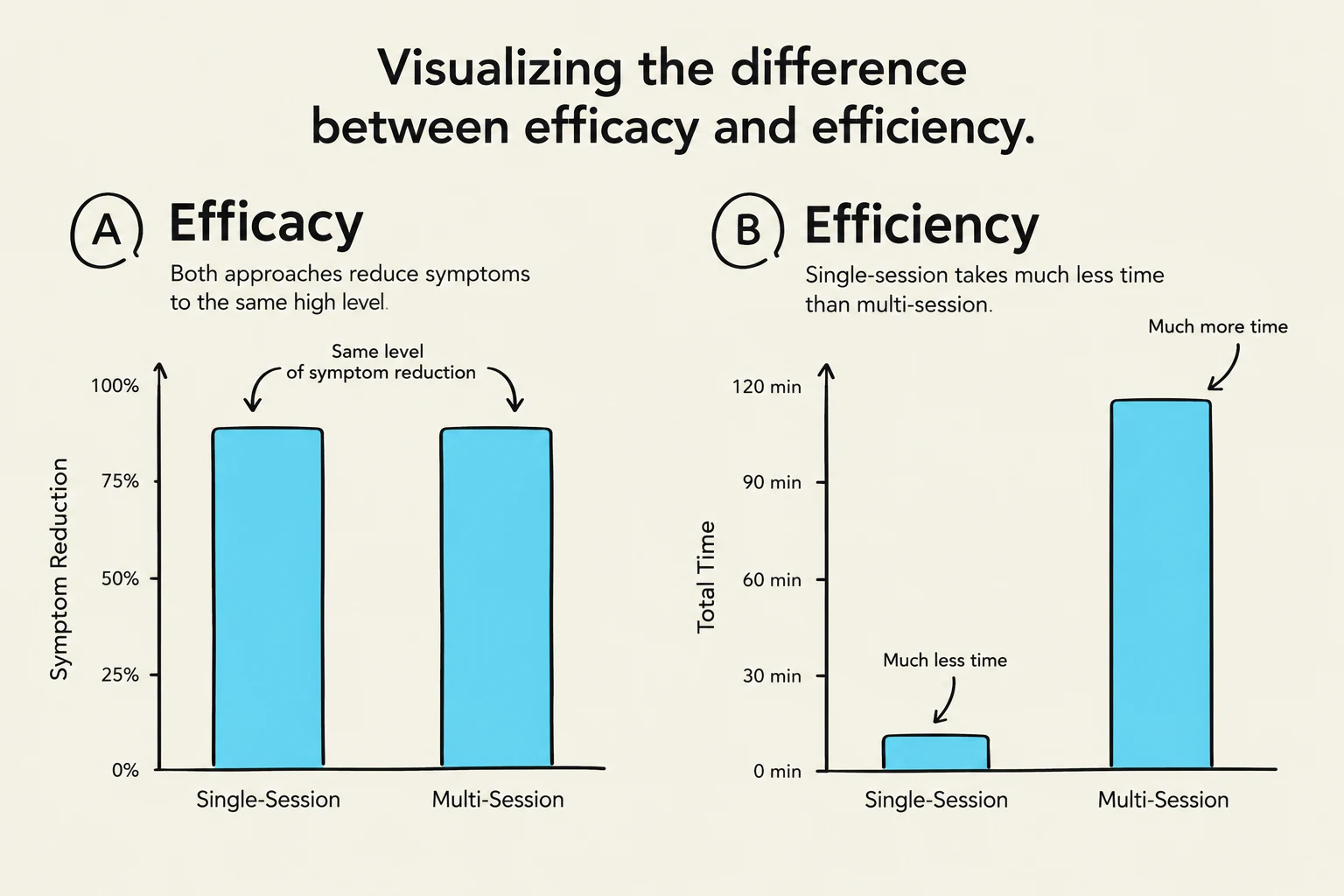
This illustration compares the efficacy and efficiency of single-session versus multi-session approaches. Efficacy is measured by symptom reduction, showing both approaches achieve the same high level. Efficiency is measured by total time, where single-session is significantly faster than multi-session.
While the outcomes are similar, the "cost" in terms of time is not. The meta-analysis found that the mean total treatment time was significantly lower for single-session exposure compared to multi-session exposure. On average, multi-session treatment required approximately 137 minutes more total time than single-session treatment.
This makes single-session exposure highly treatment efficient. For patients, this translates to:
Reduced out-of-pocket costs.
Less disruption to daily life and work schedules.
Faster access to relief from debilitating fear.
Moderators of Treatment Success
Not all phobias or patients respond to exposure in the same way. Researchers look for effect size moderators—variables that might change how well the treatment works.
Phobia Subtype
The type of phobia can influence the results. Research indicates that the phobia subtype (e.g., animal, situational, blood-injection-injury, or natural environment) significantly moderates the effect size for both treatment approaches. For example, animal phobias (like spider phobia) are frequently studied and show robust results, but the direction of how a subtype affects the outcome may differ depending on whether you are measuring self-reported fear or actual approach behavior.
Clinical Application: Behavioural Experiments
Regardless of the session format, successful exposure often functions as a behavioural experiment. Instead of just "sitting with fear," the patient is testing a specific hypothesis (e.g., "If I touch this spider, it will bite me"). By confronting the stimulus, they gather data that contradicts their fear-based expectations, facilitating the learning necessary for long-term recovery.
Summary Comparison
Feature
Single-Session Exposure
Multi-Session Exposure
Primary Mechanism
Inhibitory Learning / Massed Exposure
Fear Extinction / Spaced Exposure
Efficacy (Symptom Reduction)
Large Effect Size
Large Effect Size
Total Treatment Time
Significantly Lower
Significantly Higher
Clinical Efficiency
High
Moderate
Conclusion
For the treatment of specific phobia, the evidence suggests that "more" is not necessarily "better" in terms of session count. While multi-session exposure is a valid and effective traditional approach, single-session exposure provides comparable clinical outcomes with significantly higher time efficiency.
Given these findings, clinical policies that facilitate easier access to intensive, single-session treatments could greatly benefit the widespread population suffering from specific phobias.
Keep reading for free.
Create an account to finish this reading and make it part of your study routine.