


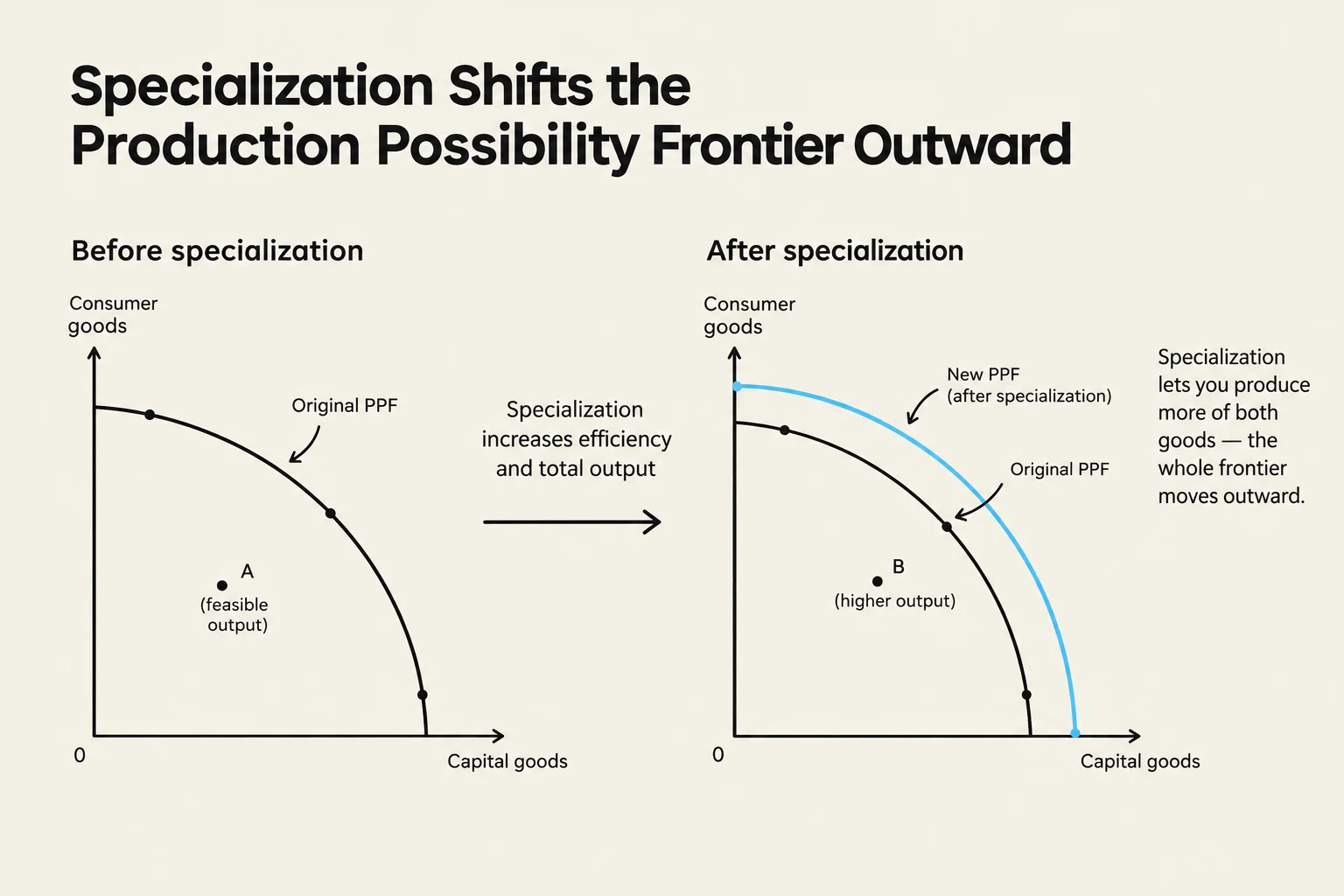
In a world of scarcity, every choice involves a trade-off. Because resources—such as time, money, and raw materials—are limited, individuals and nations cannot have everything they want. This fundamental reality of economics leads us to a powerful conclusion: through trade and specialization, we can actually consume more than we could ever produce on our own.
The Foundation: Opportunity Cost
To understand why trade is beneficial, we must first understand the true cost of any decision. In economics, the cost of something is not just the amount of money you spend; it is the value of what you must give up to get it. This is known as opportunity cost.
For example, if you spend $30 to go skiing, your cost isn't just the $30. If you could have spent that day working a job that pays $40, the true economic cost of skiing is the $30 fee plus the $40 in lost wages, totaling $70.
Exam Tip: When calculating opportunity cost, always look for the "next best alternative." It is the value of the most attractive option you forego when making a choice.
Absolute vs. Comparative Advantage
A common misconception in economics is that a person or a country should only produce goods that they are "best" at making. This is the concept of absolute advantage—the ability to produce more of a good or service than others using the same amount of resources.

Keep reading for free.
Create an account to finish this reading and make it part of your study routine.
Continue reading freeAlready have an account? Log in
Updated