This guide covers essential concepts in community health nursing, including risk assessment, environmental health, epidemiology, disease transmission, immunity, nursing roles in prevention, and evidence-based practice.
Navigating Community Health: A Comprehensive Study Guide
Community health nursing is a multifaceted discipline that shifts the focus from individual clinical care to the health of entire populations. To master this subject, a student must understand not just how a single person gets sick, but how diseases move through populations, how environmental factors influence health outcomes, and how nurses can implement systemic interventions to prevent illness. This guide serves as a roadmap for mastering the core concepts of risk assessment, epidemiology, disease transmission, and evidence-based practice.
Risk Assessment and Environmental Health
Before a community health nurse can intervene, they must understand the risks present in the environment. Risk assessment is a systematic process used to identify and evaluate potential hazards that could impact public health.
Phases of Risk Assessment
Risk assessment is not a single step but a series of organized phases. While specific models may vary slightly, the core process involves:
Hazard Identification: Determining if a specific agent (chemical, biological, or physical) is present and capable of causing harm.
Dose-Response Assessment: Evaluating the relationship between the amount of exposure and the severity of the health effect.
Exposure Assessment: Determining how much of the agent is actually reaching the population.
Risk Characterization: Integrating the previous steps to estimate the overall probability of harm to the community.
Exposure Mediums
When assessing risk, nurses must identify the "medium" through which a person is exposed to a hazard. Common exposure mediums include:
Air: Inhalation of pollutants, smoke, or pathogens (e.g., influenza or tuberculosis).
Water: Ingestion of contaminated water or contact with waterborne pathogens (e.g., Cholera).
Land: Contact with contaminated soil or ingestion of substances via the ground.
Food: Ingestion of contaminated food products (e.g., Salmonella or E. coli).
Social Determinants of Health (SDOH) and Disparities
A critical component of community health is recognizing that health is not determined solely by biology. Social Determinants of Health (SDOH) are the conditions in which people are born, grow, live, work, and age. These include economic stability, education access, social and community context, and the built environment.
Environmental health disparities occur when certain populations are disproportionately exposed to environmental hazards (such as living near industrial zones or having limited access to clean water) due to these social factors. Understanding SDOH allows nurses to move beyond treating symptoms and begin addressing the root causes of health inequities.
The Science of Epidemiology
Epidemiology is the study of the distribution and determinants of health-related states in specified populations. It is the "detective work" of public health.
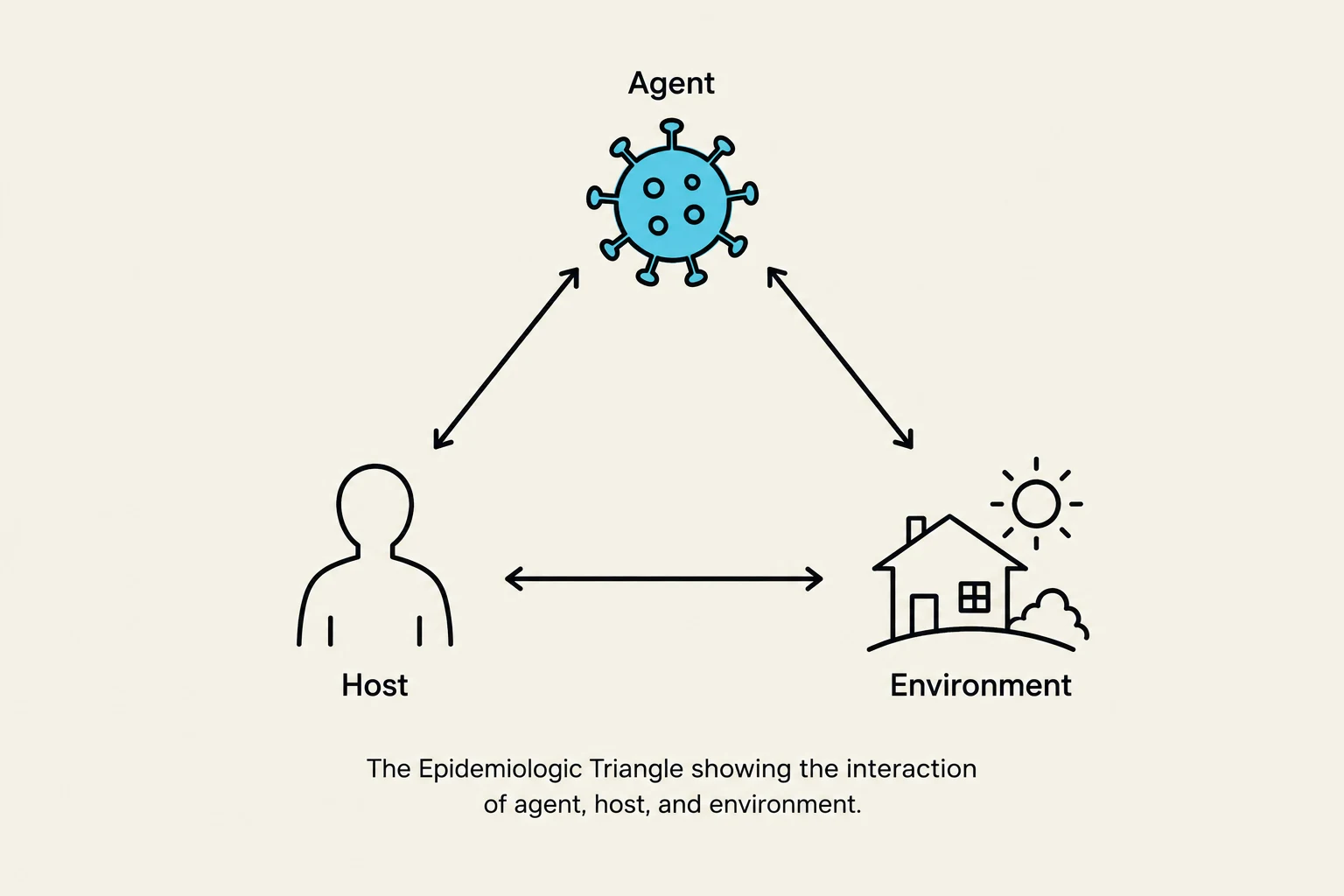
The Epidemiologic Triangle
The Epidemiologic Triangle showing the interaction of agent, host, and environment.
To understand why a disease occurs, epidemiologists use the Epidemiologic Triangle. This model posits that disease results from the interaction of three components:
The Agent: The cause of the disease (e.g., bacteria, virus, parasite, or chemical).
The Host: The organism (human) that is susceptible to the agent. Factors like age, genetics, and immune status influence host susceptibility.
The Environment: External factors that allow the agent and host to interact (e.g., temperature, crowding, sanitation, or social structures).
Descriptive vs. Analytic Epidemiology
Epidemiological studies are generally categorized into two types:
Descriptive Epidemiology: Focuses on the "Who, Where, and When." It describes the distribution of health events by person (age, gender), place (geographic location), and time (seasonal trends).
Analytic Epidemiology: Focuses on the "Why and How." It goes a step further to test hypotheses and identify the causes or risk factors associated with a disease by comparing groups (e.g., comparing a group exposed to a toxin vs. a group not exposed).
Surveillance Systems: Active vs. Passive
To monitor health trends, public health agencies use surveillance systems:
Passive Surveillance: This is the most common form. It relies on healthcare providers and laboratories to report cases of certain diseases to health departments as they occur. It is inexpensive but often suffers from underreporting.
Active Surveillance: Health agency staff actively contact providers, laboratories, or the community to seek out information about new cases. This is more accurate and thorough but is much more resource-intensive.
Measuring Health Outcomes: Morbidity vs. Mortality
When evaluating the impact of a disease on a population, nurses must distinguish between two key metrics:
Morbidity: Refers to the state of being diseased or the incidence/prevalence of illness within a population.
Mortality: Refers to the number of deaths within a population.
Exam Tip: If a question asks about the burden of a disease (how many people are living with it), think morbidity. If it asks about the lethality or death rate, think mortality.
Disease Transmission and Immunity
Understanding how diseases move through a community is essential for implementing effective prevention strategies.
Modes of Transmission
Pathogens can be transmitted through several routes:
Direct Contact: Physical touch (e.g., skin-to-skin contact, sexual contact).
Indirect Contact: Touching a contaminated object (fomite), such as a doorknob.
Droplet Transmission: Large particles from coughing or sneezing that travel short distances.
Airborne Transmission: Small particles that remain suspended in the air for long periods (e.g., Measles).
Vector-borne: Transmission via insects like mosquitoes or ticks.
Vehicle-borne: Transmission through contaminated food, water, or blood.
Immunity: Active vs. Passive
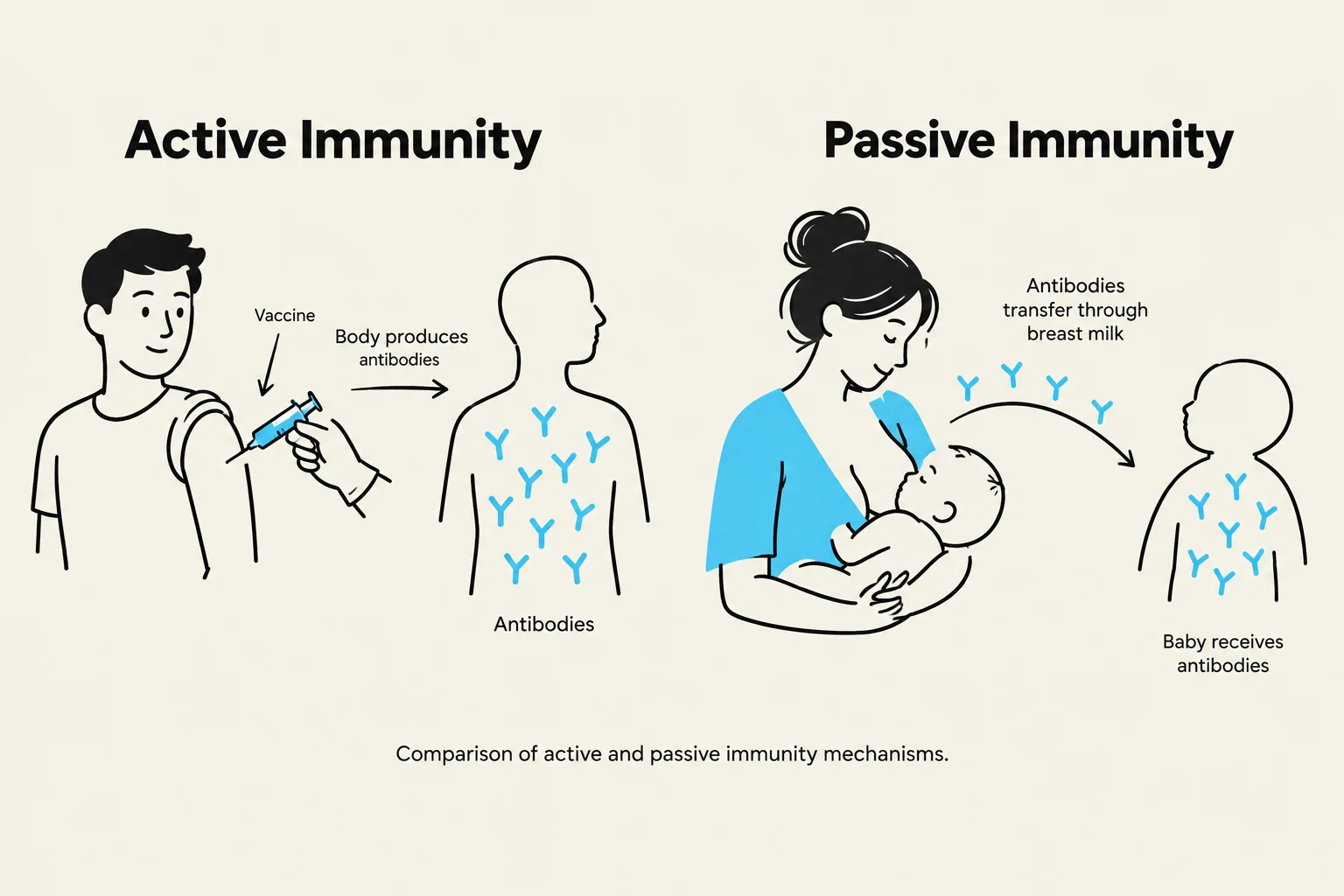
Comparison of active and passive immunity mechanisms.
Immunity is the body's ability to resist a specific disease. It is categorized based on how the antibodies are acquired:
Active Immunity: The body produces its own antibodies in response to an antigen. This can be natural (getting sick) or artificial (vaccination). Active immunity is generally long-lasting.
Passive Immunity: The body receives antibodies from an external source. This can be natural (mother to fetus via placenta or breast milk) or artificial (injection of immune globulins). Passive immunity provides immediate protection but is temporary.
Specific Infectious Disease Profiles
Nurses must be able to differentiate between common infectious agents:
HIV: Transmitted through blood, semen, vaginal secretions, and breast milk.
Hepatitis A: Typically transmitted via the fecal-oral route (contaminated food/water).
Hepatitis B & C: Primarily transmitted through blood and bodily fluids (e.g., needle sharing, sexual contact).
Nursing Roles and Prevention
The community health nurse operates across various levels of prevention to manage both infectious and chronic diseases.
Levels of Prevention
This is a fundamental concept for nursing exams. Prevention is categorized by when the intervention occurs in the disease process:
Primary Prevention: Aimed at preventing the disease before it ever occurs. Examples include immunizations, health education, and nutrition counseling.
Secondary Prevention: Aimed at early detection and prompt intervention to limit the severity of the disease. Examples include screenings (e.g., mammograms, BP checks) and TB skin tests.
Tertiary Prevention: Aimed at rehabilitation and preventing further complications in individuals who already have a permanent or chronic disease. Examples include physical therapy or support groups.
Reportable Diseases and the Nurse's Role
Nurses are legally obligated to report certain "reportable diseases" (such as Chlamydia, Syphilis, or Measles) to public health authorities. This reporting is vital for triggering surveillance and preventing outbreaks.
Evidence-Based Practice (EBP) and Data Collection
Modern nursing practice must be grounded in science rather than tradition or intuition.
The EBP Process and Hierarchy
Evidence-Based Practice involves integrating clinical expertise with the best available research and patient values.
Steps in EBP: These typically include asking a clinical question, searching for evidence, critically appraising the evidence, applying it to practice, and evaluating the outcome.
Internal vs. External Evidence:Internal evidence comes from clinical expertise and quality improvement data within a specific facility. External evidence comes from published research and systematic reviews.
The Evidence Hierarchy: Not all evidence is equal. The hierarchy ranks evidence from strongest to weakest. At the top are Systematic Reviews and Meta-analyses of Randomized Controlled Trials (RCTs), followed by individual RCTs, cohort studies, and finally, expert opinion at the bottom.
Data Collection and Community Assessment
To provide care, nurses must collect accurate data. This includes:
Health Histories: Essential for understanding individual risk factors and patterns.
Genomics: Utilizing genetic information to understand predispositions to certain diseases.
Community Assessment: A systematic process of collecting data about a community's needs, assets, and resources.
Community Nursing Diagnoses
When documenting findings for a community, nurses use a specific format for a Community Nursing Diagnosis. Unlike individual diagnoses, these focus on the population. A common format involves identifying the problem, the related factors (etiology), and the evidence (signs/symptoms) within the community context.
Exam Tip: When writing a community nursing diagnosis, ensure you are addressing the population (e.g., "Residents of District 5") rather than an individual patient.
Keep reading for free.
Create an account to finish this reading and make it part of your study routine.