This guide provides a comprehensive overview of the primary classes of cardiac medications used in modern clinical practice, including RAAS modulators, beta blockers, calcium channel blockers, and specialized vasodilators and diuretics.
Managing cardiovascular health requires a sophisticated understanding of how different drug classes interact with the body's hemodynamics. Whether treating hypertension (HTN), heart failure (HF), or recovering from a myocardial infarction (MI), clinicians must balance the benefits of reducing cardiac workload with the potential risks of hypotension, electrolyte imbalances, and organ dysfunction. This guide provides a comprehensive overview of the primary classes of cardiac medications used in modern clinical practice.
The Renin-Angiotensin-Aldosterone System (RAAS) Modulators
The RAAS pathway is a central target for treating hypertension and heart failure. By modulating this system, medications can decrease afterload (the resistance the heart must pump against) and preload (the volume of blood returning to the heart).
ACE Inhibitors ("The Prils")
Angiotensin-Converting Enzyme (ACE) inhibitors, such as Lisinopril, Enalapril, and Captopril, work by blocking the conversion of angiotensin I to angiotensin II. This results in vasodilation, which decreases both afterload and preload. Additionally, they indirectly block aldosterone, reducing water retention, and they help slow cardiac remodeling.
Common Uses: HTN, Heart Failure (HFrEF/HFpEF), Acute MI, and diabetic renal nephropathy.
Side Effects: A hallmark side effect is a dry cough due to increased bradykinin levels. Other risks include hyperkalemia (high potassium), angioedema, and hypotension.
Monitoring: Blood pressure (BP), Potassium ($K^+$) levels, and renal function (Creatinine/BUN, eGFR).
Angiotensin II Receptor Blockers (ARBs or "The Sartans")
When patients cannot tolerate ACE inhibitors—most commonly due to the dry cough—ARBs are often used as a second-line therapy. Examples include Losartan, Valsartan, and Candesartan. These drugs block the action of angiotensin II directly at the receptor site, achieving similar vasodilatory effects without the bradykinin-related cough.
Common Uses: Similar to ACE inhibitors, including HTN, HF, and diabetic nephropathy.
Side Effects/Monitoring: Hypotension, dizziness, and hyperkalemia.
ARB/Neprilysin Inhibitors (ARNi)
A newer class, represented by Sacubitril/Valsartan (Entresto™), combines an ARB with a neprilysin inhibitor. This combination provides superior benefits for patients with chronic heart failure (NYHA class II-IV) and HFrEF by further reducing afterload and slowing myocardial remodeling.
Clinical Tip: Because ARNi and other cardiac medications can have synergistic effects, monitor patients closely for significant hypotension.
Beta Blockers ("The Olols")
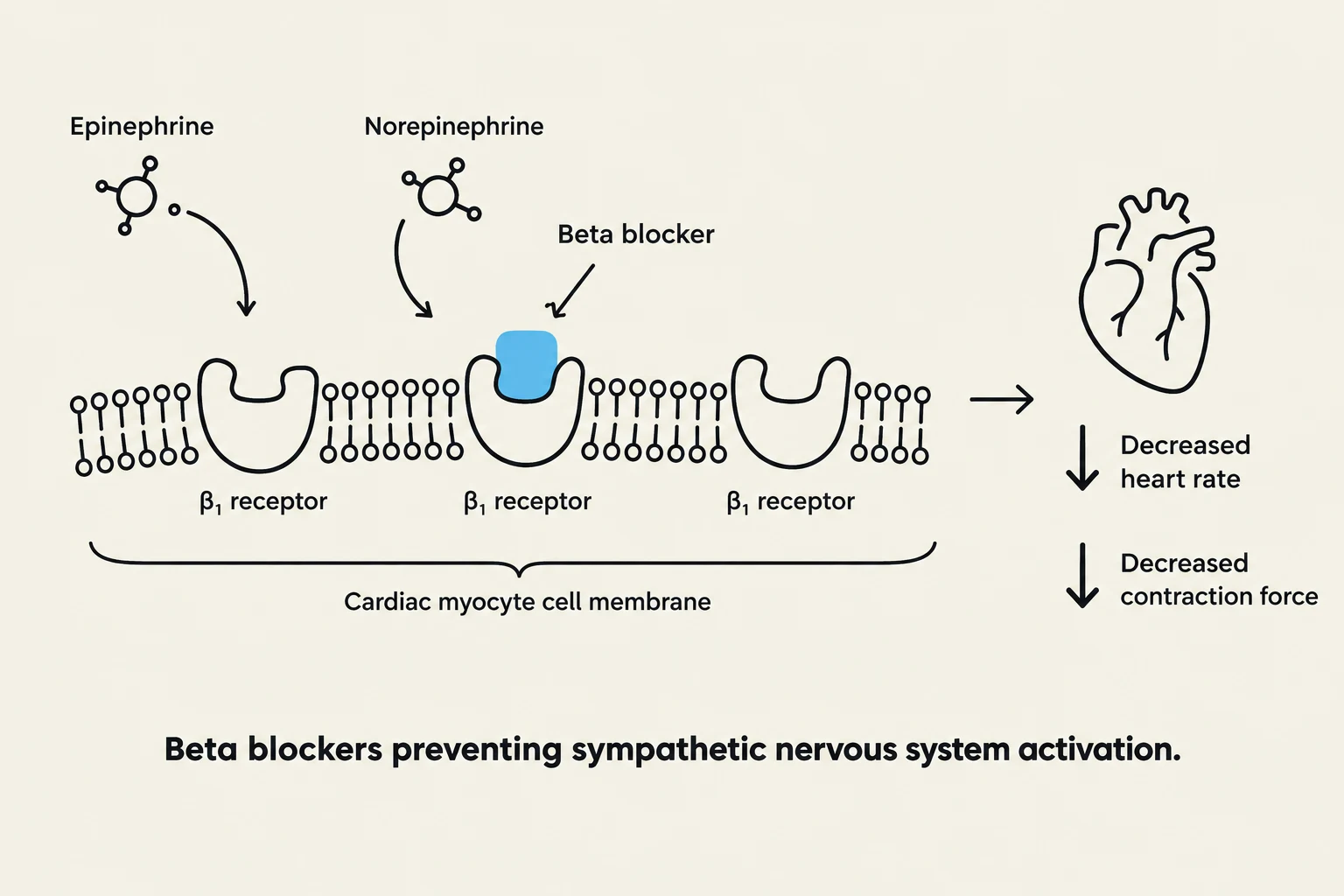
This diagram illustrates how beta blockers prevent sympathetic nervous system activation by blocking epinephrine and norepinephrine from binding to beta-1 receptors on cardiac myocytes, leading to decreased heart rate and contraction force.
Beta blockers work by blocking the sympathetic nervous system, preventing endogenous epinephrine and norepinephrine from binding to beta receptors. This results in a decreased heart rate (negative chronotrope) and decreased contractility (negative inotrope), which ultimately reduces the myocardial workload.
Beta blockers are categorized into two main types:
Cardio-Selective (β1 blockers): Such as Metoprolol, Bisoprolol, and Atenolol.
Non-Selective (β1 and β2 blockers): Such as Propranolol and Carvedilol.
Common Uses: HFrEF, HFpEF, tachycardia, arrhythmias (like AFib), and secondary prevention of MI.
Watch Out! Non-selective blockers can cause bronchospasm; use with extreme caution in patients with asthma. They can also mask symptoms of hypoglycemia and cause bradycardia or heart block.
Monitoring: Heart rate, BP, ECG, and blood glucose.
Calcium Channel Blockers (CCBs)
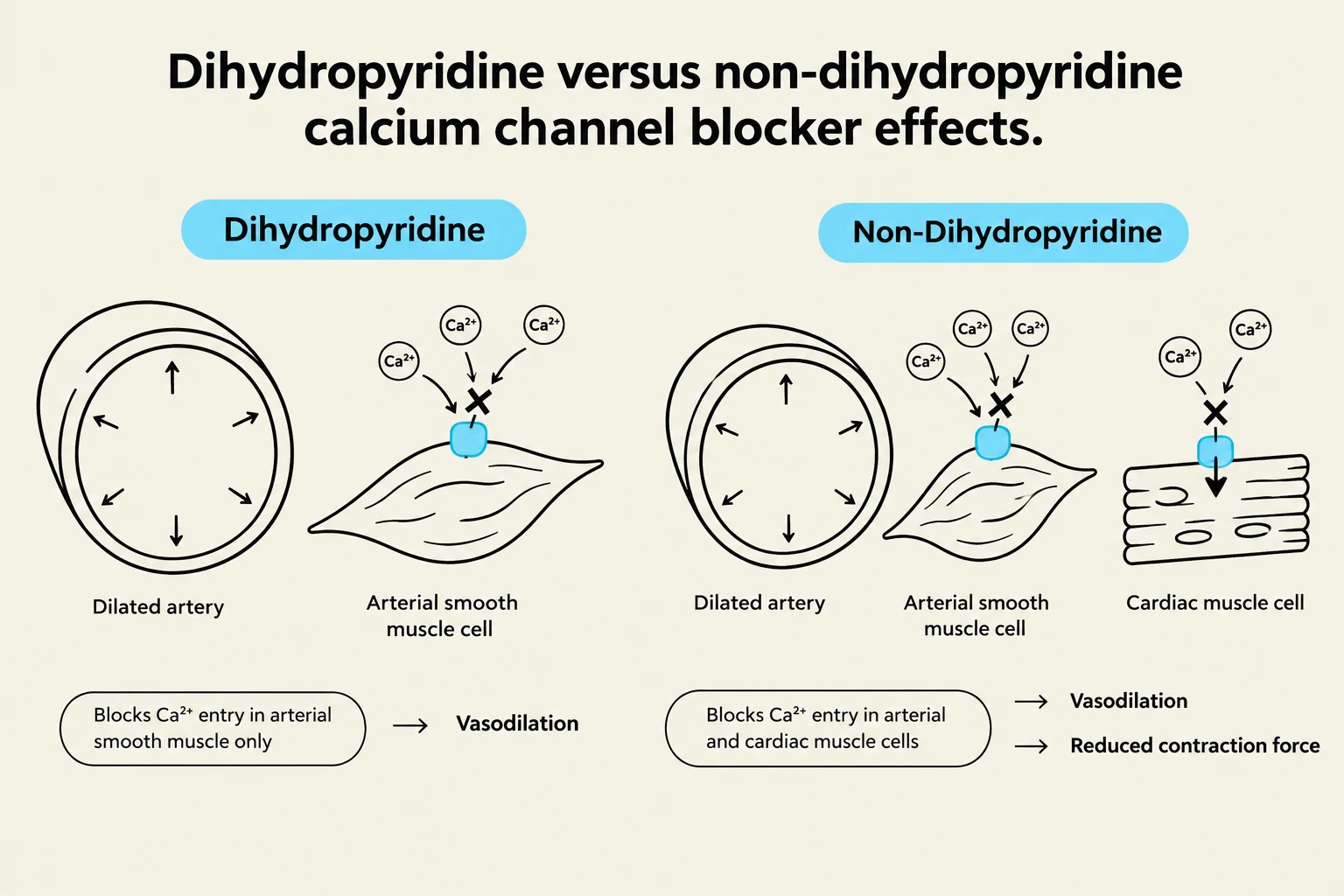
This diagram illustrates the differing effects of dihydropyridine and non-dihydropyridine calcium channel blockers on arterial smooth muscle and cardiac muscle cells, leading to vasodilation or reduced contraction force.
CCBs prevent calcium from entering the cells of the heart and blood vessel walls, leading to vasodilation and decreased heart contractility. They are divided into three sub-classes:
Dihydropyridines ("The Dipines"): Such as Amlodipine and Nifedipine. These have little effect on heart contractility and primarily cause arterial vasodilation to lower BP.
Non-Dihydropyridines: Such as Diltiazem and Verapamil. These have significant negative inotropic and chronotropic effects, meaning they slow the heart rate and reduce the force of contraction.
Common Uses: HTN, Angina, and certain arrhythmias like SVT or AFib.
Side Effects: Hypotension, bradycardia, and peripheral edema (swelling in hands/feet).
Specialized Vasodilators and Diuretics
Nitrates
Nitrates like Nitroglycerin and Isosorbide dinitrate are used to relieve acute angina or prevent it through long-term use. They work primarily through venodilation, which decreases preload.
Hydralazine
Hydralazine is a direct vasodilator used for HTN and heart failure. In African American patients with heart failure, it is often used in combination with isosorbide dinitrate to increase survival. A common side effect is reflexive tachycardia.
Mineralocorticoid Receptor Antagonists (MRA)
Often called "aldosterone antagonists," these include Spironolactone and Eplerenone. They act as potassium-sparing diuretics by blocking aldosterone, which reduces sodium and water reabsorption (decreasing preload).
Warning: There is a high risk of hyperkalemia, especially when combined with ACE inhibitors or ARBs.
SGLT2 Inhibitors
Originally developed for Type 2 Diabetes, drugs like Empagliflozin (Jardiance) and Dapagliflozin (Farxiga) are now FDA-approved for heart failure. They work by preventing the kidneys from reabsorbing glucose and sodium, acting as a mild diuretic that reduces preload and afterload.
Risks: Urinary tract infections (UTIs), euglycemic DKA, and dehydration.
Post-Myocardial Infarction (MI) Management
Patients recovering from an MI require a specific regimen to prevent recurrence and reduce mortality.
Medication Class
Primary Function
Typical Duration
Aspirin
Prevents platelet aggregation
Lifetime
P2Y12 Inhibitors
Prevents platelet aggregation
~1 year
Beta Blockers
Protects against arrhythmias; slows remodeling
Lifetime
Statins
Lowers LDL; cardioprotective
Lifetime
ACE/ARB/ARNi
Reduces preload/afterload
Lifetime (if HFrEF) or ~1 year (if EF > 40%)
P2Y12 Receptor Inhibitors
These include Thienopyridines (Clopidogrel, Prasugrel) and Non-Thienopyridines (Ticagrelor). Ticagrelor is often considered superior to Clopidogrel for STEMI and NSTEMI but is not a prodrug, meaning it does not require liver activation.
Clinical Note: When prescribing P2Y12 inhibitors, be mindful of bleeding risks. Ticagrelor, for example, should be held prior to surgery (5 days for standard, 7 days for major procedures like CABG).
Summary: The Pillars of Heart Failure Management
Modern management of heart failure relies on "pillars" of therapy that work synergistically to improve survival and reduce hospitalizations:
ARNi/ACE/ARB: To manage afterload and remodeling.
Beta Blockers: To reduce workload and protect against arrhythmias.
MRA (Aldosterone Antagonists): To manage fluid volume and potassium.
SGLT2 Inhibitors: To provide diuretic effects and metabolic stability.
General Rule for Dosing: For many cardiac medications, the clinical mantra is: "Start the dose low and bring 'em up slow!".
Keep reading for free.
Create an account to finish this reading and make it part of your study routine.