Cognition, Language, and Intelligence in Psychology
An overview of cognitive processes, including problem-solving strategies, biases, and logical reasoning. It also covers the structure and biology of language, and various theories and measurements of intelligence, including math cognition.
Understanding how we think, speak, and reason is central to the study of psychology. This unit explores the architecture of the human mind, from the rapid mental shortcuts we use to solve daily problems to the complex neurological structures that allow us to communicate. By examining cognitive biases, the mechanics of language, and the multifaceted nature of intelligence, we gain insight into both our mental strengths and our inherent limitations.
Cognition and Problem Solving
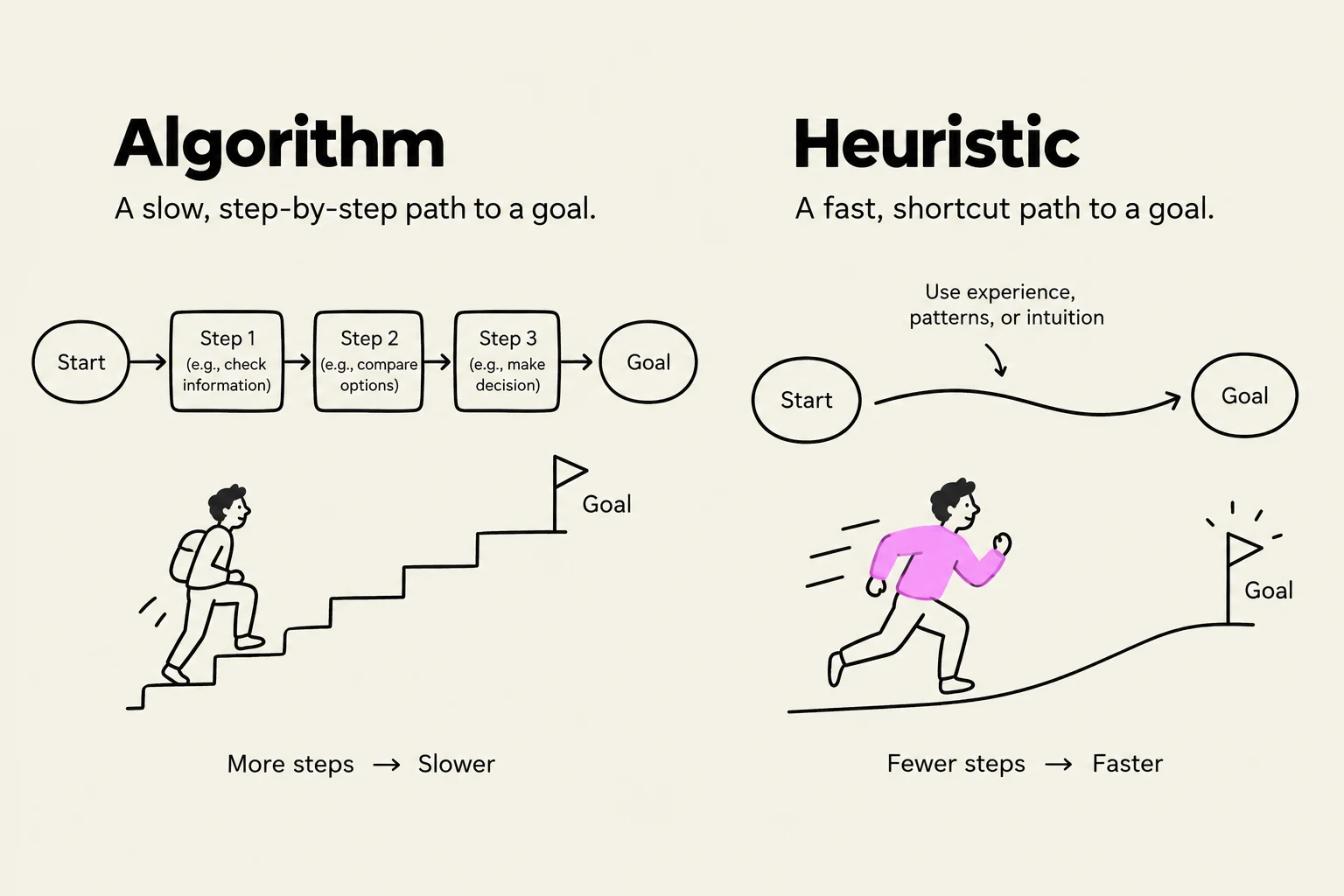
Human cognition relies on two primary methods for processing information: algorithms and heuristics. An algorithm is a step-by-step, logical procedure that guarantees a correct solution if followed precisely. In contrast, a heuristic is a mental shortcut—a "rule of thumb" that allows for quick decision-making but does not guarantee accuracy.
While heuristics save time, they often lead to cognitive biases. Two of the most common are the availability heuristic, where we judge the probability of an event based on how easily examples come to mind (e.g., fearing a plane crash because of recent news coverage), and the representativeness heuristic, where we judge things based on how well they match a particular prototype or mental image.
Exam Tip: Distinguish between a prototype (the "ideal" example of a category) and an exemplar (a specific, real-world instance you use for comparison) when discussing categorization.
This illustration contrasts an algorithm, a step-by-step process, with a heuristic, a shortcut approach, to reaching a goal.
Errors in Reasoning and Decision Making
Our reasoning is frequently hijacked by systematic errors. We often fall victim to confirmation bias, where we actively seek out information that supports our existing views while ignoring contradictory evidence. Even when presented with facts, belief perseverance can cause us to cling to incorrect ideas.
Other critical biases include:
Overconfidence & The Dunning-Kruger Effect: We often overestimate our own abilities. The Dunning-Kruger Effect specifically describes how people with low competence in a task often lack the very skills needed to recognize their own incompetence.
Framing & Anchoring: Decision-making is influenced by how information is presented (framing) or by an initial piece of information that we fixate on (anchoring).
The Gambler’s Fallacy: The mistaken belief that if an event happens more frequently than normal during a given period, it will happen less frequently in the future (or vice versa), failing to recognize independent probability.
Belief-Bias Effect: The tendency to judge the strength of an argument based on how believable the conclusion is, rather than how logically valid the reasoning is.
When solving problems, we may encounter mental sets (approaching a problem in a way that worked in the past, even if it's no longer effective) or functional fixedness (the inability to see a new use for a familiar object). Overcoming these often requires insight—the "aha!" moment of sudden realization.
Logical Reasoning
We generally use two types of logic: inductive reasoning, which moves from specific observations to broader generalizations, and deductive reasoning, which moves from general premises to specific, logical conclusions. Note that if a conclusion is based on faulty premises, even perfect deductive reasoning will lead to an incorrect result.
Language and Communication
Language is more than just words; it is a structured system of symbols and rules. At the most granular level, we have phonemes (the smallest units of sound) and morphemes (the smallest units of meaning, such as roots or prefixes). These are organized into a lexicon (our mental dictionary) using syntax (the rules of grammar) to create meaningful sentences through semantics (the study of meaning).
The relationship between language and thought is debated through the lens of linguistic determinism, the idea that the structure of a language determines or limits the way its speakers think. Some theorists propose a Language Acquisition Device (LAD), an innate biological mechanism that allows children to learn language rapidly.
This diagram illustrates the components of language, from phonemes (sound units) to morphemes (word parts), syntax (sentence structure), and semantics (meaning), using the example sentence "The cat is happy."
The Biology of Language
Language processing is localized in specific brain regions:
Broca’s Area: Primarily responsible for speech production. Damage here often results in "broken" speech that is difficult to produce.
Wernicke’s Area: Primarily responsible for language comprehension. Damage here can result in "word salad," where speech is fluent but lacks meaning.
Intelligence and Math Cognition
Intelligence is a complex construct often measured by the Intelligence Quotient (IQ). For an IQ test to be useful, it must demonstrate reliability (consistency of results over time) and validity (the ability to measure what it actually claims to measure).
Measuring Potential and Achievement
It is vital to distinguish between different types of testing:
Aptitude Tests: Designed to predict your future potential or capacity to learn.
Achievement Tests: Designed to measure what you have already learned or mastered.
Theories of Intelligence
Psychologists categorize intelligence in several ways. The two-factor theory distinguishes between:
Fluid Intelligence (gF): The ability to reason speedily and abstractly to solve new problems.
Crystallized Intelligence (gC): Accumulated knowledge and verbal skills acquired through experience.
Furthermore, Gardner’s Theory of Multiple Intelligences suggests that intelligence is not a single general ability but a collection of distinct modalities (e.g., musical, spatial, interpersonal).
Finally, our approach to intelligence matters. Those with a fixed mindset believe intelligence is static and unchangeable, whereas those with a growth mindset believe intelligence can be developed through effort, which is strongly linked to better academic performance.
Math Cognition
Mathematical thinking involves relational reasoning—understanding how numbers relate to one another—which is essential for processing numerical magnitude. Humans (and some animals) appear to possess an approximate number system, an innate sense of quantity.
In math, we encounter specific cognitive hurdles:
Whole Number Bias: The tendency to treat fractions as if they were whole numbers (e.g., thinking 41 is larger than 21 because 4 is larger than 2).
Distance and Size Effects: These refer to how the perceived difference between numbers (distance) or the actual magnitude of the numbers (size) affects our ability to process them.
To improve mathematical performance, students utilize metacognition—the ability to think about one's own thinking processes—to monitor understanding and correct errors in real-time.
Keep reading for free.
Create an account to finish this reading and make it part of your study routine.