An exploration of cognition, creativity, problem-solving, and the various stages, encoding strategies, and challenges of memory, including forgetting and memory errors.
How do we make sense of the world, solve complex problems, and remember what we learned yesterday? The answer lies in the intricate dance of cognition, creativity, and memory. These processes allow us to transform raw sensory input into meaningful knowledge, navigate challenges through creative thought, and store information for future use. Understanding these mechanisms is not just a matter of academic interest; it is the key to improving how we learn and make decisions in our daily lives.
Cognition: The Architecture of Thought
At its core, cognition refers to all the mental activities associated with thinking, knowing, remembering, and communicating. To manage the overwhelming amount of data we encounter, our brains use concepts—mental groupings of similar objects, events, or ideas.
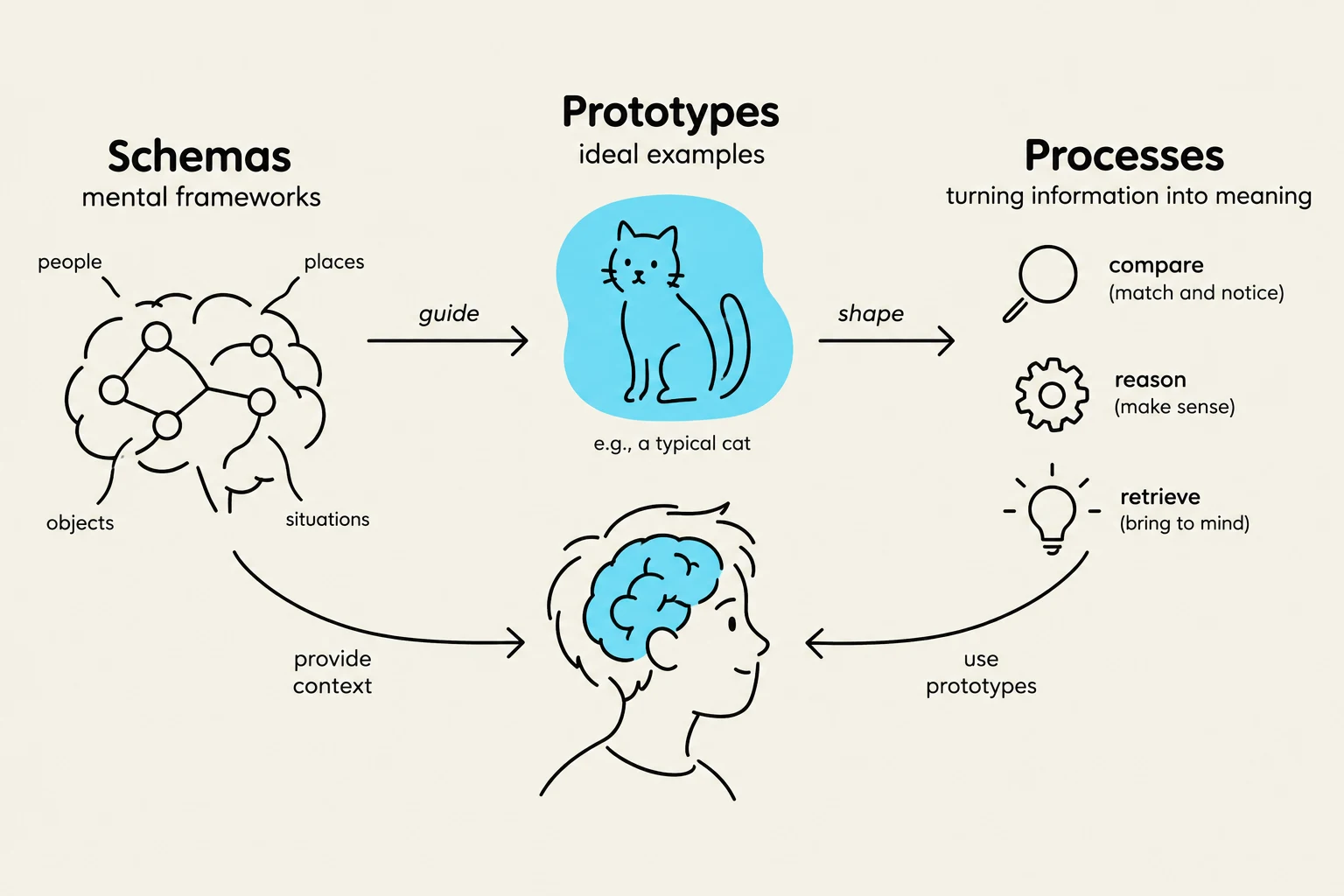
We organize these concepts using schemas, which are mental frameworks that help us interpret information. For example, you likely have a "classroom schema" that includes desks, a teacher, and a whiteboard. Within these schemas, we use prototypes, or idealized examples, to categorize new things quickly. If you see a robin, you immediately categorize it as a "bird" because it matches your prototype of a bird more closely than an ostrich does.
When we encounter new information, we process it in one of two ways:
Assimilation: Fitting new information into our existing schemas (e.g., seeing a different breed of dog and knowing it is still a "dog").
Accommodation: Modifying our existing schemas or creating new ones because the new information doesn't fit (e.g., seeing a cat for the first time and realizing it doesn't belong in your "dog" schema).
Beyond basic thought, we engage in metacognition, which is "thinking about thinking"—the ability to monitor and regulate our own cognitive processes.
This diagram illustrates the cognitive processes of schemas, prototypes, and how they relate to turning information into meaning through comparison, reasoning, and retrieval.
Creativity and Problem Solving
Creativity is the ability to produce new and valuable ideas. This often involves two distinct styles of thinking: divergent thinking, which generates many possible solutions to a problem, and convergent thinking, which narrows down possibilities to find the single correct answer.
However, our ability to solve problems is often hindered by cognitive obstacles. One common barrier is functional fixedness, the tendency to perceive objects only in their usual function (e.g., failing to see a shoe as a potential hammer). We also struggle with mental sets, which are ingrained patterns of approaching a problem that may no longer be effective.
Exam Tip: If a question asks about a person being unable to use a paperclip to reset a router because they only see it as a tool for holding paper together, the answer is functional fixedness.
Biases in Decision Making
Our judgment is frequently clouded by cognitive biases:
Confirmation Bias: Seeking out information that supports our existing beliefs while ignoring contradictory evidence.
Belief Perseverance: Persisting in a belief even after the initial evidence for it has been discredited.
Overconfidence: The tendency to be more confident than correct. This is closely linked to the sunk-cost fallacy, where we continue an endeavor simply because we have already invested resources into it.
Framing Effects: How a question or problem is "framed" or worded can drastically change our decisions (e.g., preferring "90% survival" over "10% mortality").
Heuristics: Mental shortcuts that allow us to make quick judgments. These include the availability heuristic (judging based on how easily examples come to mind) and the representativeness heuristic (judging based on how well something matches a prototype).
The Mechanics of Memory
Memory is the process of encoding, storing, and retrieving information. It can be measured through recall (retrieving info from scratch), recognition (identifying info previously learned), and relearning (learning something again more quickly).
The Three-Stage Multistore Model
Information moves through three distinct stages:
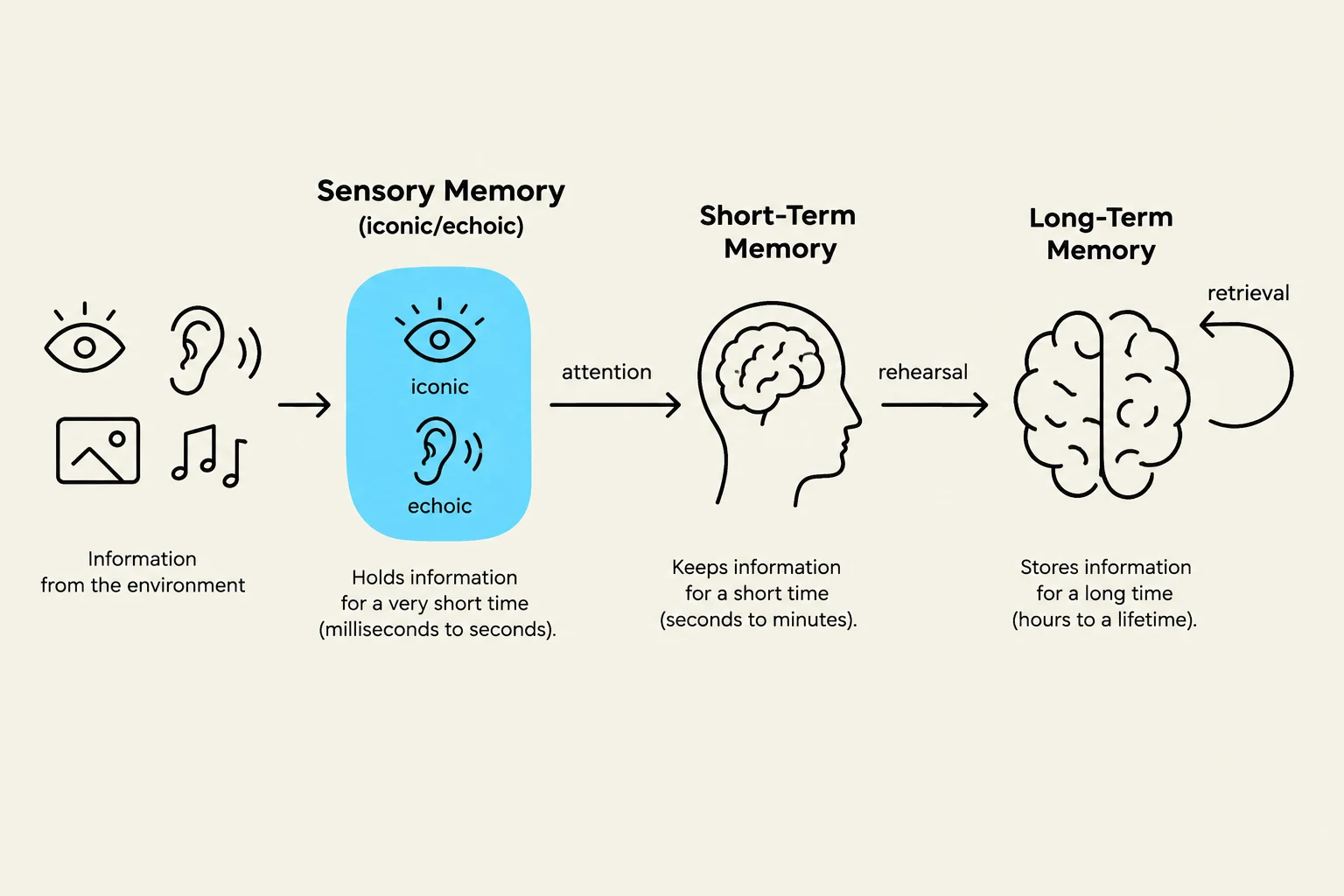
Sensory Memory: The immediate, very brief recording of sensory information. This includes iconic memory (visual) and echoic memory (auditory).
Short-Term/Working Memory: A limited-capacity stage used for active manipulation of information. While short-term memory is often cited as having a capacity of the "magic number" 7±2 items, working memory is a more complex system involving a central executive (the coordinator), a phonological loop (auditory info), and a visuospatial sketchpad (visual info).
Long-Term Memory: The relatively permanent and limitless storehouse of the memory system.
This diagram illustrates the three stages of memory: sensory memory, short-term memory, and long-term memory, detailing the flow of information and the duration each type of memory holds information.
Types of Long-Term Memory
Long-term memory is divided into two main categories:
Explicit (Declarative) Memory: Conscious memories of facts and events. This includes semantic memory (general knowledge/facts) and episodic memory (personal experiences/events).
Implicit (Non-declarative) Memory: Unconscious memories, such as procedural memory (skills like riding a bike).
The biological basis of memory involves neurogenesis (the creation of new neurons) and long-term potentiation (LTP), which strengthens the synaptic connections between neurons through repeated stimulation. Key brain regions involved include the hippocampus (forming new memories), the amygdala (emotional memories), the cerebellum (procedural memory), and the basal ganglia.
Encoding and Improving Memory
How we process information determines how well we remember it. Automatic processing handles trivial details without effort, while effortful processing requires conscious attention.
To move information into long-term storage, we use different types of rehearsal. Maintenance rehearsal involves simple repetition, which is often insufficient for deep learning. In contrast, elaborative rehearsal involves connecting new info to existing knowledge, leading to deep processing (semantic/meaning-based) rather than shallow processing (structural or phonemic).
Strategies for Success
To maximize retention, students should utilize:
Chunking: Organizing items into familiar, manageable units.
Mnemonics: Memory aids like the Method of Loci (associating items with physical locations).
The Spacing Effect: Using distributed practice (studying in short sessions over time) rather than massed practice (cramming).
The Testing Effect: The finding that actively retrieving information through self-testing is more effective than simply re-reading.
This illustration compares "Massed Practice" (cramming) with "Distributed Practice" (short, spaced-out sessions), highlighting differences in long-term recall, retention, mental effort, and overall effectiveness, concluding that distributed practice leads to better, longer-lasting learning.
Retrieval, Forgetting, and Memory Errors
Retrieving a memory is not like playing a video; it is a reconstructive process. Retrieval is influenced by the encoding specificity principle, which suggests that memory is improved when the conditions at retrieval match the conditions at encoding. This includes context-dependent memory (surroundings) and state-dependent memory (internal states like mood).
Why We Forget
Forgetting can happen at several stages:
Encoding Failure: The information never actually entered long-term memory.
Retrieval Failure: The info is there, but you can't access it (e.g., the tip-of-the-tongue phenomenon).
Interference:
Proactive interference: Old information hinders the recall of new information.
Retroactive interference: New information hinders the recall of old information.
Finally, our memories can be distorted. The misinformation effect occurs when misleading information is incorporated into a person's memory of an event. We also experience source amnesia (forgetting where we learned something) and imagination inflation (believing an imagined event actually occurred).
Summary Checklist for Students:
Did I use elaborative rehearsal to connect this to a schema?
Am I using distributed practice to avoid the forgetting curve?
Am I testing myself to leverage the testing effect?
Keep reading for free.
Create an account to finish this reading and make it part of your study routine.