Clinical Nutrition: Practice Settings, Team Roles, and the Nutrition Care Process
An overview of clinical nutrition, including its practice settings, the roles of healthcare professionals on the nutrition team, and the standardized Nutrition Care Process (NCP) used for patient care.
Clinical nutrition, often referred to as Medical Nutrition Therapy (MNT), is the practical application of food and nutrition science to prevent and treat disease. It involves medical interventions by healthcare professionals to impact both the physiological and mental health of clients. To provide high-quality care, practitioners must navigate diverse practice environments, collaborate within multidisciplinary teams, and follow a standardized, evidence-based framework known as the Nutrition Care Process (NCP).
Practice Settings in Clinical Nutrition
Clinical nutrition is not confined to a single environment; rather, it spans a wide spectrum of healthcare settings. These settings are generally categorized by the intensity and duration of care required by the patient.
Acute Care: High-intensity environments such as hospitals, including specialized units like the Intensive Care Unit (ICU), cardiology, oncology, neurology, and neonatal intensive care.
Chronic and Long-Term Care: Facilities designed for extended stays, such as long-term care (LTC) homes, rehabilitation centers, and palliative or supportive care centers.
Community and Outpatient Care: Settings focused on managing ongoing conditions or providing preventative care, including family health teams (FHTs), community health centers (CHCs), outpatient diabetes or cancer care centers, and private practice.
Home Care: Programs that bring nutritional support directly to the patient's residence.
This diagram illustrates the spectrum of clinical nutrition settings, ranging from highly specialized acute care to broader community and home-based care.
The Clinical Nutrition Team
Effective nutritional care is rarely a solo endeavor; it requires a multidisciplinary team where each member has specific responsibilities to ensure patient safety and optimal outcomes.
Team Roles and Responsibilities
The composition of the team can vary depending on the setting, but the following roles are standard in clinical environments:
Clinical Nutrition Manager: Focuses on the administrative and leadership aspects of the department. Responsibilities include hiring, training, and evaluating employees, developing policies and procedures, and managing departmental goals and productivity.
Registered Dietitian (RDN): The primary provider of nutrition therapy. RDs are trained to use the Nutrition Care Process (NCP) to perform assessments, develop diagnoses, implement interventions, and monitor/evaluate patient progress. In some jurisdictions, such as Ontario, RDs are regulated health professionals with specific legal scopes of practice.
Dietetic Technician (NDTR): Supports the RDN by gathering data for nutritional screening, assigning malnutrition risk levels based on established criteria, and administering dietary supplements.
Dietetic Assistant/Diet Clerk: Handles routine operational tasks, such as processing diet orders, distributing menus, and collecting food records to help evaluate nutrient intake.
Exam Tip: When distinguishing between the NDTR and the RDN, remember that the RDN is responsible for the high-level clinical decision-making (diagnosis and intervention design), while the NDTR focuses on data collection and implementation support.
Medical Problem Solving and Evidence-Based Practice
To provide safe and effective care, clinicians must engage in medical problem-solving, which is the ability to identify nutrition-related problems and select the most appropriate solutions. This process is underpinned by Evidence-Based Practice (EBP).
EBP is the integration of three core components:
Systematically reviewed scientific evidence.
Professional expertise and clinical judgment.
Client, customer, and community values.
Practitioners often rely on Clinical Practice Guidelines (CPG) to assist in decision-making. These are systematically developed statements based on scientific evidence designed to help practitioners and patients make decisions about specific clinical circumstances, such as the Diabetes Canada Clinical Practice Guidelines.
The Nutrition Care Process (NCP)
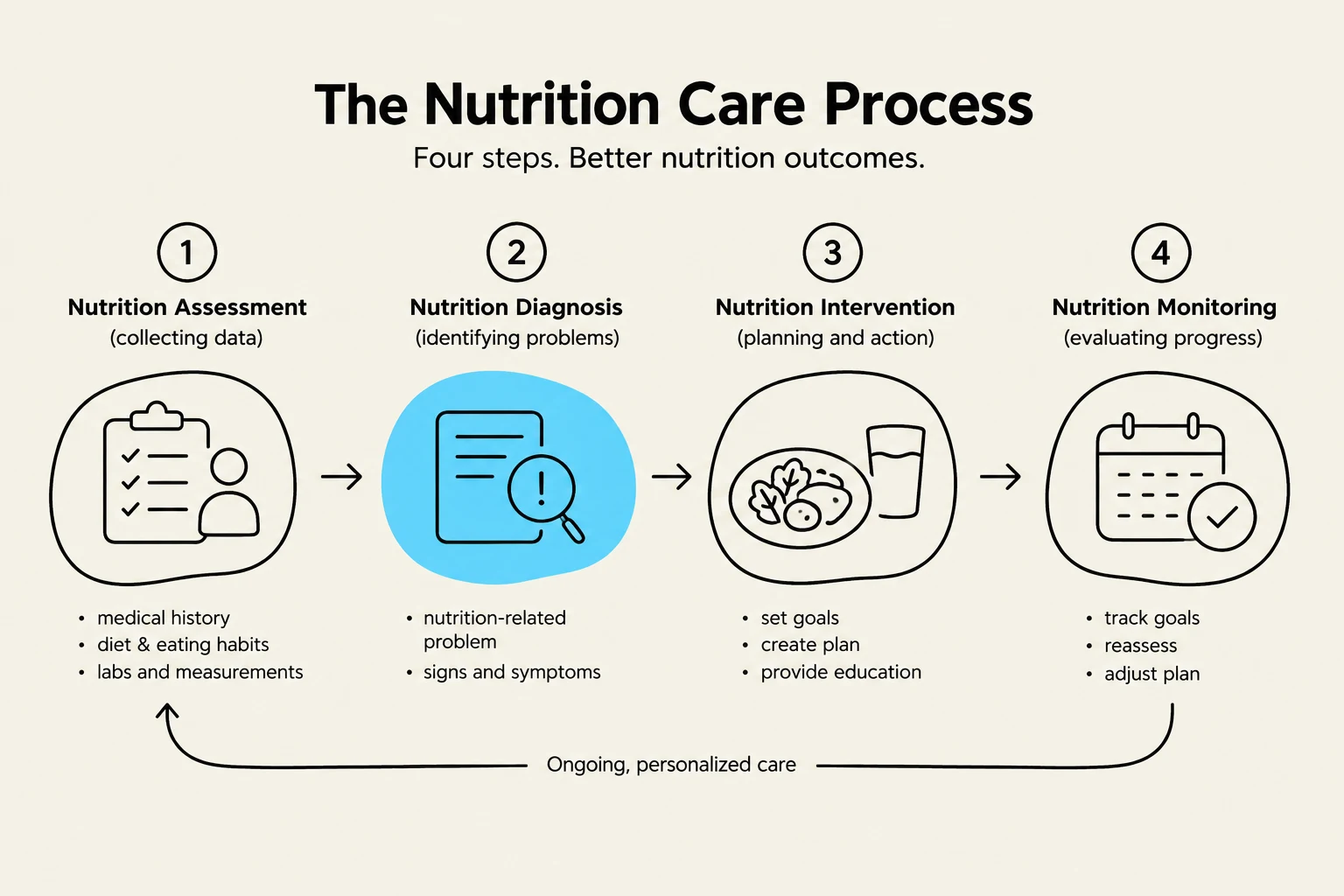
The Nutrition Care Process (NCP) is a standardized, four-step systematic method used to provide high-quality, consistent nutrition care. By using a consistent structure, the NCP guides critical thinking and ensures that the content of care is evidence-based.
The Nutrition Care Process outlines four steps: Nutrition Assessment, Nutrition Diagnosis, Nutrition Intervention, and Nutrition Monitoring, leading to better nutrition outcomes through ongoing, personalized care.
Step 1: Nutrition Assessment
The first step involves obtaining and verifying appropriate data to identify nutrition-related problems. Data is typically clustered into several categories:
Unlike a medical diagnosis, a nutrition diagnosis describes a specific nutrition issue that a dietetics practitioner can treat through nutritional interventions. It serves as the direct link between assessment and intervention.
Nutrition diagnoses are often documented using the PES Statement format:
P (Problem): The diagnostic label describing the alteration in nutritional status.
E (Etiology): The underlying cause or contributing factor.
S (Signs and Symptoms): The objective or subjective evidence that confirms the problem.
The format is expressed as:
Problem (P) related to Etiology (E) as evidenced by Signs/Symptoms (S)
Step 3: Nutrition Intervention
Once the diagnosis is established, the practitioner prioritizes the diagnoses and develops a plan of action. This includes:
Writing a nutrition prescription.
Setting measurable goals.
Selecting and implementing specific interventions (e.g., dietary changes, education, or nutrition support like enteral/parenteral feeding).
Step 4: Nutrition Monitoring and Evaluation
The final step is to assess the patient's progress toward the established goals. This involves measuring outcomes—such as clinical status or patient-centered outcomes—and comparing them against reference standards. Based on this evaluation, the practitioner decides whether to continue, adjust, or discharge the patient from nutrition care.
Standardized Nutrition Language
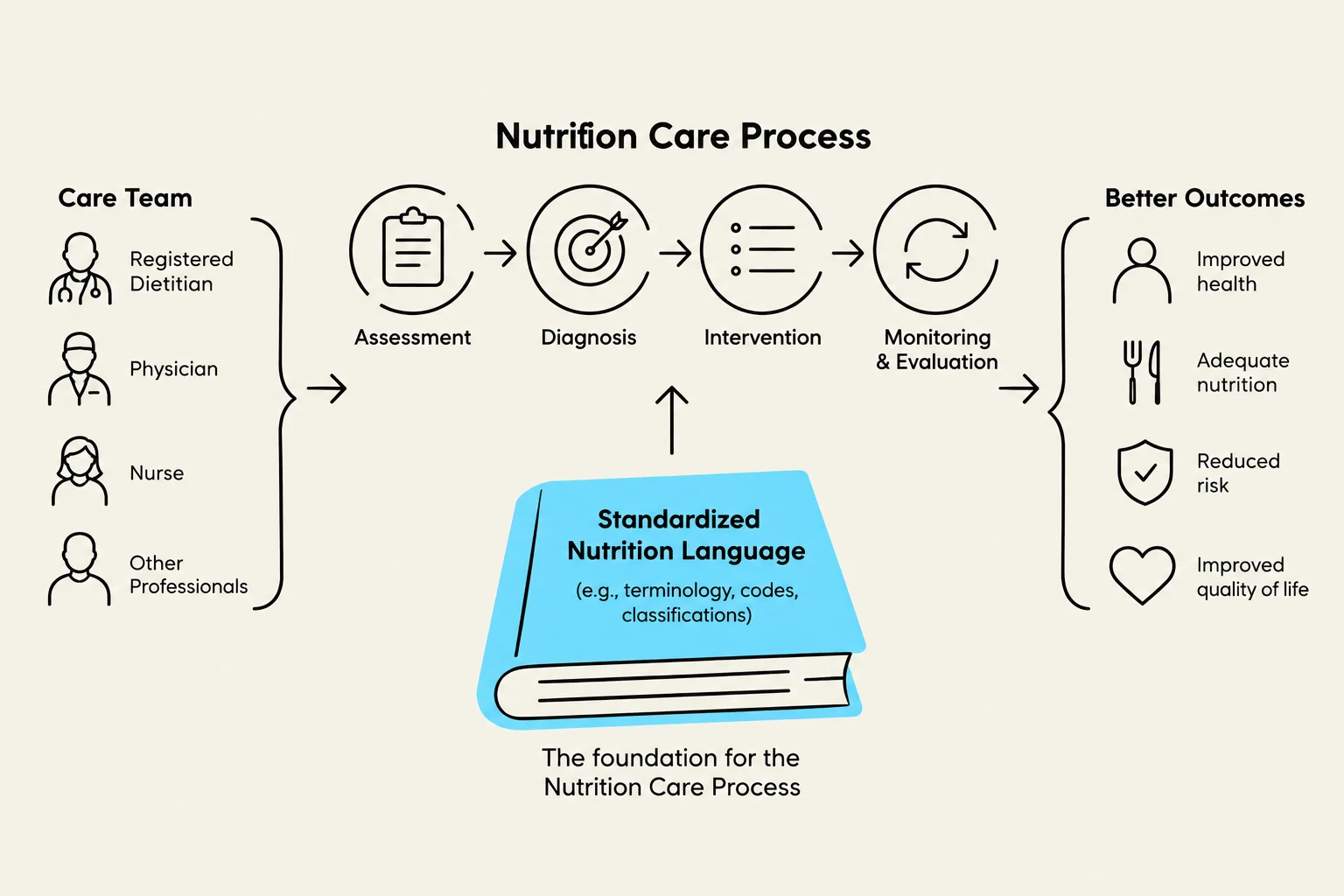
A critical component that supports the entire NCP is the use of standardized nutrition language. This refers to a uniform terminology used to describe professional practice.
Standardization provides several benefits:
Consistent Documentation: Ensures that different practitioners record information in the same way.
Clear Communication: Facilitates seamless information exchange among the multidisciplinary healthcare team.
Improved Quality of Care: By providing a common language, it reduces errors and ensures the content and process of care remain high-quality.
The Nutrition Care Process outlines the steps involved in providing nutrition care, including assessment, diagnosis, intervention, and monitoring & evaluation. It is supported by a standardized nutrition language and leads to better outcomes such as improved health and reduced risk.
Keep reading for free.
Create an account to finish this reading and make it part of your study routine.