This guide explains the integration of the Clinical Judgment Measurement Model (CJMM) with the nursing process, covering assessment, analysis, planning, implementation, and evaluation for safe and effective patient care, particularly in pharmacology.
In the high-stakes environment of clinical nursing, particularly regarding pharmacology, a nurse's ability to make safe, rapid, and accurate decisions is paramount. While many students focus on the mechanical task of drug administration, true nursing excellence lies in the cognitive processes that precede the needle or the pill. To master this, one must understand the interplay between the traditional Nursing Process and the Clinical Judgment Measurement Model (CJMM). Together, these frameworks ensure that care is not merely a series of tasks, but a scientific, patient-centered approach to health and safety.
The Frameworks: Nursing Process vs. CJMM
To understand how a nurse thinks, we must distinguish between the "what" and the "how."
The Nursing Process is a systematic, rational method used to deliver prioritized patient care. It provides the structural workflow: Assessment, Analysis, Planning, Implementation, and Evaluation.
The Clinical Judgment Measurement Model (CJMM), developed by the NCSBN, focuses on the cognitive skills required to navigate complex scenarios. While the nursing process provides the roadmap, the CJMM describes the mental engine driving the nurse through that map. The NCSBN defines clinical judgment as the observed outcome of critical thinking and decision-making.
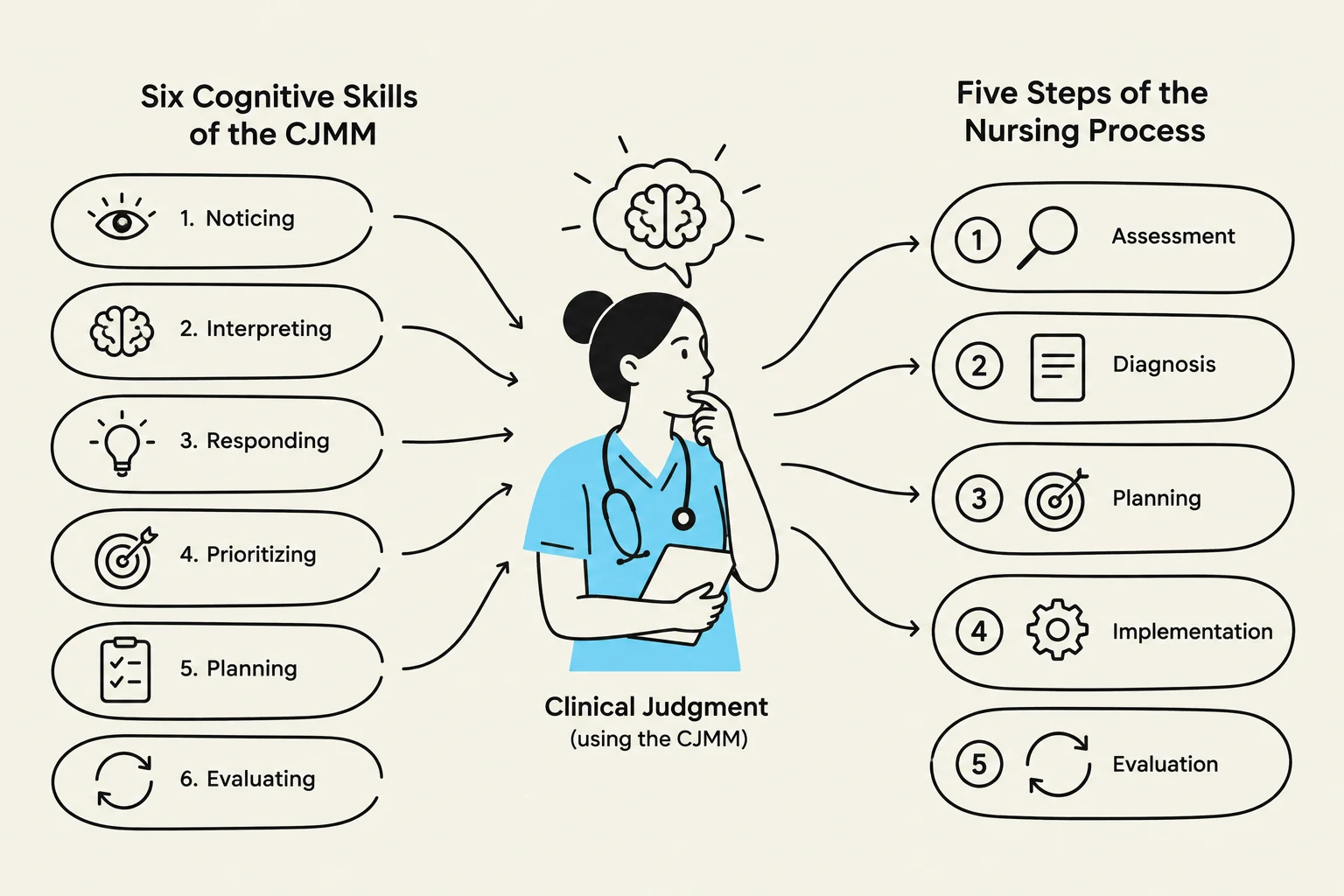
The relationship between these two is best understood by mapping the six cognitive skills of the CJMM directly onto the five steps of the nursing process:
This diagram illustrates the six cognitive skills of the CJMM (Clinical Judgment Measurement Model) and the five steps of the nursing process: Assessment, Diagnosis, Planning, Implementation, and Evaluation.
Step 1: Recognize Cues [Assessment]
The foundation of all clinical care is the collection of data. In the CJMM, this is known as Recognizing Cues. During the Assessment phase of the nursing process, the nurse gathers information that will form the basis of the entire plan of care.
Data is categorized into two distinct types:
Subjective Data: Information verbalized by the patient, family, or friends. These are "imperceptible" to the nurse's senses and must be communicated by the patient, such as reports of pain, nausea, or lifestyle habits like tobacco use.
Objective Data: Observable and measurable facts collected through the nurse's senses (seeing, hearing, smelling, touching). Examples include vital signs, laboratory results, physical assessment findings, and even the patient's body language.
A critical component of this stage, especially in pharmacology, is medication reconciliation. This involves reviewing a patient's new drug orders and comparing them to the medications they were taking at home to prevent errors such as omission, duplication, or dangerous drug interactions.
Student Tip: When answering NCLEX-style questions, distinguish between "subjective" (what they say) and "objective" (what you see/measure). If a patient says, "I feel dizzy," that is subjective. If you observe the patient swaying while standing, that is objective.
Step 2 & 3: Analyze Cues and Prioritize Hypothesis [Analysis]
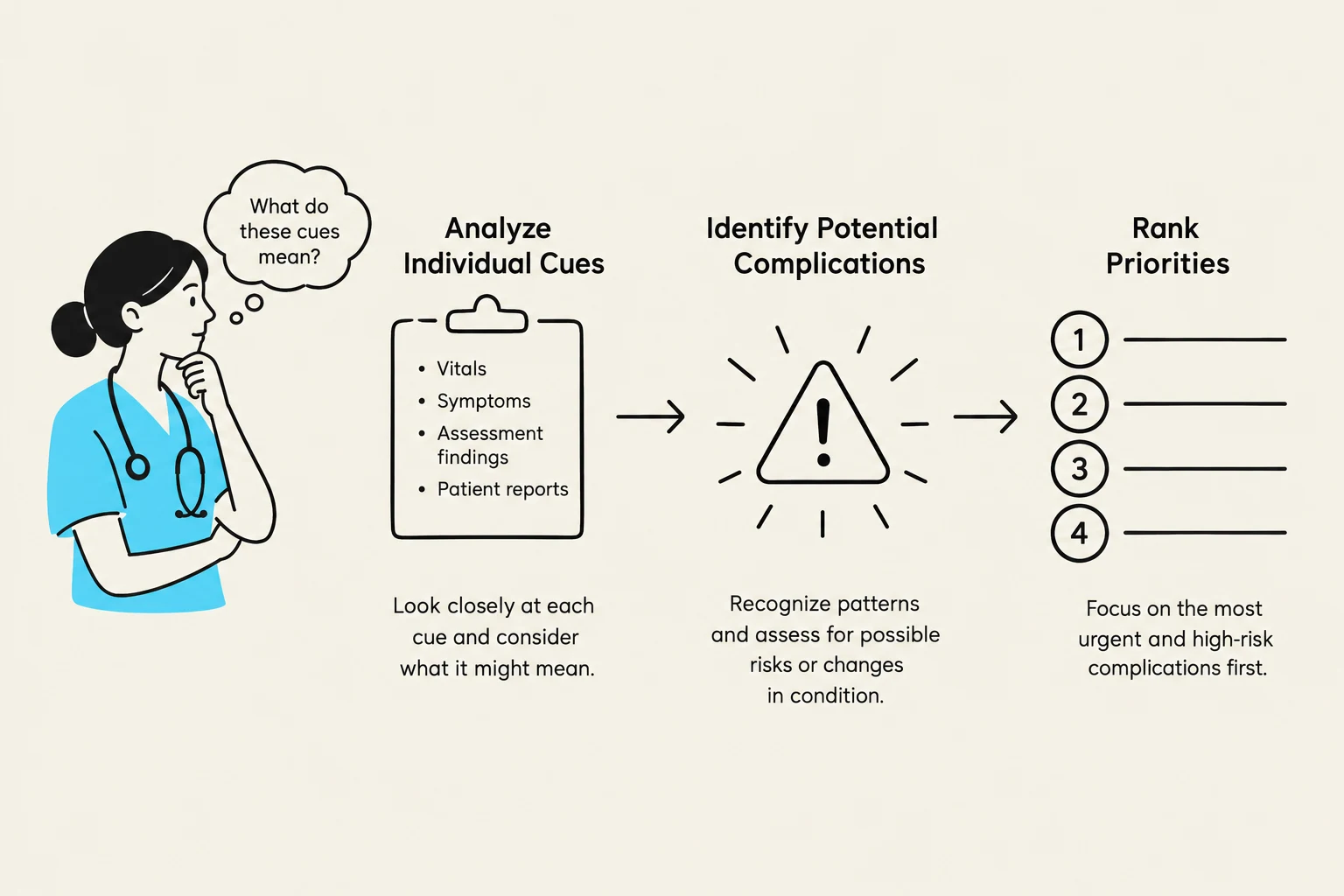
Once cues are gathered, the nurse enters the Analysis phase. This is broken into two cognitive movements: Analyzing Cues and Prioritizing Hypotheses.
Analyzing Cues involves interpreting the facts. The nurse asks, "How do these cues relate to the patient's condition or history?". For example, if a patient is prescribed a nephrotoxic drug, the nurse must analyze whether the patient's current creatinine clearance levels are appropriate.
Prioritizing Hypotheses is where the nurse organizes and ranks the identified patient problems. Unlike the "disease-centered" model which focuses on a medical diagnosis, the nursing model is "patient-centered," focusing on specific problems like nonadherence, knowledge deficits, or confusion.
When ranking problems, nurses use several criteria:
Acuity and Urgency: Which problem will kill or harm the patient first?
Risk and Likelihood: How likely is a complication to occur?
Difficulty: How complex is the intervention required?
This diagram illustrates a four-step process for analyzing patient cues, identifying potential complications, and ranking priorities in a medical context. The steps include analyzing individual cues such as vitals, symptoms, assessment findings, and patient reports; identifying potential complications by recognizing patterns and assessing risks; and finally, ranking priorities by focusing on the most urgent and high-risk complications first.
Step 4: Generate Solutions [Planning]
With a prioritized list of problems, the nurse moves to the Planning phase to Generate Solutions. This involves developing expected outcomes and evidence-based interventions.
An effective expected outcome is not a vague wish; it must be a specific, measurable goal. To be successful, an outcome must be:
Realistic and Measurable: It must be something you can actually prove happened.
Patient-Centered: It must be acceptable to the patient and dependent on their decision-making ability.
Time-Bound: It must include a specific timeframe for achievement.
Example of a Poor Outcome: "The patient will understand how to take insulin." (Not measurable).
Example of a Strong Outcome: "The patient will independently administer the prescribed dose of 4 units of regular insulin by the end of the fourth session of instruction".
Step 5: Take Action [Implementation]
The Implementation phase is where the nurse performs the actual interventions, such as medication administration and patient education.
Medication Administration
Nurses are the "first line of defense" against drug errors. Because approximately 40% of a nurse's time is spent on medication administration, mastery of this task is essential for safety.
Patient Education
Successful teaching is more than just handing out a pamphlet. To ensure effective education, the nurse must assess:
Health Literacy: The patient's ability to read, write, and communicate.
Readiness to Learn: Factors like pain, fatigue, or environmental noise can act as barriers.
Cultural Needs: Language barriers may require a professional interpreter rather than a family member.
A gold-standard strategy for confirming learning is the "teach-back" method or a return demonstration. For example, if teaching a patient how to use an inhaler, the nurse should ask the patient to perform the action themselves to confirm they have mastered the skill.
Step 6: Evaluate Outcomes [Evaluation]
The final stage of the nursing process is Evaluation. The nurse assesses whether the interventions were effective and if the expected outcomes were met.
This is a continuous loop. If the patient's condition has improved, the nurse documents the success. However, if the expected outcomes were not met (e.g., the patient still cannot demonstrate insulin administration), the nurse must not simply "try again" blindly. Instead, the nurse must revise the plan of care. This might mean changing the teaching method, addressing a new barrier like pain, or adjusting the timing of the intervention.
Summary Table: Integration of Models
Nursing Process Step
CJMM Cognitive Skill
Clinical Action Example
Assessment
Recognize Cues
Collecting BP, heart rate, and patient reports of pain.
Analysis
Analyze Cues & Prioritize Hypothesis
Determining that a high heart rate is related to pain and ranking it as the priority.
Planning
Generate Solutions
Setting a goal: "Pain score will be <3 within 30 mins of medication".
Implementation
Take Action
Administering the analgesic and providing education on side effects.
Evaluation
Evaluate Outcomes
Re-assessing pain 30 minutes later to see if the goal was met.
By synthesizing these models, nurses move beyond simple task completion to provide holistic, safe, and effective pharmacological and clinical care.
Keep reading for free.
Create an account to finish this reading and make it part of your study routine.