An overview of clinical judgment, clinical reasoning, and the nursing process (ADPIE), including critical thinking attitudes and the Clinical Judgment Measurement Model (CJMM).
In the fast-paced environment of healthcare, a nurse's ability to think clearly under pressure is what ensures patient safety. Nursing is not merely a series of tasks; it is a continuous cycle of observing, analyzing, and acting. To do this effectively, nurses rely on a sophisticated interplay of critical thinking, clinical reasoning, and clinical judgment. Understanding how these concepts connect to the systematic Nursing Process is essential for any student preparing for professional practice and the Next Generation NCLEX-RN.
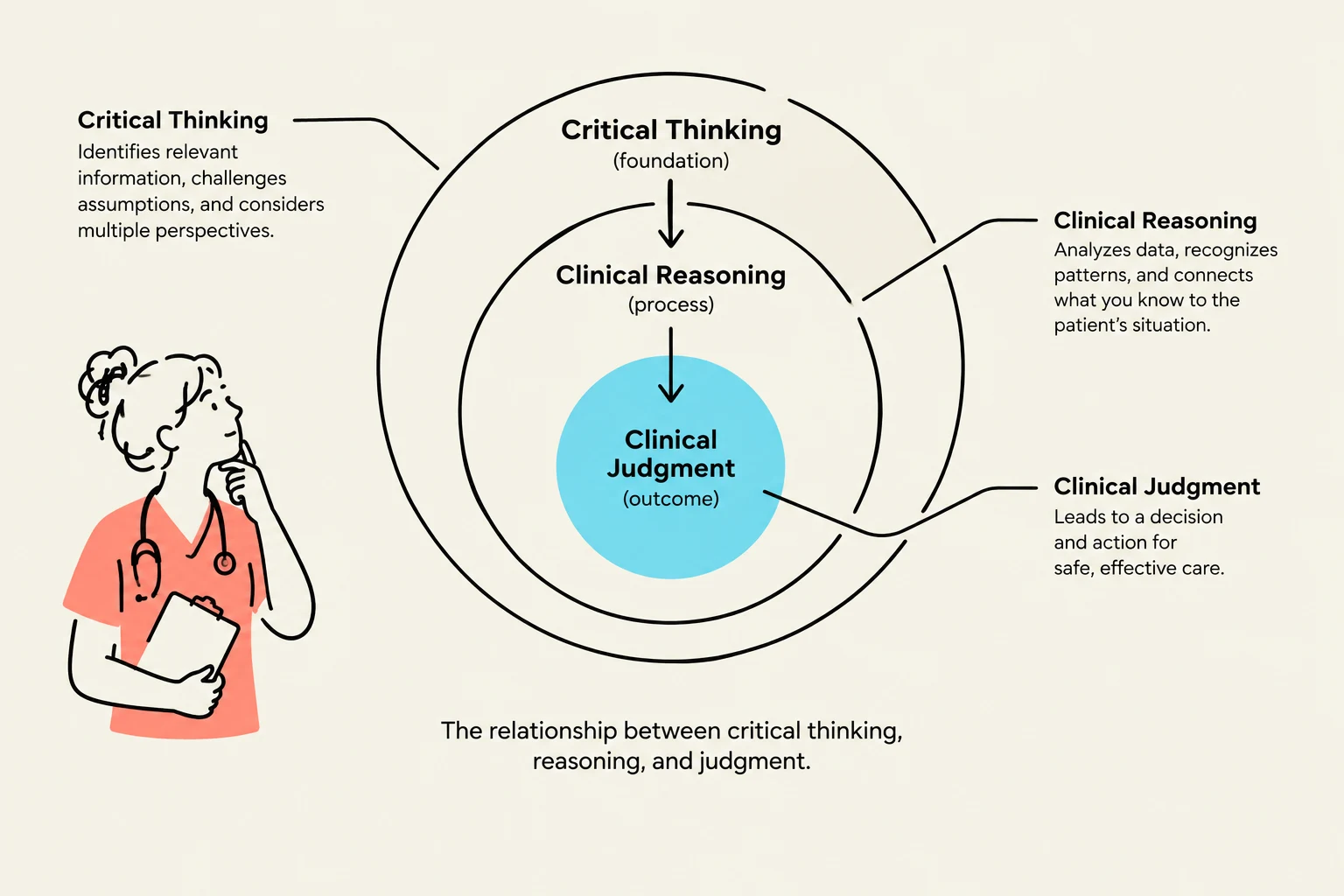
This diagram illustrates the relationship between critical thinking, clinical reasoning, and clinical judgment, showing how critical thinking forms the foundation for clinical reasoning, which in turn leads to clinical judgment as an outcome.
The Foundations: Thinking, Reasoning, and Judgment
While often used interchangeably, these three terms represent distinct stages of the cognitive process.
Critical Thinking: This is the foundational ability to recognize that an issue exists, analyze the information related to it, evaluate that information, and draw conclusions.
Clinical Reasoning: This is the specific thinking process used by healthcare professionals to assess, analyze, and make decisions regarding a patient's care. It is the "how" behind the decision-making.
Clinical Judgment: This is the final decision or outcome made by the nurse after the clinical reasoning process is complete.
A vital component of this process is situational awareness—the ability to be aware of what is happening around you, understand how those events affect the current situation, and anticipate what might happen next.
Clinical Tip: The "Gut Feeling"
Nurses often experience intuition, an inner sensing or "gut feeling". While intuition is valuable, you should always respect it by increasing your frequency of observation and searching for physical cues to verify that feeling.
Critical Thinking Attitudes
To move from basic task completion to advanced clinical judgment, nurses must adopt specific attitudes:
Curiosity: Constantly asking "why" and "what else" (e.g., "Why is this patient's heart rate elevated? Is it pain, or are they dehydrated?").
Perseverance: Staying engaged even when data is confusing and avoiding premature conclusions.
Fairness: Treating all information objectively and avoiding biases based on a patient's age, background, or history.
Creativity: Thinking flexibly and adapting interventions to meet unique needs, such as modifying education for a patient with low health literacy.
Willingness (Risk Taking): The courage to speak up about safety concerns or call a provider when something "just doesn't feel right".
The Clinical Judgment Measurement Model (CJMM)
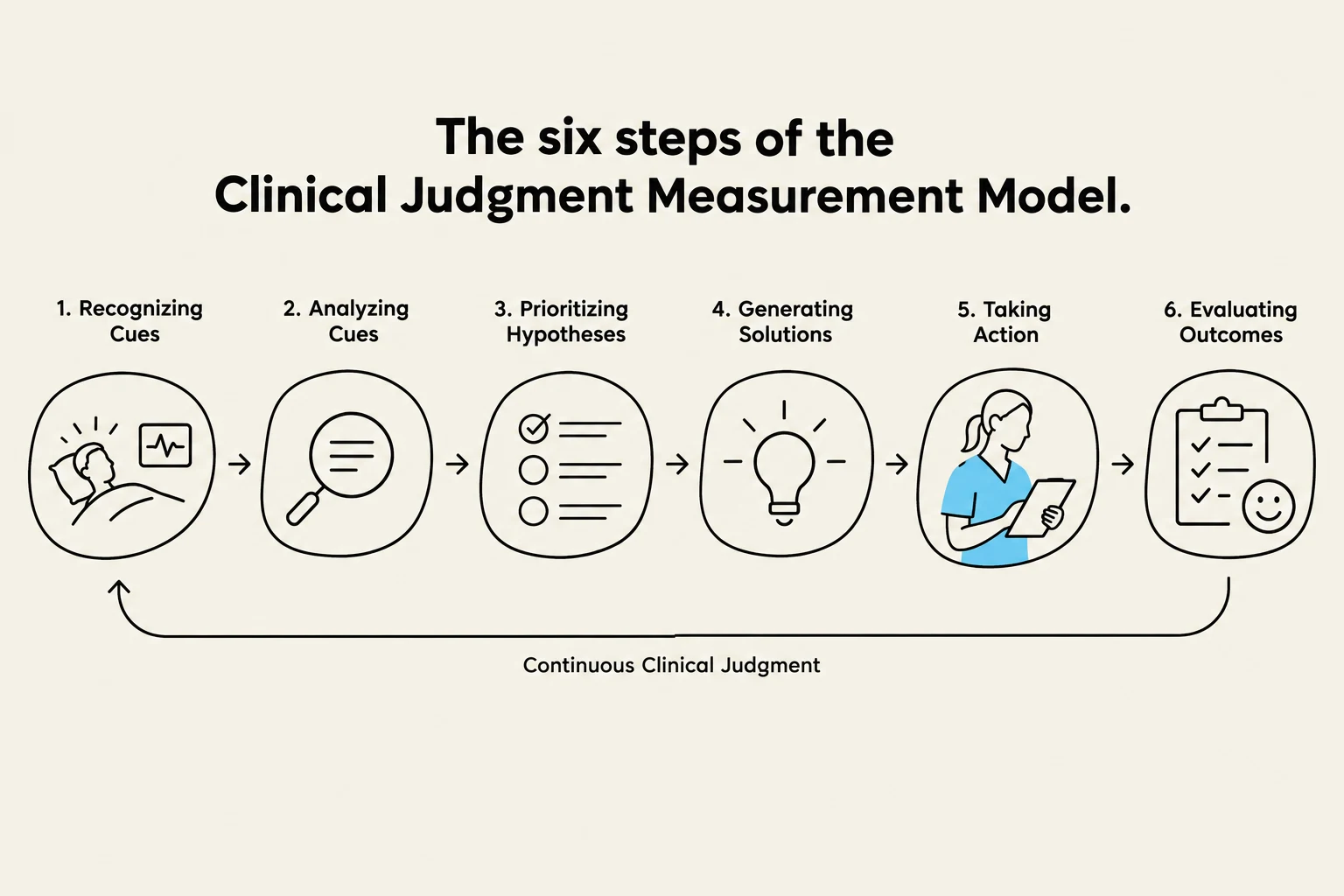
The six steps of the Clinical Judgment Measurement Model: Recognizing Cues, Analyzing Cues, Prioritizing Hypotheses, Generating Solutions, Taking Action, and Evaluating Outcomes, with Continuous Clinical Judgment.
The National Council of State Boards of Nursing (NCSBN) developed the Clinical Judgment Measurement Model (CJMM) to define and measure how nurses use judgment in practice. This model is the foundation of the Next Generation NCLEX-RN. The CJMM breaks the complex process of decision-making into six measurable, connected skills:
Recognizing Cues: Identifying relevant data.
Analyzing Cues: Connecting findings to determine what is happening.
Prioritizing Hypotheses: Deciding which problem is the most urgent.
Generating Solutions: Determining what can be done to help.
Taking Action: Implementing the chosen intervention.
Evaluating Outcomes: Determining if the action worked.
The Nursing Process (ADPIE)
The Nursing Process is the systematic framework used to apply critical thinking to patient care. It utilizes a mental model—an organized way of thinking—to help the nurse navigate complex situations.
1. Assessment
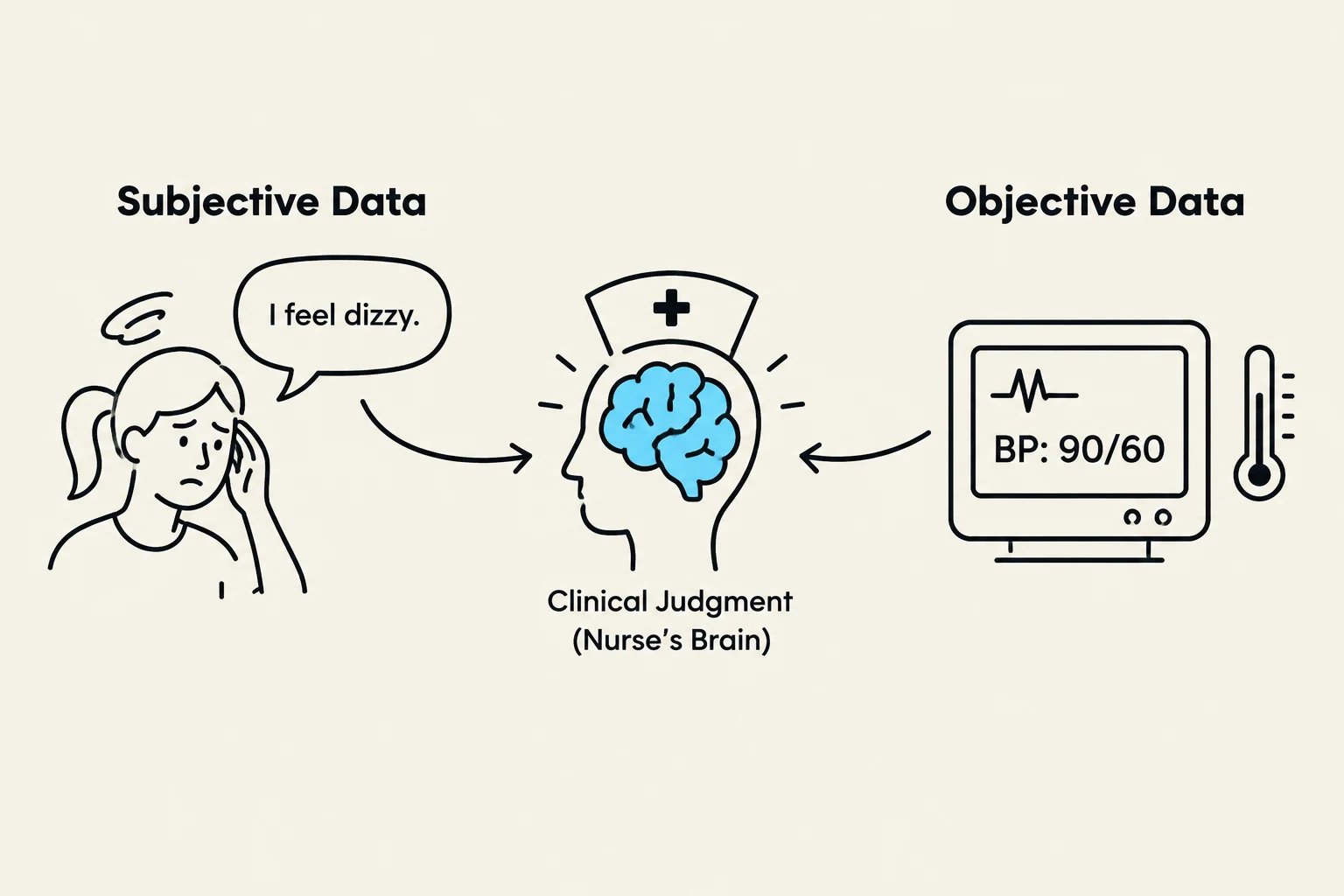
This diagram illustrates the process of clinical judgment, differentiating between subjective data (patient's reported symptoms like dizziness) and objective data (measurable vital signs such as blood pressure) that a nurse uses to make informed decisions.
Assessment is the systematic and ongoing collection, analysis, validation, and communication of patient data. Data is categorized into two types:
Subjective Data: Information perceived only by the affected person (e.g., "I feel dizzy" or "My pain is a 6/10").
Objective Data: Observable and measurable data (e.g., blood pressure, skin moisture, or a visible wound).
Nurses perform different types of assessments based on the clinical need:
Initial Assessment: Performed shortly after admission to establish a complete baseline database.
Focused Assessment: A problem-specific approach used to gather data about a specific, already identified issue.
Triage: A screening assessment used to determine the severity of problems and recommend appropriate follow-up.
The Nursing History is a key part of the assessment, often obtained through a patient interview. This interview typically follows four phases: Preparatory (reviewing the chart), Introduction/Orientation (building rapport), Working (collecting data), and Termination (closing the interview).
2. Diagnosis / Problem Identification
In this phase, the nurse identifies how the patient responds to health conditions. Note that a nursing diagnosis is different from a medical diagnosis; while a doctor diagnoses a disease (e.g., hypertension), a nurse diagnoses the human response (e.g., risk for falls).
A complete nursing diagnosis includes the problem, the etiology (the contributing factors or underlying causes), and the signs/symptoms. There are three main types:
Problem-focused: An actual, undesirable response (e.g., Acute Pain).
Risk: A vulnerability to developing a problem (e.g., Risk for Hemorrhage).
Health Promotion: Motivation to increase well-being (e.g., Readiness for Enhanced Knowledge).
3. Planning
During planning, the nurse establishes priorities and identifies expected patient outcomes and interventions. When prioritizing, nurses often use Maslow’s Hierarchy of Needs or the ABCs (Airway, Breathing, Circulation).
Exam Tip: Prioritization
If a patient is in respiratory distress, that is a high priority because it threatens physiological stability. A "disturbed personal identity" or "risk for powerlessness" would be considered lower priorities compared to an airway issue.
4. Implementation
Implementation is the "taking action" phase. Interventions can be:
Nurse-initiated (Independent): Actions the nurse can take autonomously (e.g., repositioning a patient).
Physician-initiated (Dependent): Actions requiring a doctor's order (e.g., administering medication).
Collaborative: Treatments initiated by other providers, like a dietitian, but carried out by the nurse.
5. Evaluation
The final step is determining if the interventions were successful. The nurse compares the patient's current status against the expected outcomes. Outcomes can be cognitive (knowledge), psychomotor (skills), affective (values/attitudes), or physiologic (physical changes).
If the outcome was met, the care plan may be terminated. If not, the nurse must modify the plan, change interventions, or adjust the diagnosis.
Synthesizing Knowledge: Concept Maps
To manage complex patients, nurses use tools like concept maps. A concept map is a visual representation of the meaningful relationships between assessment data, nursing diagnoses, and interventions. While a standard written plan of care guides daily tasks, a concept map acts as a "visual roadmap" that helps the nurse see how one problem (like impaired mobility) might lead to another (like skin breakdown).
Keep reading for free.
Create an account to finish this reading and make it part of your study routine.