Clinical Impression vs. Medical Diagnosis: Understanding Healthcare Provider Roles
This content explains the critical distinction between a clinical impression and a medical diagnosis in healthcare. It details how a clinical impression serves as a working hypothesis guiding immediate actions, while a medical diagnosis is a definitive conclusion based on further testing. The explanation also covers ho
In the fast-paced environment of clinical practice, healthcare providers must constantly weigh evidence to make decisions. One of the most critical distinctions a practitioner must master—especially when navigating the boundaries of their scope of practice—is the difference between a clinical impression and a medical diagnosis. While these terms are often used interchangeably in casual conversation, they represent two distinct stages of the clinical reasoning process. Understanding this distinction is not just a matter of semantics; it is a fundamental requirement for legal documentation, patient safety, and professional accountability.
The Clinical Impression: The Working Hypothesis
A clinical impression is the provider's professional judgment based on the immediate data gathered during a patient encounter. It represents the "strongest hypothesis" at a specific moment in time. When you perform a physical exam, listen to a patient's history, and observe their presenting symptoms, you are synthesizing that information into a preliminary conclusion.
A clinical impression is inherently provisional. It is an educated guess that acknowledges the limitations of the current information. For example, if a patient presents with acute chest pain, shortness of breath, and diaphoresis, a clinician might form a clinical impression of "acute coronary syndrome." This is not a definitive statement of fact, but rather a direction that dictates the next steps in care, such as ordering an EKG or troponin levels.
Exam Tip: If a question asks for the "initial assessment" or "preliminary conclusion" based on physical findings alone, it is likely looking for a clinical impression rather than a definitive diagnosis.
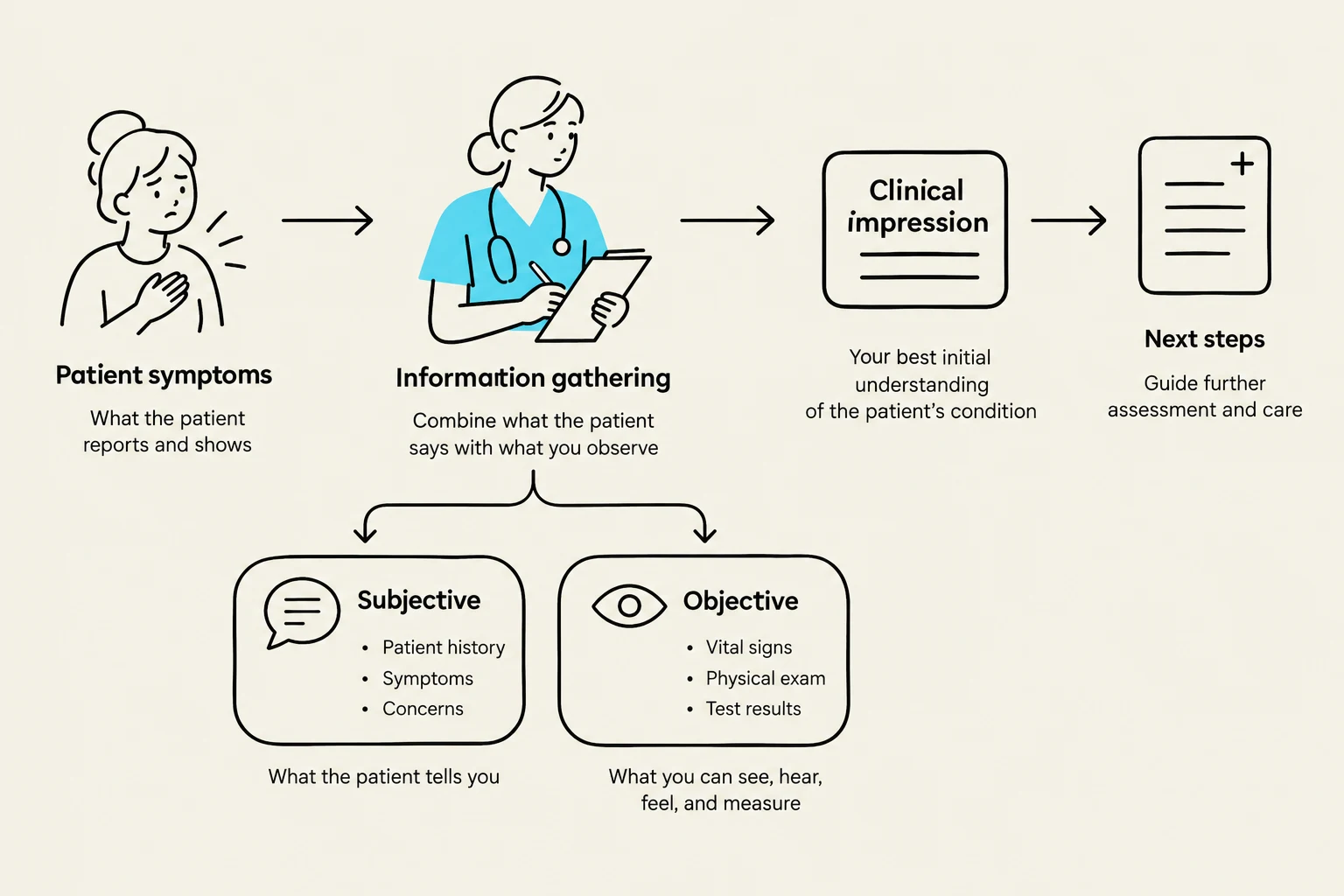
This diagram illustrates the process of information gathering in a clinical setting, distinguishing between subjective patient-reported information and objective findings.
The Medical Diagnosis: The Definitive Conclusion
A medical diagnosis is a much more rigorous and formal determination. It is the identification of a specific disease, condition, or injury that explains the patient's symptoms and signs. Unlike an impression, a diagnosis is typically reached after the clinical impression has been tested against objective data, such as laboratory results, imaging studies, or biopsy reports.
The diagnosis serves as the "gold standard" for the patient's condition. It is the foundation upon which a definitive treatment plan is built and is the term used for billing, coding, and long-term medical record-keeping. While a clinical impression tells you where you think the problem lies, the diagnosis tells you exactly what the problem is.
Feature
Clinical Impression
Medical Diagnosis
Nature
Provisional / Hypothesis
Definitive / Conclusion
Basis
History, Physical Exam, Observation
Lab tests, Imaging, Pathological evidence
Certainty
Moderate to Low
High
Purpose
Guides immediate next steps/testing
Guides definitive treatment and billing
Navigating Scope of Practice
The distinction between these two concepts becomes legally and professionally significant when considering a provider's scope of practice. Every healthcare professional—whether a nurse practitioner, physician assistant, respiratory therapist, or paramedic—operates within a defined set of permissions regulated by their licensing board.
In many jurisdictions and clinical settings, there is a subtle but vital boundary regarding who can "diagnose."
The Clinical Impression as a Tool for All: Almost all clinicians, regardless of their level of licensure, are trained to form clinical impressions. This is a vital part of the assessment process that allows a provider to stabilize a patient or determine if a referral is necessary.
The Diagnosis as a Regulated Act: The authority to provide a formal medical diagnosis is often restricted to specific providers (such as MDs, DOs, or certain advanced practice providers depending on state law).
If a provider is working at the edge of their scope, they may use the clinical impression to justify their interventions while deferring the formal diagnosis to a collaborator or a specialist. For instance, a paramedic in the field may have a clinical impression of "acute asthma exacerbation" to justify administering a nebulizer treatment, even if they do not formally "diagnose" the patient in the legal sense of a permanent medical record.
This diagram illustrates the process of clinical diagnosis, starting from patient assessment and data collection, moving through clinical impression and differential diagnosis, to a final diagnosis.
A Worked Example: The Path to Certainty
To see how these concepts interact in a real-world scenario, let's follow a single patient case:
Step 1: The Presentation
A 55-year-old male presents to an urgent care clinic complaining of sharp right-sided abdominal pain and fever.
Step 2: The Clinical Impression
The provider performs a physical exam and notes guarding and rebound tenderness in the right lower quadrant. Based on this, the provider forms a clinical impression of "acute appendicitis." This impression is used to justify an immediate order for an abdominal CT scan and to keep the patient NPO (nothing by mouth).
Step 3: The Diagnostic Evidence
The CT scan results return, showing significant inflammation and a thickened wall of the appendix.
Step 4: The Medical Diagnosis
With the imaging confirmed, the provider can now move from an impression to a formal medical diagnosis of "acute appendicitis." This diagnosis is then used to facilitate surgical consultation and for insurance reimbursement.
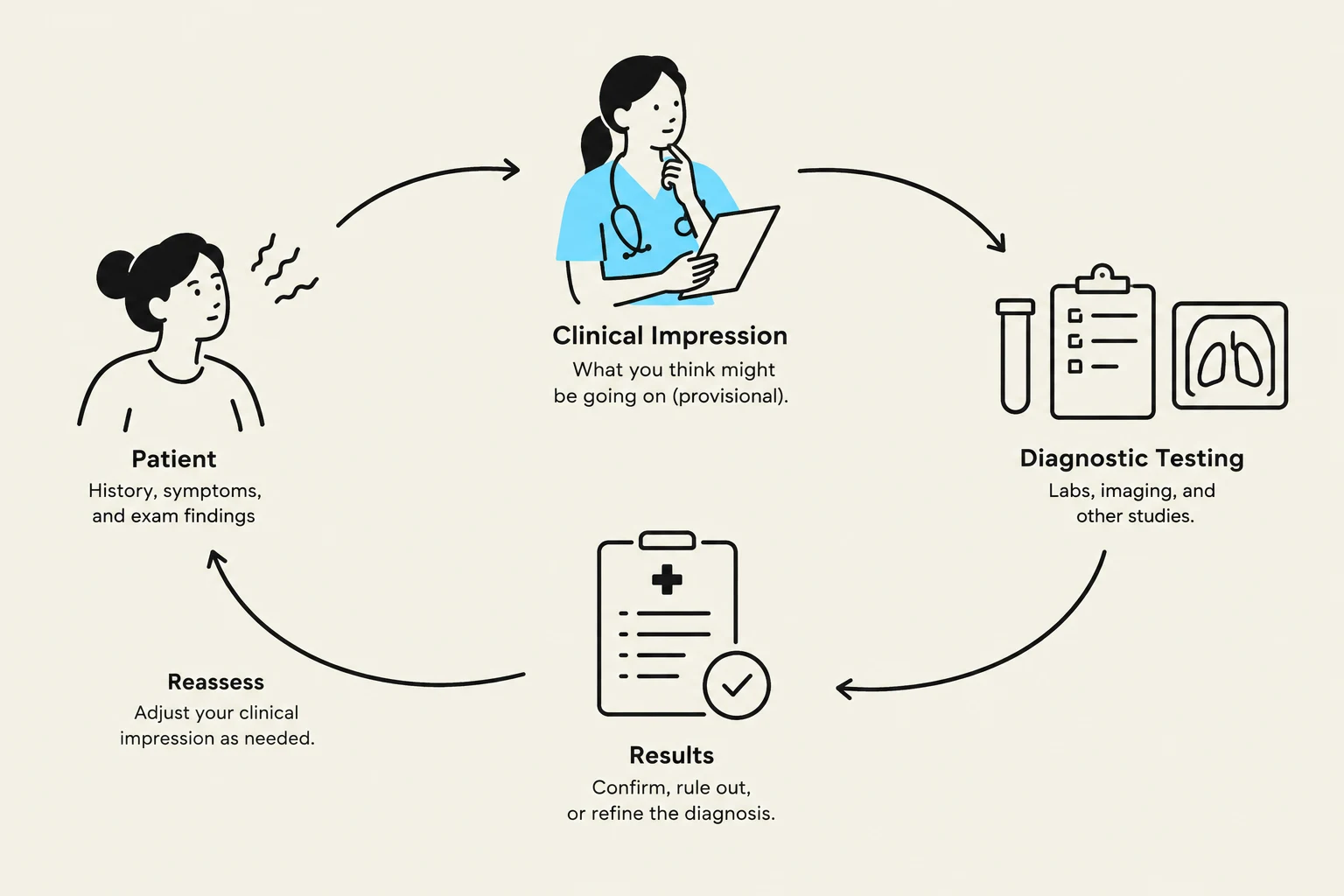
This diagram illustrates the diagnostic process in healthcare, starting with patient information, leading to a clinical impression, followed by diagnostic testing, and finally results that inform reassessment.
Summary of Key Differences
To ensure you are applying these concepts correctly in clinical practice and on examinations, remember the following relationship:
The clinical impression is the starting point of the investigative journey, while the diagnosis is the destination. Mastering this distinction allows you to communicate effectively with your healthcare team, document your findings accurately, and remain strictly within the bounds of your professional scope.
Keep reading for free.
Create an account to finish this reading and make it part of your study routine.