| Feature | Delirium | Dementia | Psychiatric Illness |
|---|
| Onset | Acute (hours to days) | Chronic (years) | Variable |
| Course | Fluctuating | Progressive | Stable/Episodic |
| Attention/Arousal | Impaired | Intact | Intact |
In dementia, the decline is slow and progressive, and the patient's ability to maintain attention and arousal remains relatively intact until very late stages. In contrast, delirium is marked by an immediate change in the ability to focus or shift attention.
Causes and Risk Factors
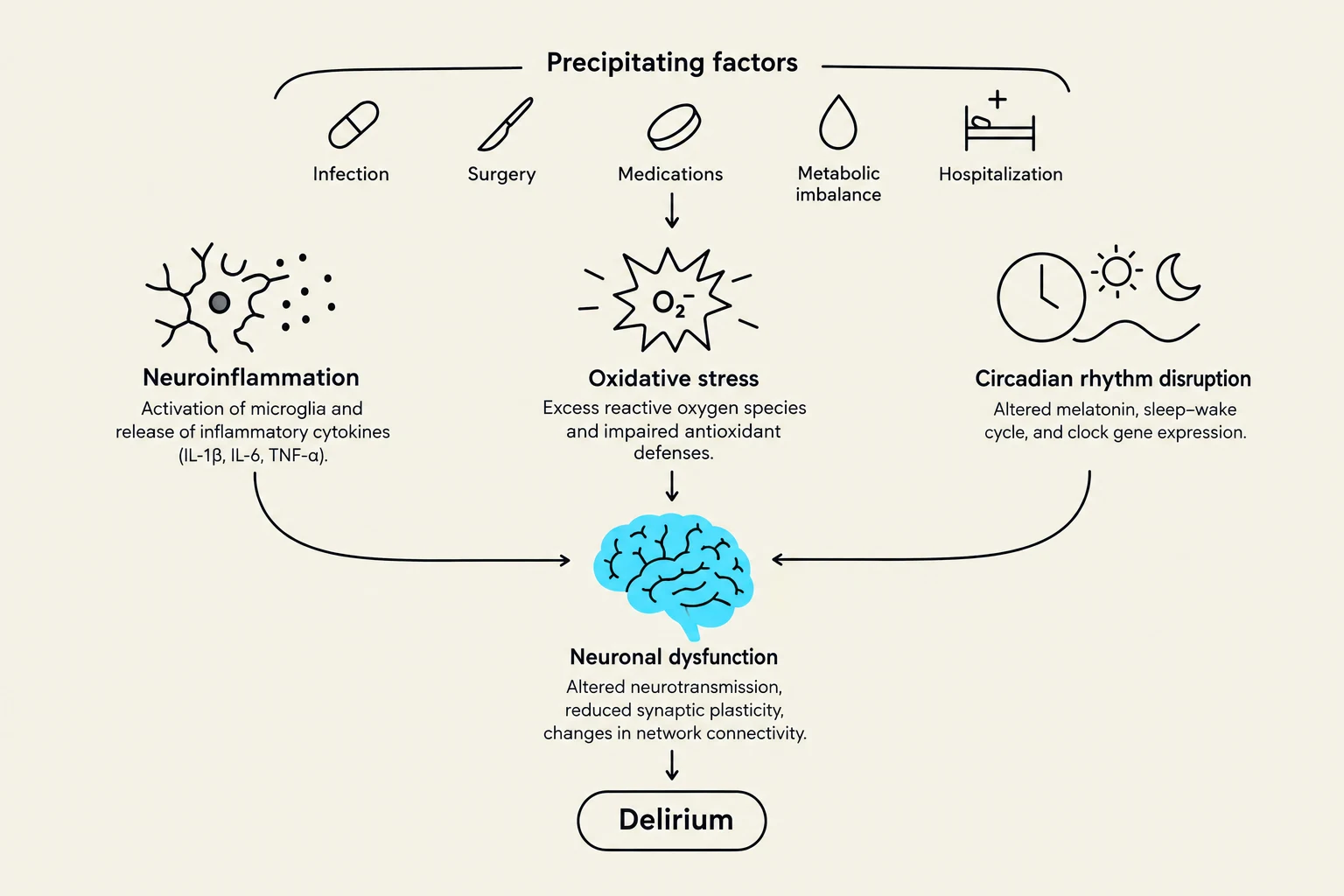
To manage delirium, you must identify the underlying driver. Clinicians often use the mnemonic I WATCH DEATH to categorize potential causes:
- Infection
- Withdrawal
- Acute metabolic disturbance
- Trauma or pain
- CNS pathology
- Hypoxia
- Deficiencies (e.g., B12, thiamine)
- Endocrinopathies
- Acute vascular events
- Toxins or drugs
- Heavy metals
Broad risk factors can be remembered via the DELIRIUM mnemonic: Drugs, Electrolytes/physiologic abnormalities, Lack of drugs (withdrawal), Infection, Reduced sensory input (blindness/deafness), Intracranial problems, Urinary retention/fecal impaction, Myocardial problems.
Assessment and Management of Delirium
The CAM-ICU Tool
The Confusion Assessment Method for the ICU (CAM-ICU) is a highly validated, rapid bedside tool used to identify delirium. A positive diagnosis requires the presence of features 1 and 2, plus either 3 or 4:
- Acute onset or fluctuating course: A change from baseline or symptoms that come and go within 24 hours.
- Inattention: Inability to focus (e.g., failing a letter-recognition task).
- Disorganized thinking: Checked via simple yes/no questions or commands.
- Altered level of consciousness: Any RASS score other than zero (calm and alert).
Management Strategies
Management should prioritize reversing the underlying cause rather than simply treating the symptoms.
- Non-Pharmacological (First-line): Frequent reorientation, a quiet/simplified environment, consistent staffing, early mobilization, and ensuring the patient has their glasses or hearing aids.
- Avoid Physical Restraints: Restraints can roughly quadruple the risk of delirium in hospitalized patients.
- Pharmacological: Antipsychotics (like haloperidol or quetiapine) should be reserved for severe agitation, danger to self/others, or extreme distress.
- Warning: Never combine IV olanzapine with IV benzodiazepines due to the high risk of respiratory depression and death. Avoid benzodiazepines generally, as they often worsen delirium.
Concussion: Definition and Presentation
A concussion is a traumatic brain injury (TBI) resulting from biomechanical forces—either a direct blow to the head, face, or neck, or an impulsive force transmitted to those areas.
Crucially, a concussion is a functional disturbance, not a structural one. This explains why standard neuroimaging (CT/MRI) typically appears normal in these patients. Symptoms are rapid-onset and self-limited, usually resolving within minutes to hours, though recovery can take longer.
Symptoms generally fall into three categories:
- Somatic: Headache, dizziness, light/sound sensitivity, blurred vision.
- Cognitive: Feeling "in a fog," poor focus, memory trouble.
- Neurobehavioral: Fatigue, sleep disturbance, irritability, or sadness.
Concussion Assessment and Recovery
Because there is no single definitive test for concussion, diagnosis relies on a structured clinical evaluation combining three elements:
- Focused History: Using tools like the Post-Concussion Symptom Checklist to assess symptoms, balance, and cognition.
- Neurological Exam: Including gait and balance testing (e.g., Balance Error Scoring System) and coordination tests.
- Neurocognitive Testing: Computer-based (e.g., ImPACT) or formal neuropsychological testing.
When these three components are used together, sensitivity for detecting a concussion exceeds 90%.
Return-to-Play (RTP) Grading
Management of concussion in athletes requires a conservative, graded approach. The severity of the grade is determined by the duration of symptoms and whether a loss of consciousness (LOC) occurred:
| Grade | Clinical Presentation | 1st Concussion Protocol | 2nd Concussion Protocol |
|---|
| Grade 1 | No LOC; symptoms < 15 mins | Return once symptoms normalize | One full symptom-free week before return |
| Grade 2 | No LOC; symptoms ≥ 15 mins | Done for the day; return after 1 symptom-free week | Two full symptom-free weeks before return |
| Grade 3 | Any Loss of Consciousness (LOC) | Hospital workup; return after 1–2 symptom-free weeks | One full month symptom-free before return |
Exam Tip: If imaging shows an abnormality in a Grade 2 concussion, the athlete is typically ruled out for the remainder of the season.
Summary Table for Quick Reference
| Condition | Primary Feature | Onset | Imaging Findings |
|---|
| Delirium | Impaired Attention/Arousal | Acute/Fluctuating | Variable (depends on cause) |
| Dementia | Progressive Cognitive Decline | Chronic/Slow | Often shows atrophy |
| Concussion | Functional Brain Disturbance | Acute | Typically Normal |