Climate Change Abatement and Adaptation Strategies
This content explains the two main strategies for addressing climate change: abatement (mitigation) and adaptation. It details economic considerations, challenges like intermittency and lock-in, and the role of policy intervention in managing greenhouse gas emissions and their consequences.
As global greenhouse gas (GHG) concentrations continue to rise, the international community faces a dual challenge: how to stop the cause of climate change and how to manage its inevitable consequences. Economists and policymakers categorize the response into two primary strategic pillars: abatement (mitigation) and adaptation. While abatement seeks to address the root cause by reducing emissions, adaptation focuses on minimizing the damages caused by the warming that has already been "locked in" to the climate system.
Abatement: Reducing the Root Cause
Abatement, or mitigation, refers to actions taken to reduce or affect the atmospheric concentration of GHGs over time. This can be achieved through several pathways: reducing the demand for emission-intensive goods, increasing the efficiency of existing technologies (such as building insulation or vehicle fuel economy), and deploying new, low-carbon technologies.
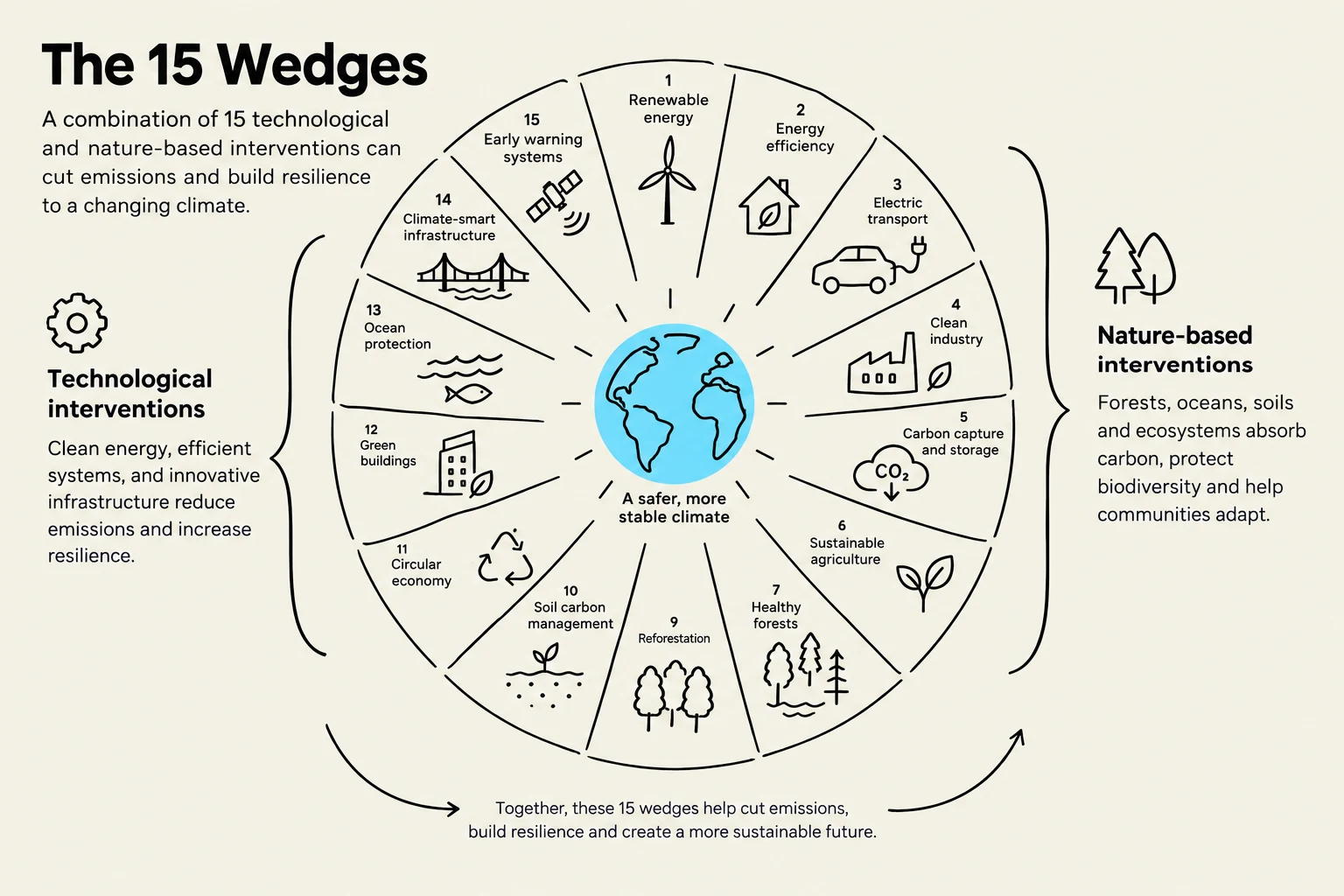
One of the most optimistic frameworks for understanding mitigation is Pascala and Socolow’s 15 wedges argument. This argument suggests that we do not necessarily need "miracle" technologies to stabilize emissions; rather, we can achieve significant reductions by implementing a combination of existing, proven methods. These "wedges" include:
Efficiency gains: More efficient vehicles, buildings, and coal plants.
Fuel switching: Using natural gas instead of coal, or nuclear power instead of coal.
Renewables: Expanding wind, solar, and other renewable sources.
Nature-based solutions: Reforestation and conservation tillage.
This diagram illustrates 15 technological and nature-based interventions aimed at cutting emissions and building resilience to climate change, categorized into technological and nature-based approaches.
The Challenge of Intermittency and Storage
While the "wedges" are theoretically available, a major technical hurdle remains: the nature of renewable energy. Wind and solar are intermittent power sources. Without advanced storage technologies (such as large-scale batteries or pumped hydro), a stable energy grid cannot rely solely on these sources. Consequently, to maintain grid stability, we may need to rely on non-renewable but carbon-free sources, such as nuclear power or coal equipped with Carbon Capture and Storage (CCS).
Exam Tip: When discussing the transition to renewables, always mention the "intermittency problem." A complete answer should note that renewables alone may not suffice for grid stability without either massive investment in storage or the use of carbon-free baseload power like nuclear or CCS-enabled fossil fuels.
Economic Considerations in Abatement
Selecting the right abatement path is not just a technical decision; it is an economic one involving complex trade-offs.
Lock-in and Delayed Abatement
Policymakers face the risk of lock-in. If we delay abatement, we may continue to invest heavily in high-emission infrastructure (like new gas pipelines or coal plants) that will be useful for decades. This "locks" the economy into a high-carbon pathway, making future decarbonization much more expensive. Furthermore, delayed action requires much more aggressive (and costly) rates of emission decline in the future to meet the same targets.
The Risk of Overshoot
There is also the danger of overshoot, where atmospheric concentrations exceed safe limits before mitigation catches up. This is particularly dangerous because climate impacts can be non-linear; once certain temperature thresholds are crossed, the relationship between emissions and temperature may change in ways that are difficult to predict.
Measuring the Cost of Regulation
To evaluate the efficiency of a specific regulation, economists use the ratio of the cost of the regulation to the reduction it achieves. This is known as the implicit price of carbon:
Implicit Price of Carbon=RC
Where:
C is the differential cost of implementing the regulation.
R is the consequent reduction in emissions.
This value can be compared against the social cost of carbon to determine if a policy is economically sound.
Adaptation: Managing the Consequences
Adaptation refers to actions taken to reduce the costs and damages resulting from existing GHG concentrations. Unlike abatement, which tries to change the future, adaptation tries to protect the present and near future from the changes already in motion.
The Limits of Adaptation
A critical concept in climate economics is that adaptation has limits. While it can reduce the negative impacts of climate change, it cannot eliminate them entirely. For a scenario involving a doubling of atmospheric GHGs, research suggests that adaptation costs might only cover 7–25% of the total potential damage. This leaves significant residual costs (75–93%) that cannot be avoided through adaptation alone.
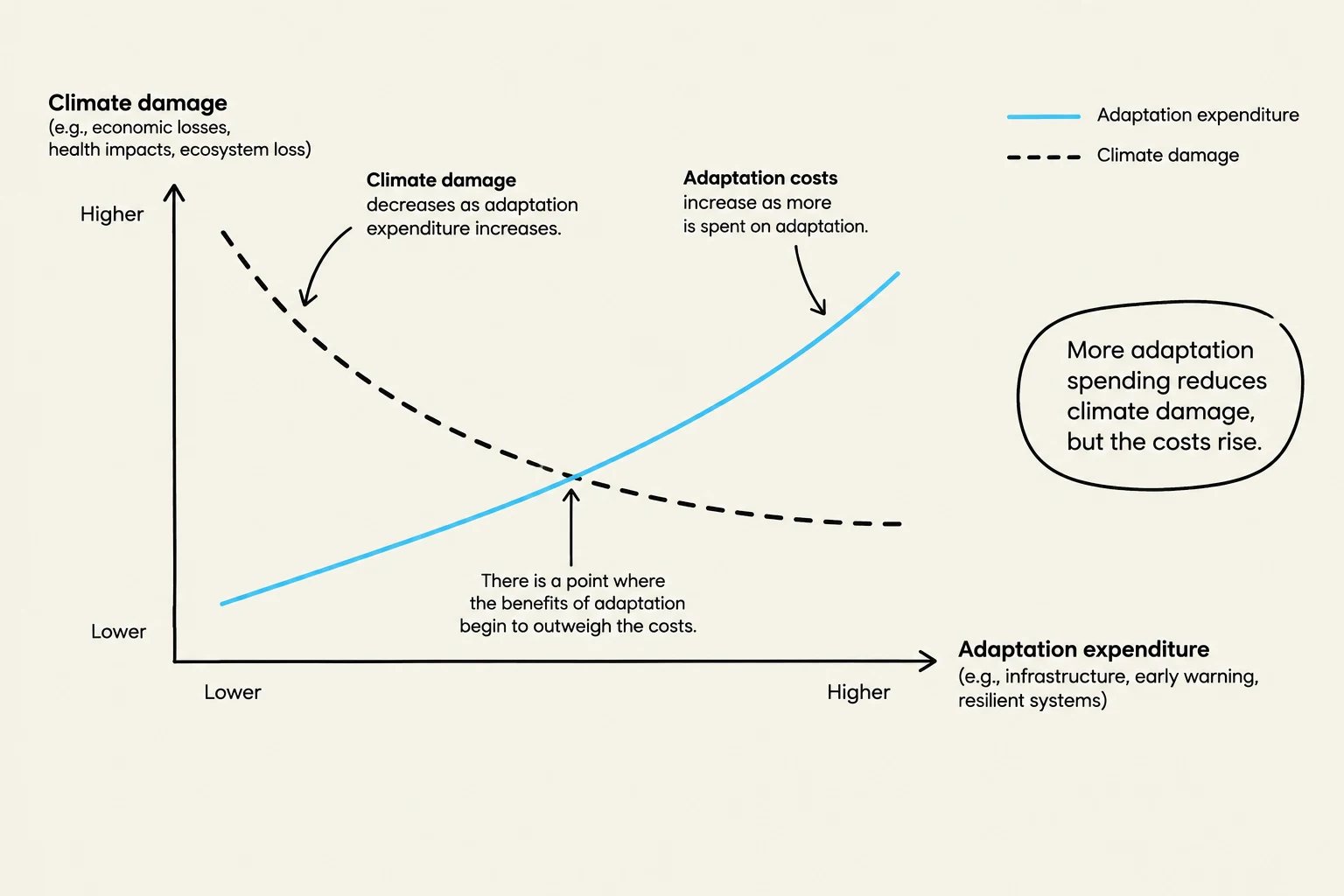
This graph illustrates the relationship between adaptation expenditure and climate damage. As adaptation expenditure increases, climate damage generally decreases, while adaptation costs rise. There is an optimal point where the benefits of adaptation begin to outweigh the costs.
Optimizing the Strategy
How much should a society spend on abatement versus adaptation? The economic rule of thumb is to equalize the marginal benefits of both. If an extra dollar spent on abatement reduces more damage than an extra dollar spent on adaptation, the society should shift its spending toward abatement, and vice versa.
Policy Intervention and Market Failures
Adaptation can occur in two ways: autonomously (through private individual or firm action) or through policy-driven measures.
In a perfect market, individuals would adapt on their own (e.g., a farmer buying drought-resistant seeds). However, private markets often fail to provide sufficient adaptation due to several factors:
Uncertainty and Imperfect Information: People may not know how much the climate will change or how to prepare.
Missing Markets: Many adaptation measures (like sea walls) are public goods; a single person cannot easily pay for a sea wall that protects an entire city.
Financial Constraints: The poor often lack the credit or capital to invest in necessary adaptation technologies.
To address these failures, governments must step in with roles such as providing information, implementing land-use regulations, and offering financing to bridge credit gaps.
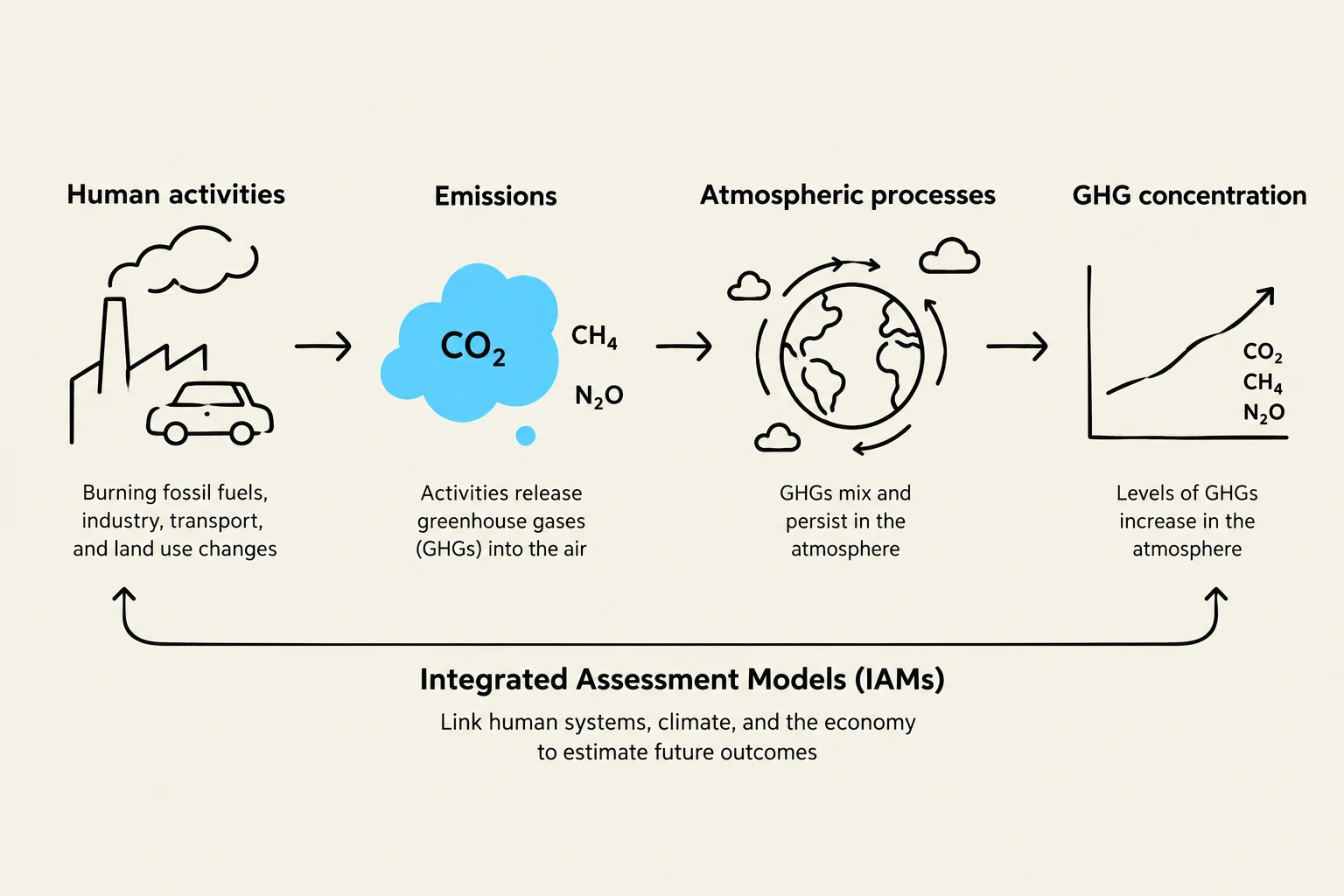
This diagram illustrates the process of greenhouse gas emissions from human activities, their persistence in the atmosphere, and the resulting increase in GHG concentrations, which are analyzed using Integrated Assessment Models (IAMs).
Summary Table: Abatement vs. Adaptation
Feature
Abatement (Mitigation)
Adaptation
Primary Goal
Reduce GHG concentrations
Reduce costs/damages from GHGs
Target
The cause (emissions)
The effect (climate impacts)
Key Challenge
Intermittency & Lock-in
Residual costs & Limits
Economic Tool
Implicit price of carbon (C/R)
Marginal benefit equalization
Keep reading for free.
Create an account to finish this reading and make it part of your study routine.