Classification of Matter: Elements, Compounds, and Mixtures
This guide explains how to classify matter into pure substances (elements and compounds) and mixtures (homogeneous and heterogeneous) based on their chemical composition and physical uniformity. It covers definitions, examples, and a step-by-step identification process.
Everything we touch, see, and breathe is composed of matter. In chemistry, matter is defined as anything that has mass and takes up space. However, not all matter is created equal. To understand how substances interact, react, and change, scientists categorize matter based on its chemical composition and how uniformly its components are distributed.
By learning to distinguish between pure substances and mixtures, you can predict how a material will behave in a laboratory setting or in a real-world environment.
The Broad Divide: Pure Substances vs. Mixtures
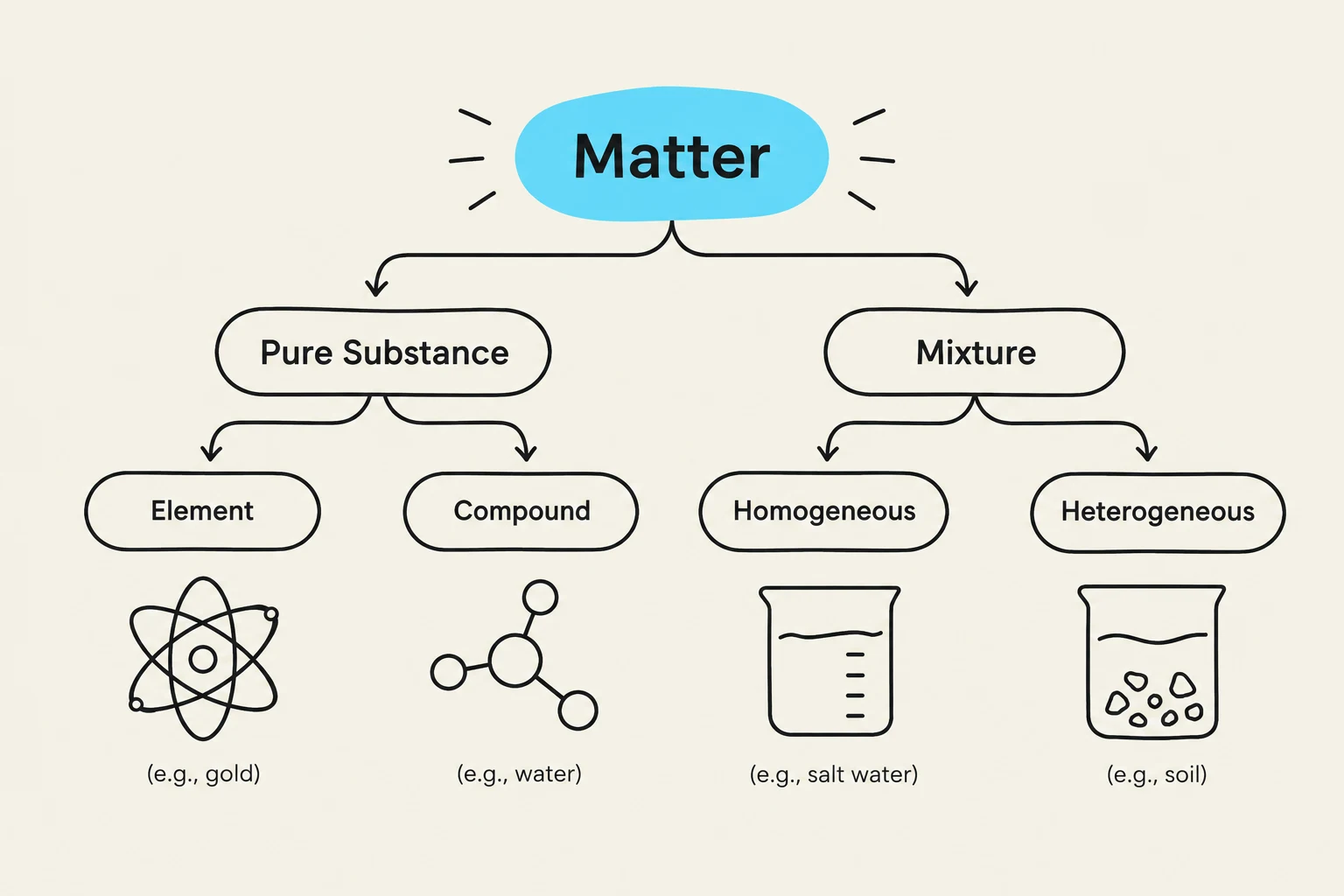
The first step in classifying matter is determining whether it is a pure substance or a mixture. This distinction is based on whether the material has a fixed, constant composition or if it is a combination of different substances that can vary in proportion.
Pure Substances
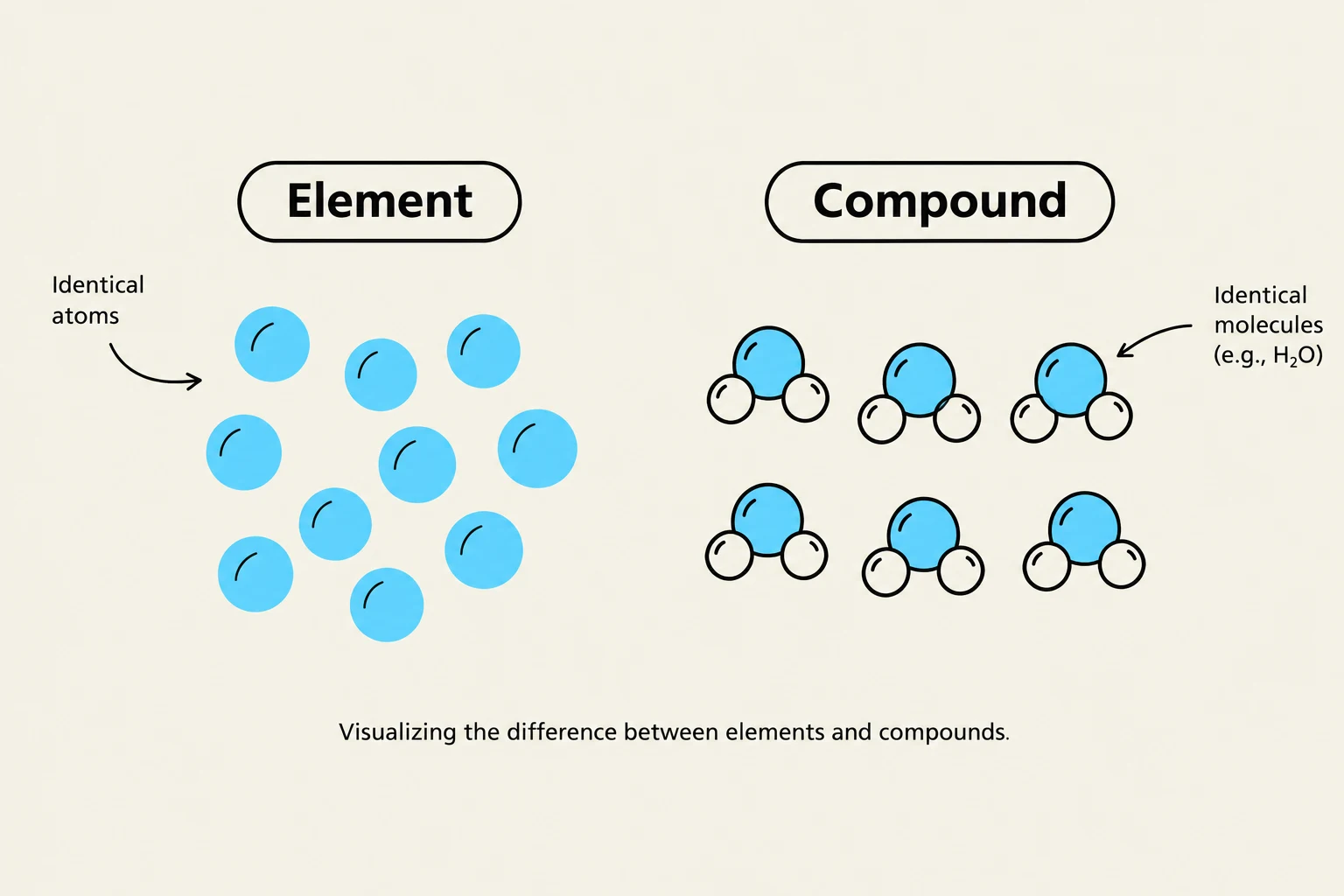
This illustration visually distinguishes between elements, depicted as identical atoms, and compounds, represented by identical molecules like H₂O.
A pure substance consists of only one type of particle (either atoms or molecules) and has a constant chemical composition throughout. Because the composition is fixed, pure substances have specific, characteristic properties, such as a precise melting point or boiling point.
Pure substances are further divided into two categories:
Elements: The simplest form of matter. An element consists of only one type of atom and cannot be broken down into simpler substances by chemical means. Examples include Gold (Au), Oxygen (O2), and Iron (Fe).
Compounds: Substances formed when two or more different elements are chemically bonded together in a fixed ratio. Unlike elements, compounds can be broken down into simpler substances, but only through chemical reactions. For example, water (H2O) is a compound made of hydrogen and oxygen.
Mixtures
A mixture is a physical combination of two or more substances where each substance retains its own chemical identity. Unlike compounds, the components of a mixture are not chemically bonded and can be separated using physical methods like filtration, evaporation, or magnetism.
Exam Tip: If a question asks whether a substance is a compound or a mixture, look for the "ratio." If the ratio of components is fixed (like H2O), it is a compound. If the ratio can change (like salt water with varying amounts of salt), it is a mixture.
Classifying Mixtures: Homogeneous vs. Heterogeneous
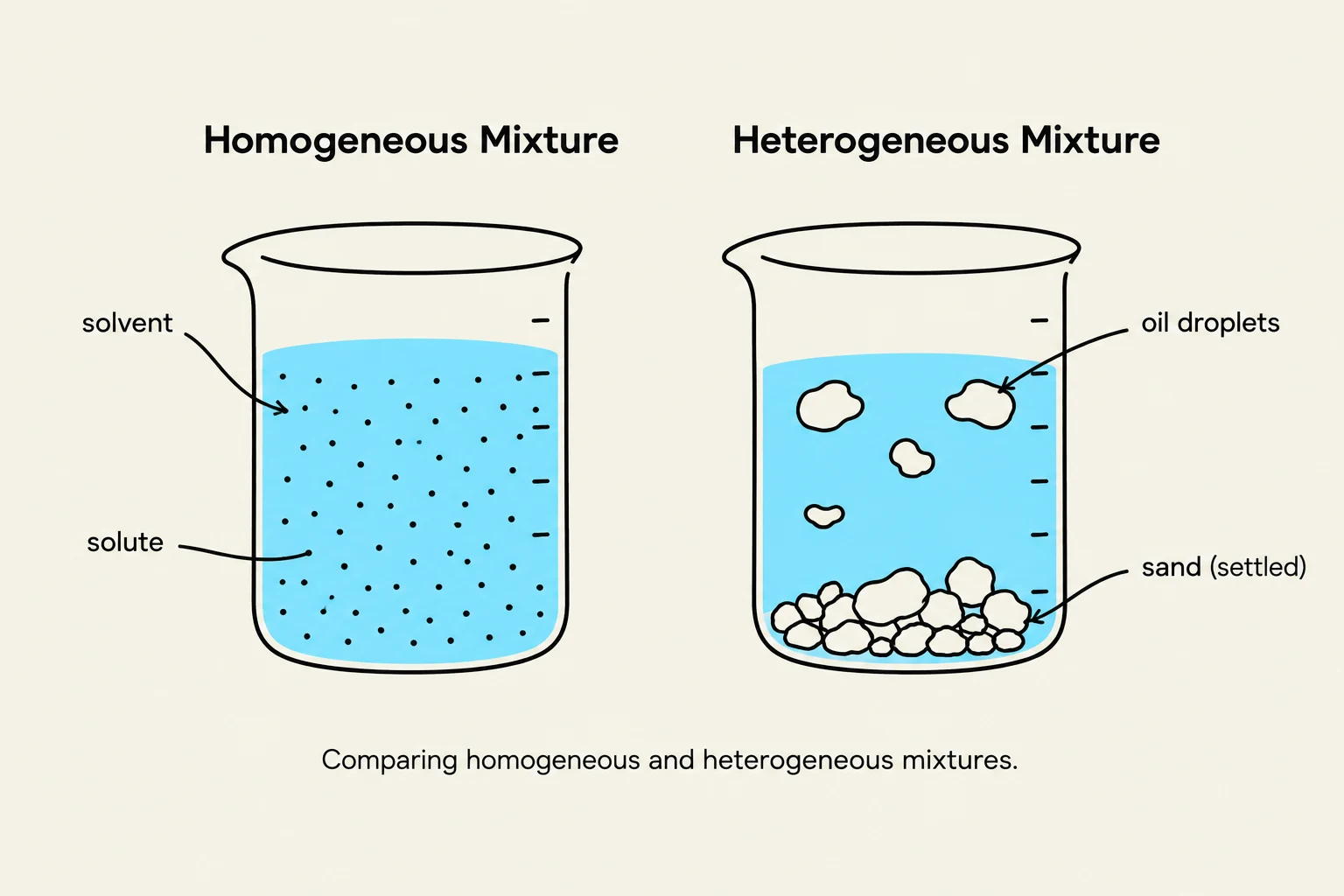
This illustration compares homogeneous and heterogeneous mixtures, showing a solvent with dissolved solute for the former, and a solvent with undissolved oil droplets and settled sand for the latter.
Once you have identified that a substance is a mixture, you must determine its level of uniformity. This is where we distinguish between homogeneous and heterogeneous mixtures.
Homogeneous Mixtures (Solutions)
A homogeneous mixture is one where the components are distributed so evenly that the mixture appears to be a single phase. You cannot see the individual parts even with a microscope, and the composition is uniform throughout the entire sample.
In chemistry, these are often referred to as solutions.
Example: Salt dissolved in water. Once the salt is fully dissolved, every drop of the liquid will have the exact same concentration of salt.
Example: Air. A mixture of nitrogen, oxygen, and other gases that appears as a single, clear gas.
Heterogeneous Mixtures
A heterogeneous mixture is non-uniform in composition. The different components are not distributed evenly, and you can often see distinct phases or boundaries between them.
Example: A bowl of cereal with milk. You can clearly see the solid cereal particles and the liquid milk.
Example: Oil and water. No matter how much you shake them, they will eventually separate into two distinct layers.
Summary Classification Table
To help visualize these relationships, refer to the table below, which organizes matter from the most specific (elements) to the most diverse (mixtures).
Category
Sub-category
Composition
Uniformity
Example
Pure Substance
Element
One type of atom
Uniform
Copper (Cu)
Pure Substance
Compound
Two+ elements chemically bonded
Uniform
Carbon Dioxide (CO2)
Mixture
Homogeneous
Two+ substances physically mixed
Uniform
Brass (alloy)
Mixture
Heterogeneous
Two+ substances physically mixed
Non-uniform
Sand in water
Worked Example: The Identification Process
This diagram illustrates the classification of matter into pure substances (elements and compounds) and mixtures (homogeneous and heterogeneous), with examples.
Let's apply these concepts to a real-world scenario. Imagine you are given three unlabeled containers:
Container A: A piece of pure silver jewelry.
Container B: A glass of sugar water.
Container C: A salad with lettuce, tomatoes, and cucumbers.
Step 1: Is it a pure substance or a mixture?
A: Silver is a single type of atom. It is a pure substance.
B: Sugar and water are physically combined. It is a mixture.
C: Lettuce, tomatoes, and cucumbers are physically combined. It is a mixture.
Step 2: Refine the classification.
A: Since silver is an element, Container A is an element.
B: Since the sugar is dissolved evenly, Container B is a homogeneous mixture.
C: Since you can see the different parts and they are not uniform, Container C is a heterogeneous mixture.
By following this hierarchical approach—first checking for chemical purity and then checking for physical uniformity—you can classify any form of matter encountered in the study of chemistry.
Keep reading for free.
Create an account to finish this reading and make it part of your study routine.