Classification of Matter and Solubility Principles
An introduction to the classification of matter into pure substances and mixtures, and the principles of solubility, including factors affecting dissolution and biological implications like osmosis and diffusion.
Understanding the nature of matter is fundamental to chemistry. Whether we are looking at the air we breathe, the water we drink, or the blood flowing through our veins, we are interacting with different classifications of matter. By learning how to distinguish between pure substances and mixtures, and by understanding the principles that govern how substances dissolve, we can predict how chemicals will behave in everything from a laboratory beaker to a human cell.
Classifying Matter: Pure Substances and Mixtures
Matter can be broadly categorized based on its composition and how uniformly its components are distributed.
Pure Substances
A pure substance consists of only one type of element or one type of compound. Because the chemical identity is consistent throughout, pure substances have fixed physical and chemical properties.
Mixtures
Unlike pure substances, mixtures contain two or more different pure substances physically combined. Mixtures are classified into two main types based on their uniformity:
Homogeneous Mixtures: These have a uniform distribution of substances throughout the entire sample. A common example is a solution, where the components are so well-mixed that they appear as a single phase.
Heterogeneous Mixtures: These are not uniformly distributed. You can often see different phases or components within the mixture.
The distinction between these can be further refined by looking at particle size, as shown in the table below:
Mixture
Particle Size
Appearance
Particle Settling?
Separation of Particles
Solution
Small (<1 nm)
Clear
No
Cannot be separated by filtration or centrifugation
Colloid
Intermediate (1 nm−1μm)
Usually cloudy
No
Can usually be separated by special techniques
Suspension
Large (>1μm)
Cloudy
Yes
Can be separated by filtration or centrifugation
The Mechanics of Solutions
A solution is a specific type of homogeneous mixture. To understand how a solution forms, we must define the roles of its components:
Solvent: The component present in the greatest amount.
Solute: The component that is being dissolved in the solvent.
Solubility and "Like Dissolves Like"
Solubility is the term used to describe the maximum amount of solute that will dissolve in a given amount of solvent at a specific temperature.
For a solution to form, the solute and solvent particles must be able to interact through noncovalent interactions, and they generally need to be of similar size. A vital rule of thumb in chemistry is "like dissolves like":
Exam Tip: If you encounter a substance that is "hydrophobic" (water-fearing), it is nonpolar and will not dissolve in water. If it is "hydrophilic" (water-loving), it is polar or ionic and will dissolve readily.
Precipitation
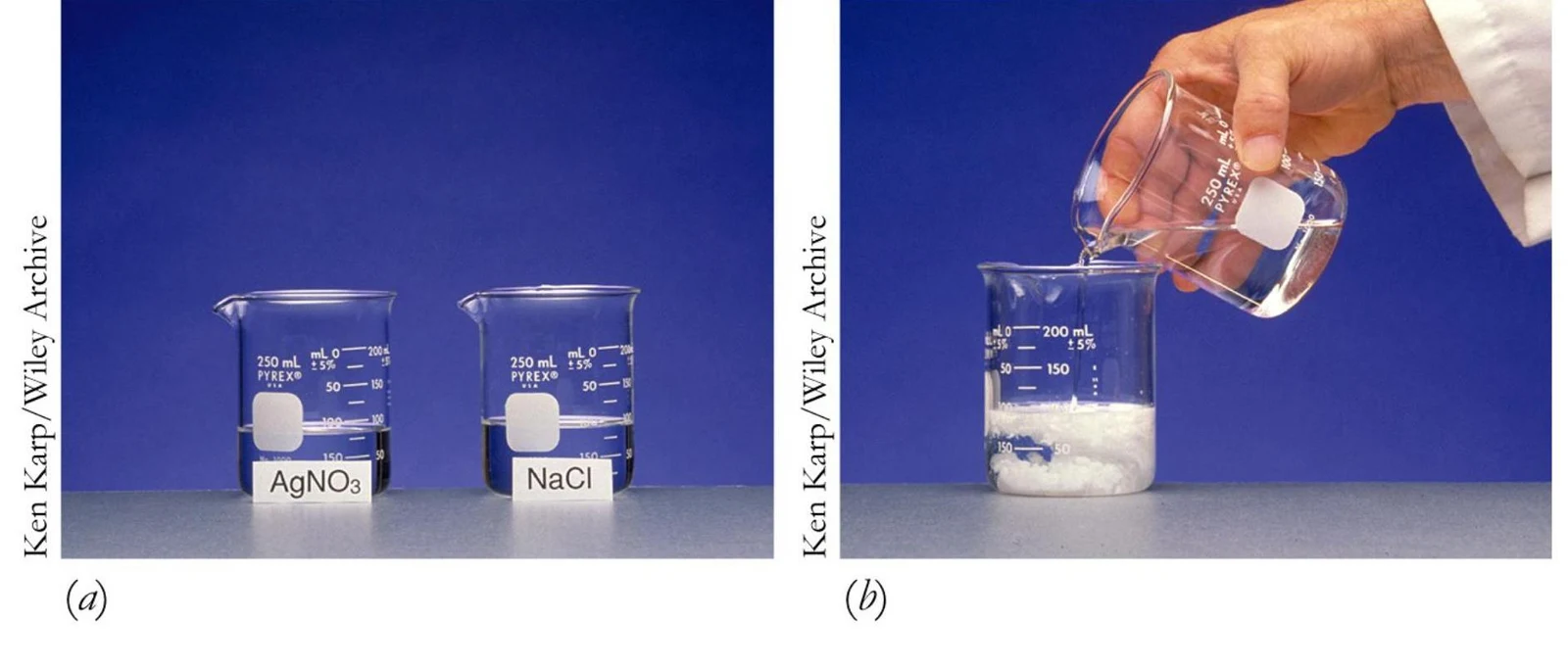
Sometimes, when two clear solutions are mixed, they react to form an insoluble solid called a precipitate. This often occurs during double displacement reactions where the new combinations of ions result in a compound that is insoluble in water.
This image shows two beakers, one containing silver nitrate (AgNO3) and the other sodium chloride (NaCl). In the second part of the image, a liquid is poured into the beaker containing NaCl, causing a precipitate to form.
The Influence of Temperature
Temperature plays a critical role in how substances dissolve, but its effect depends on whether the solute is a gas, liquid, or solid:
Gases: As temperature increases, the solubility of gases in water decreases.
Solids and Liquids: For most solid and liquid solutes, solubility increases as temperature increases.
Worked Example: Solubility Limits
Suppose the solubility of acetaminophen (C8H9NO2) in water at 20∘C is 0.000085 mol/mL. If you add 800 mg of acetaminophen to 25 mL of water, will it dissolve?
Convert mass to moles:0.800 g×151.17 g1 mol=0.00529 mol
Calculate the actual concentration:25 mL0.00529 mol=0.00021 mol/mL
Compare to solubility limit: Since 0.00021 mol/mL is greater than the limit of 0.000085 mol/mL, the extra solute will not dissolve, resulting in a heterogeneous mixture.
Biological Implications: Osmosis and Diffusion
In biological systems, the concentration of solutes is life-critical. Two processes govern how substances move across semipermeable membranes (like cell walls):
Diffusion: The movement of substances from an area of higher concentration to an area of lower concentration.
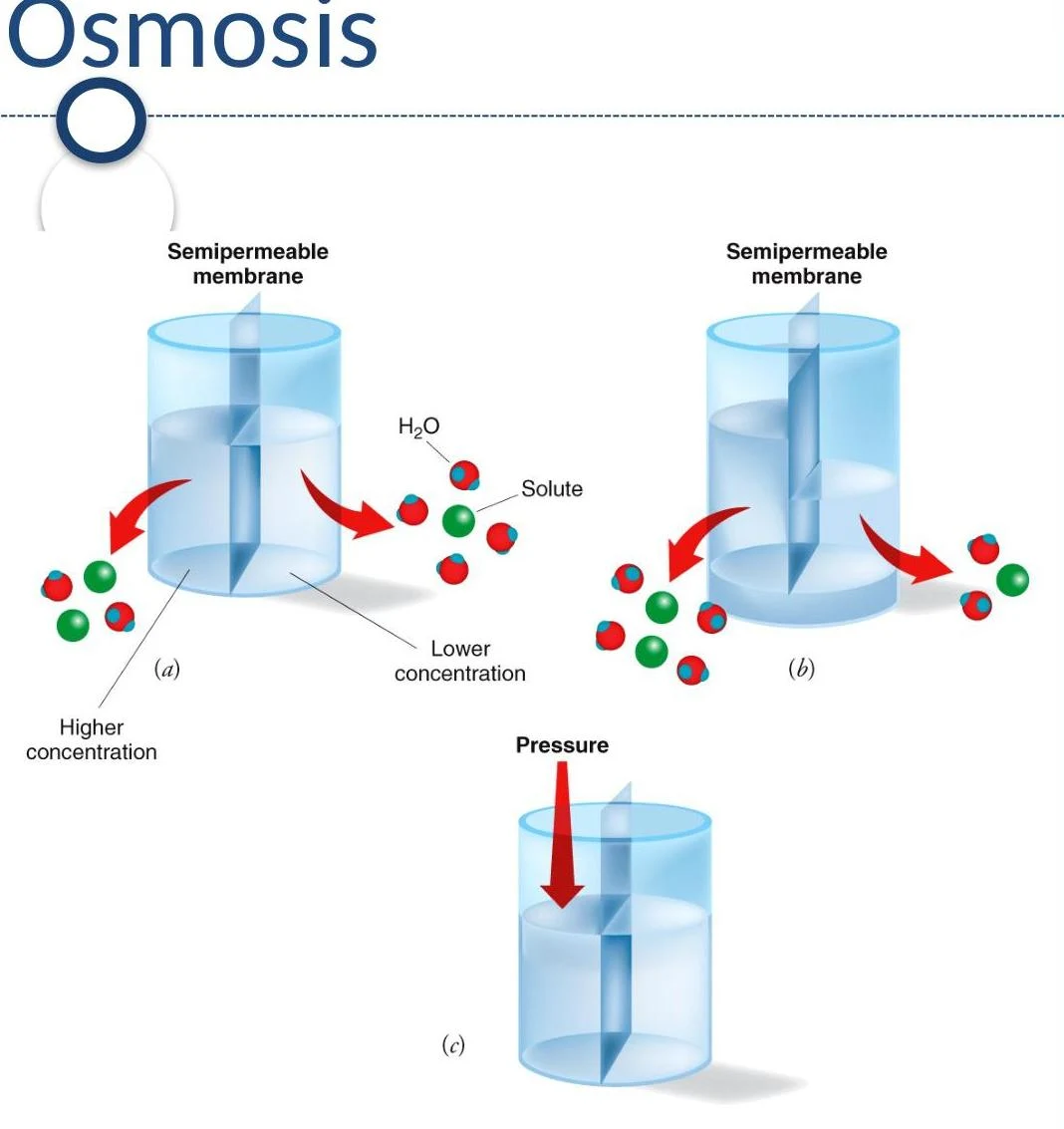
Osmosis: The net movement of solvent (water) across a semipermeable membrane from a region of lower solute concentration to a region of higher solute concentration.
This illustration depicts the process of osmosis, where water molecules move across a semipermeable membrane from an area of lower solute concentration to an area of higher solute concentration. Part (c) shows that pressure can be applied to oppose this movement.
The concentration of the surrounding fluid determines the health of a cell:
Isotonic solution: The concentration is the same inside and outside the cell; the cell maintains its shape.
Hypertonic solution: The surrounding solution has a higher solute concentration; water flows out of the cell, causing it to shrink (crenation).
Hypotonic solution: The surrounding solution has a lower solute concentration; water flows into the cell, causing it to swell and potentially burst (hemolysis).
Understanding these principles allows scientists and medical professionals to manage everything from the concentration of electrolytes in blood to the way medicines are delivered to the body.
Keep reading for free.
Create an account to finish this reading and make it part of your study routine.