


In the world of taxation, not all profits are created equal. When you sell an asset or trade a piece of property, the tax impact on your bottom line depends entirely on how that property is classified. This classification determines whether your profit is treated as a "capital gain" or an "ordinary gain," a distinction that can significantly alter the amount of tax you owe.
Understanding this distinction is the cornerstone of tax planning and asset management.
The Core Distinction: Capital vs. Ordinary
The character of a gain or loss is determined by the nature of the asset involved in the transaction. Generally, the rules follow a simple binary:
- Capital Gain or Loss: This results from the sale or trade of a capital asset.
- Ordinary Gain or Loss: This results from the sale or trade of a non-capital asset.
While most transactions fall into one of these two buckets, the tax code allows for complexity. In certain sophisticated or multi-part transactions, a single sale might yield a "split" result, where a portion of the profit is treated as capital and another portion is treated as ordinary.
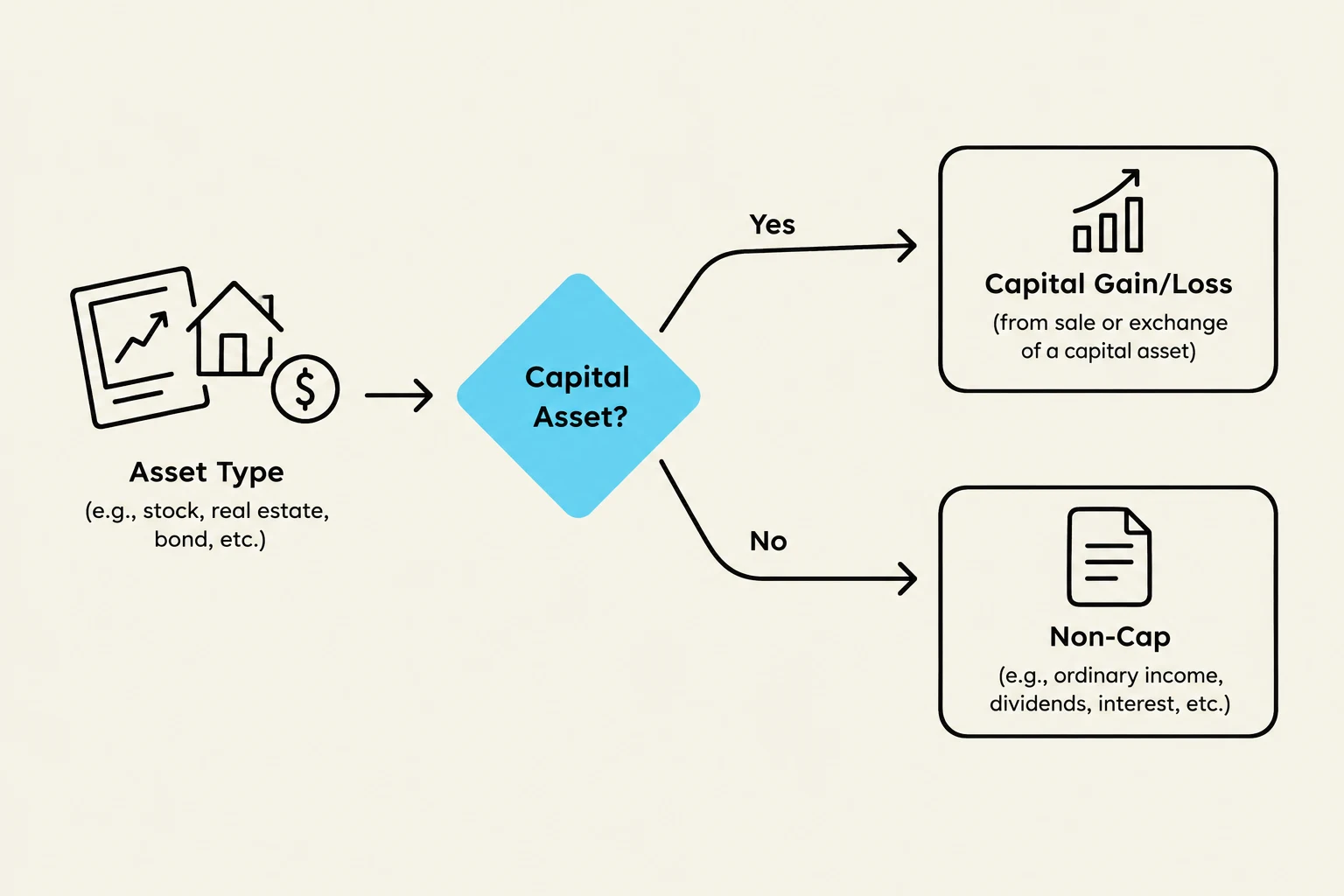
Exam Tip: When analyzing a problem, always identify the asset type first. Do not jump to calculating the gain until you have determined if the asset is capital or non-capital.
Defining Capital Assets through Exclusion
A common point of confusion for students is the definition of a "capital asset." Interestingly, tax law often avoids providing an exhaustive list of what is a capital asset. Instead, it provides a specific list of properties that are explicitly not capital assets.
Keep reading for free.
Create an account to finish this reading and make it part of your study routine.
Continue reading freeAlready have an account? Log in
Updated