Classical Liberalism: From Revolution to the Harm Principle
Explore the evolution of liberty from the French Revolution's collective struggles to John Stuart Mill's individualistic philosophies, focusing on the development of the Harm Principle as a boundary for authority.
The history of modern liberty is often viewed as a transition from the violent, collective struggles of revolution to the refined, individualistic philosophies of the Victorian era. While the French Revolution sought to dismantle the structures of monarchy and feudalism through radical upheaval, the later development of classical liberalism—most notably through the work of John Stuart Mill—sought to define the precise boundaries of state power and individual autonomy. Understanding the connection between these two eras requires us to look at how the "rights of man" evolved from a tool of mass mobilization into a sophisticated framework for personal liberty.
The Revolutionary Spark: Rights and Paradoxes
The French Revolution serves as a primary case study in the pursuit of liberty. It was driven by the desire to replace absolute monarchy with a system based on citizenship and legal equality. The revolutionary ideals were centered on the notion that certain rights are inherent to human beings and cannot be stripped away by a sovereign.
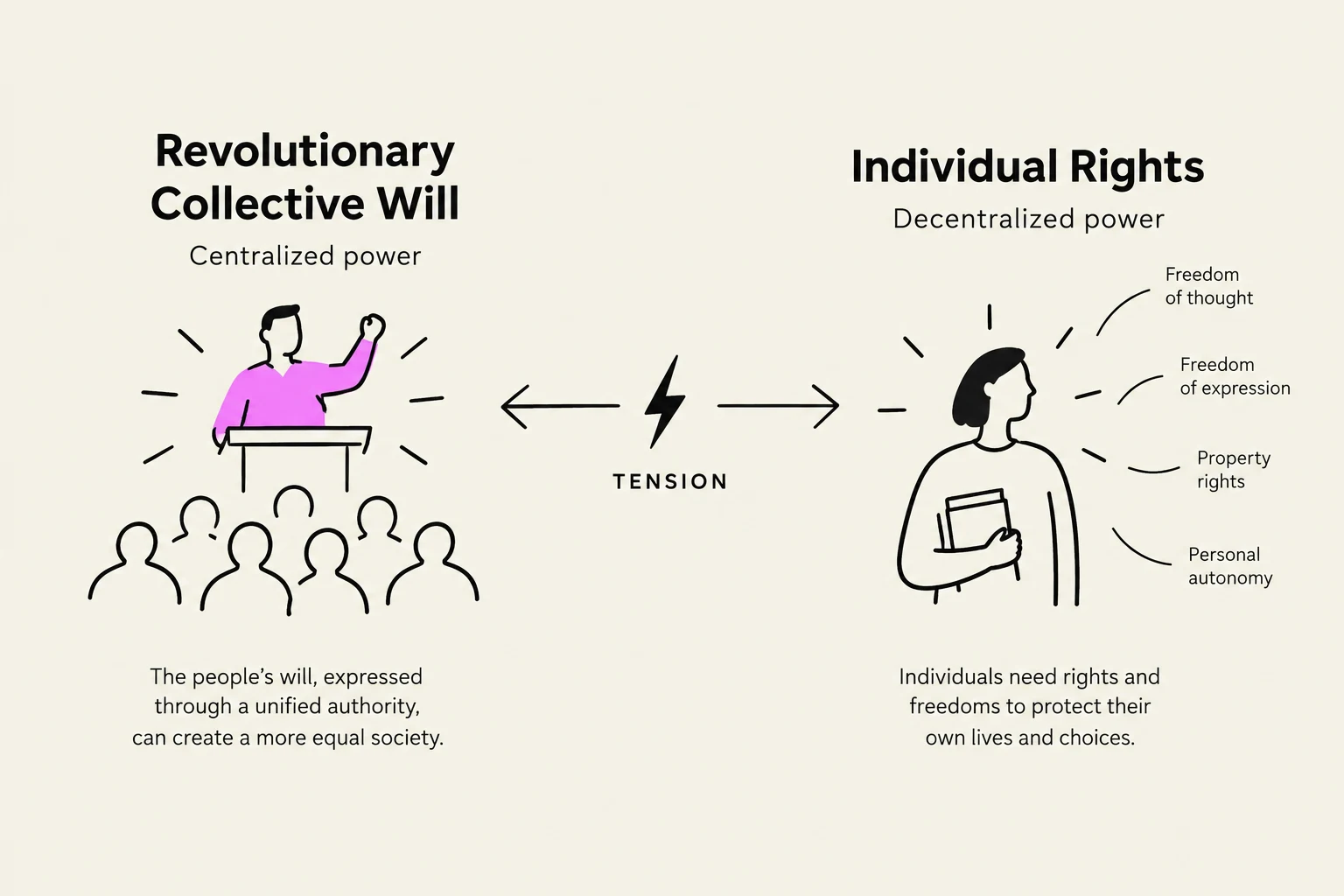
However, the revolution also revealed a profound paradox: the pursuit of collective liberty can sometimes lead to the suppression of individual liberty. In the name of "the will of the people" or the preservation of the Republic, revolutionary governments often resorted to centralized control and the suspension of rights for those deemed enemies of the state. This tension between the collective good and the individual's right to dissent is the central problem that later liberal thinkers would attempt to solve.
Exam Tip: When discussing the French Revolution in a political science context, always distinguish between positive liberty (the freedom to participate in political life) and negative liberty (freedom from interference). The revolution excelled at the former but often struggled with the latter.
This illustration depicts the tension between centralized power, represented by a "Revolutionary Collective Will," and decentralized power, represented by "Individual Rights" including freedom of thought, freedom of expression, property rights, and personal autonomy.
John Stuart Mill and the Refinement of Liberty
As the radicalism of the 18th century gave way to the industrial and social complexities of the 19th century, thinkers like John Stuart Mill sought to move away from the "all or nothing" approach of revolution. Mill’s contribution to classical liberalism was not just about granting rights, but about defining the limits of authority.
Mill’s philosophy is centered on the idea that the individual is sovereign over their own body and mind. Unlike the revolutionaries who often viewed the state as the instrument to realize human potential, Mill viewed the state with caution, seeing it as a potential source of "the tyranny of the majority." He argued that society should not coerce individuals into behaving in certain ways simply because those behaviors are deemed "unconventional" or "immoral" by the masses.
The Harm Principle: A Boundary for Authority
The most significant tool Mill provided to protect individual liberty is the Harm Principle. This principle serves as a litmus test for whether a government or society has the right to interfere with an individual's actions.
The Harm Principle states that:
The only purpose for which power can be rightfully exercised over any member of a civilized community, against his will, is to prevent harm to others.
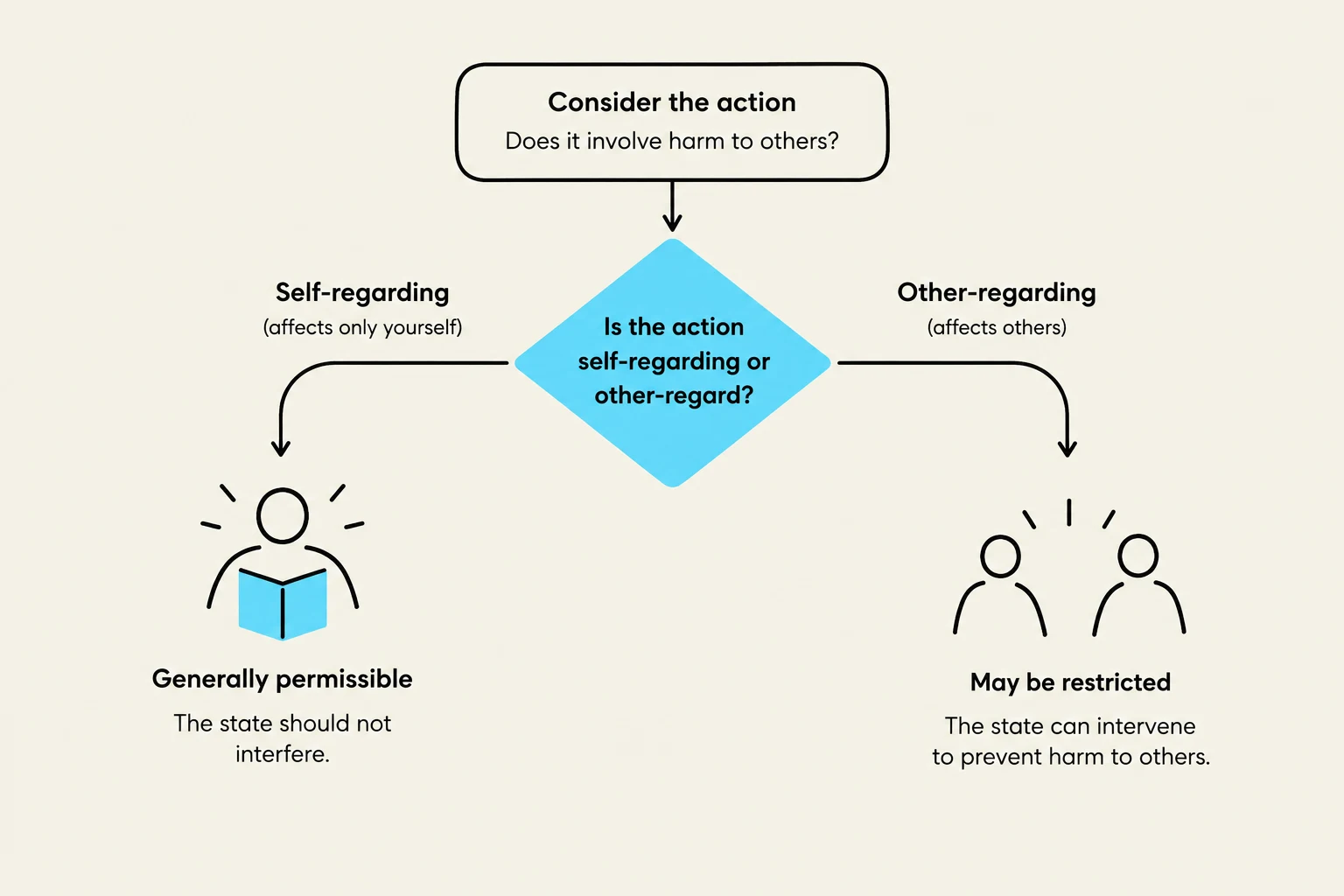
To understand this, we can break down the relationship between action and intervention using a simple logical framework:
Self-Regarding Actions: Actions that only affect the person performing them (e.g., personal beliefs, dietary choices, private habits). Under the Harm Principle, these are immune to state interference.
Other-Regarding Actions: Actions that have a direct, demonstrable impact on the well-being or rights of others (e.g., theft, physical assault, pollution). These are subject to legal and social regulation.
A flowchart illustrating the distinction between self-regarding and other-regarding actions, and their implications for state intervention.
Worked Example: The Case of Public Speech
Imagine a citizen decides to express a highly unpopular and offensive opinion in a public square.
The Revolutionary Approach: A radical government might suppress this speech if they believe it threatens "social harmony" or "national unity".
The Millian Approach: Using the Harm Principle, we ask: Does this speech cause direct harm to others? Mere offense is not considered "harm" in the strict Millian sense. Unless the speech is an incitement to immediate violence (which would harm others), the individual has the right to speak, even if the majority finds it loathsome.
Comparing the Two Paradigms
The transition from revolutionary ideals to Millian liberalism can be summarized by how they view the relationship between the individual and the state.
Feature
Revolutionary Idealism
Millian Classical Liberalism
Primary Goal
Overthrowing old structures to create new rights.
Protecting the individual from state and social coercion.
View of the State
An instrument for collective liberation.
A necessary but potentially dangerous entity.
Risk Factor
The "Tyranny of the Mob" or centralized dictatorship.
Social atomization or lack of collective direction.
Core Metric
Equality and National Sovereignty.
The Harm Principle.
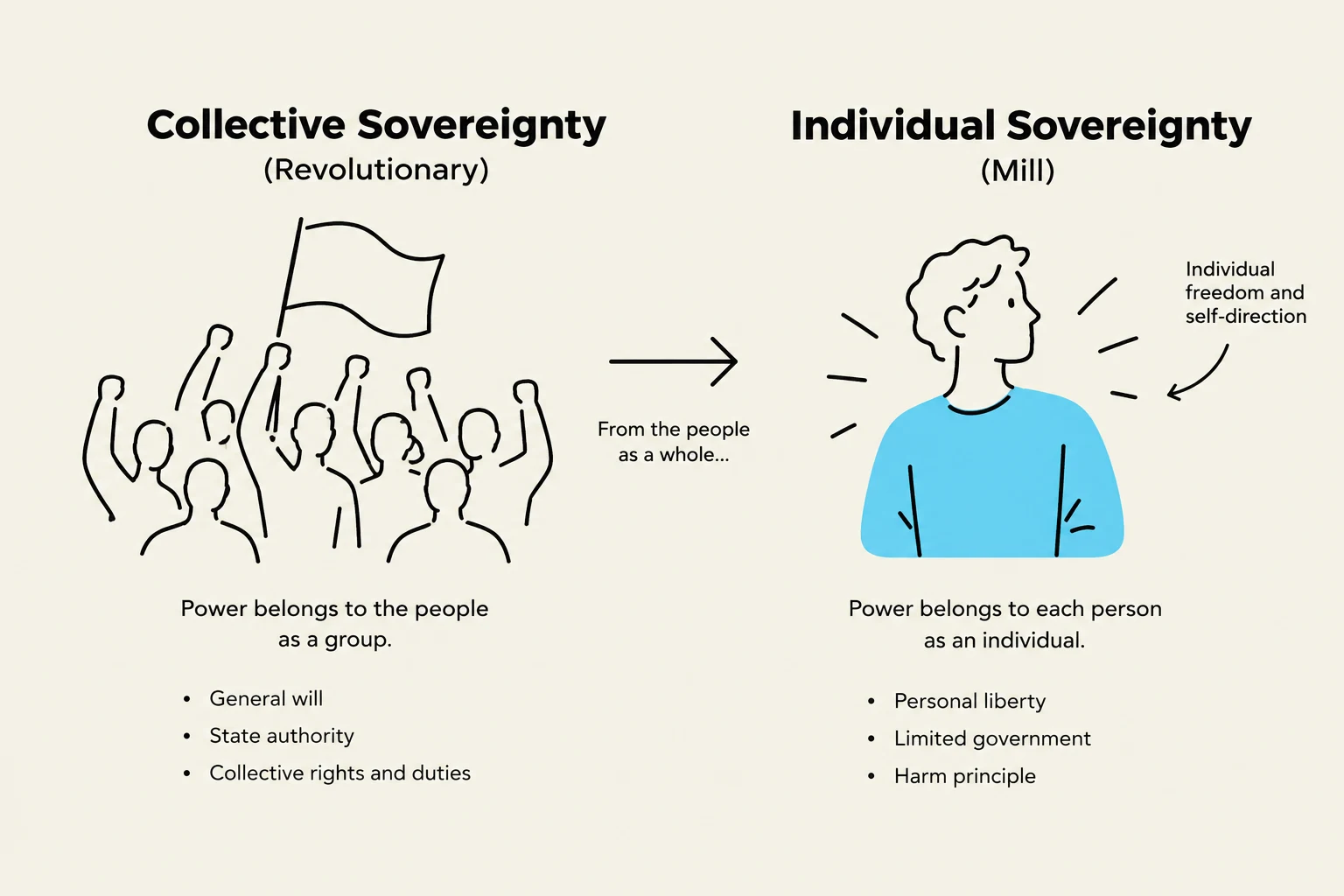
This illustration contrasts collective sovereignty, where power resides with the group and is associated with general will and state authority, with individual sovereignty, where power belongs to each person and is linked to personal liberty and limited government.
Conclusion: The Legacy of the Connection
The connection between these two concepts lies in their shared origin: the rejection of arbitrary authority. The French Revolution broke the chains of the old regime, creating the space for modern citizenship. However, it was the refinement of these ideals through classical liberalism and the Harm Principle that provided the "guardrails" necessary to prevent that new freedom from collapsing into a different form of tyranny. For the modern student, the lesson is clear: liberty requires both the courage to demand rights and the intellectual discipline to define where those rights end.
Summary Checklist for Students:
Did the revolution prioritize the collective or the individual?
Does the Harm Principle distinguish between "offense" and "harm"?
Can you identify a "self-regarding" action versus an "other-regarding" action?
Keep reading for free.
Create an account to finish this reading and make it part of your study routine.