


When designing a software system or a database, architects must create visual models to represent how different components interact. Two of the most fundamental tools for this task are Class Diagrams and Entity Relationship Diagrams (ERD). While they may appear similar, they serve different purposes: Class Diagrams model both the structural and behavioral features of a system, providing a dynamic view, whereas ERDs focus strictly on structural features, providing a static view of the data.
Class Diagrams
Class diagrams are a staple of object-oriented modeling. They represent the "blueprint" of a system by defining the objects that will exist and how they behave.
The Building Blocks: Classes, Attributes, and Behaviours
At the heart of the diagram is the Class, represented as a rectangular box. A class defines a general concept and contains two primary types of information:
- Attributes: These are the characteristics or data fields that describe what is known about an object of that class (e.g., a
Professorclass might have anameattribute). - Behaviours (Operations): These are the actions or functions that the objects of the class can perform (e.g., a
Courseclass might have aregisterStudent()operation).
Relationships and Associations
Classes rarely exist in isolation; they interact through various types of relationships.
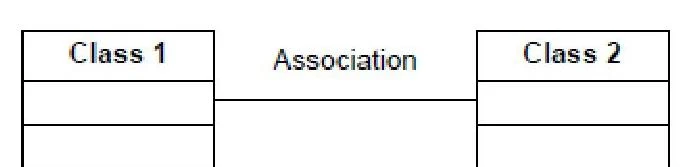
There are several specific types of associations:
- Binary Association: A simple relationship between exactly two classes.
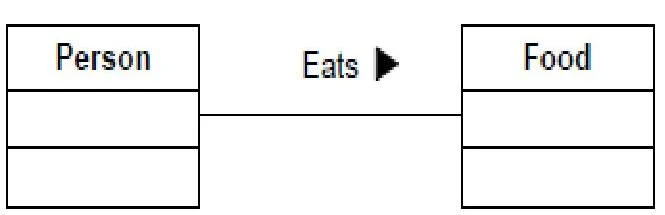
A diagram illustrating the relationship between 'Person' and 'Food' with the action 'Eats'. - n-ary Association: A complex relationship that connects three or more classes simultaneously.

An n-ary relationship diagram showing three classes. - Aggregation: A "has-a" relationship where one class is a part of another, but can exist independently.
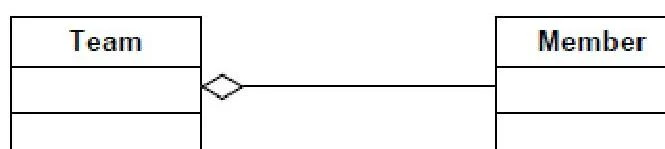
This is a database entity-relationship diagram showing a one-to-many relationship between Team and Member entities. - Composition: A stronger version of aggregation, often called an "is-composed-of" relationship, where the parts cannot exist without the whole.
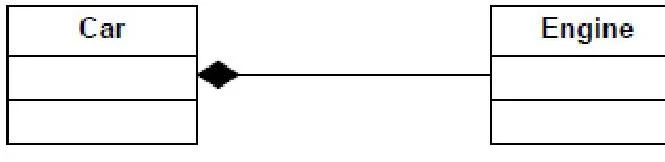
A diagram illustrating the relationship between a Car and an Engine. - Association Classes: Sometimes, an association itself has attributes. In these cases, an association class is used to capture data belonging to the relationship rather than the individual classes.

This diagram illustrates an association class in object-oriented programming, connecting two classes and representing a relationship with its own attributes and operations.

Keep reading for free.
Create an account to finish this reading and make it part of your study routine.
Continue reading freeAlready have an account? Log in
Updated