Explore the fundamental concepts of chromosomal variations, including structural changes like deletions, duplications, inversions, and translocations, as well as numerical variations such as euploidy and aneuploidy. Understand the mechanisms leading to these alterations and their impact on genetic information.
Chromosomes are the fundamental carriers of genetic information, organized into specific structures and numbers within a cell. However, these arrangements are not always perfect. Genetic mutations can lead to significant alterations in either the physical structure of a chromosome or the total number of chromosomes present in an organism. These variations can range from subtle rearrangements to profound abnormalities that result in significant phenotypic differences, developmental issues, or even lethality.
Chromosomal Structural Variations
Structural variations occur when the architecture of a chromosome is modified. These changes are generally categorized into two groups: those that alter the total amount of genetic material and those that merely rearrange it.
Changes in Genetic Material Amount
When a chromosome undergoes a change that adds or removes DNA, it affects the "dosage" of genes available to the cell.
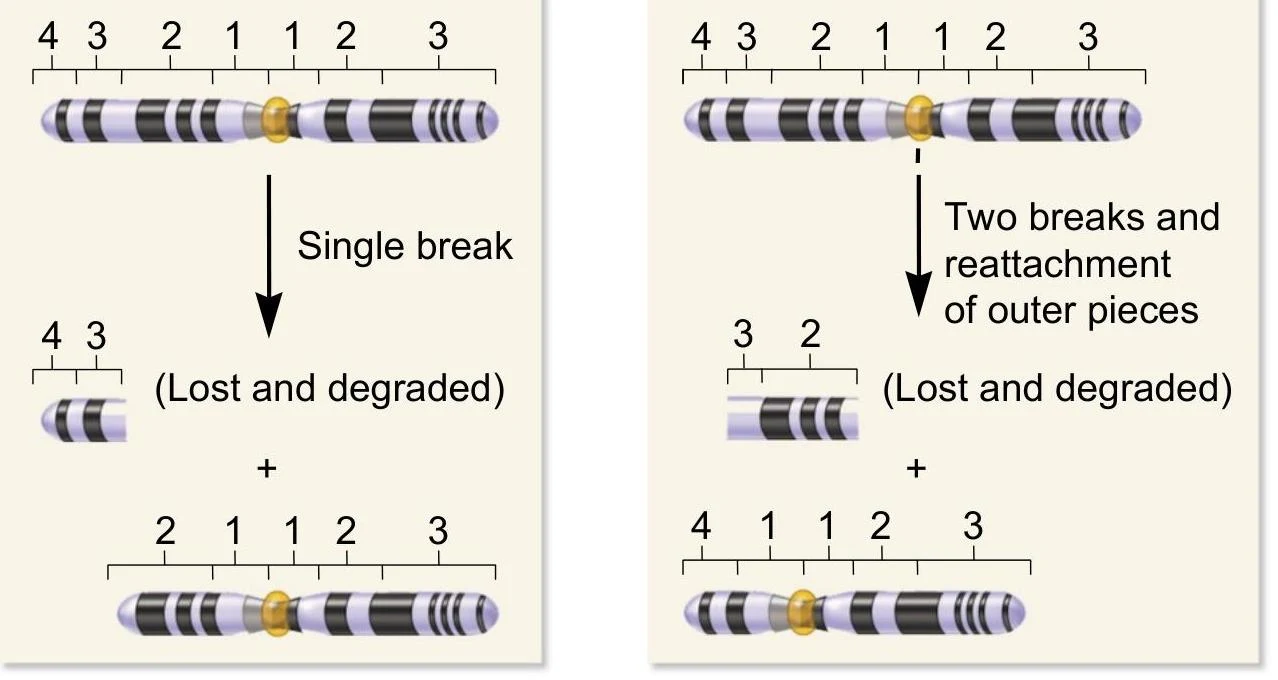
Deletions (Deficiencies): A deletion occurs when a specific segment of a chromosome breaks off and is lost, resulting in missing genetic information. The severity of a deletion often depends on how many essential genes are lost. A well-known clinical example is cri-du-chat syndrome, which is caused by a deletion in the short arm of chromosome 5.
Diagram illustrating chromosome breakage and rearrangement, showing the loss of genetic material.
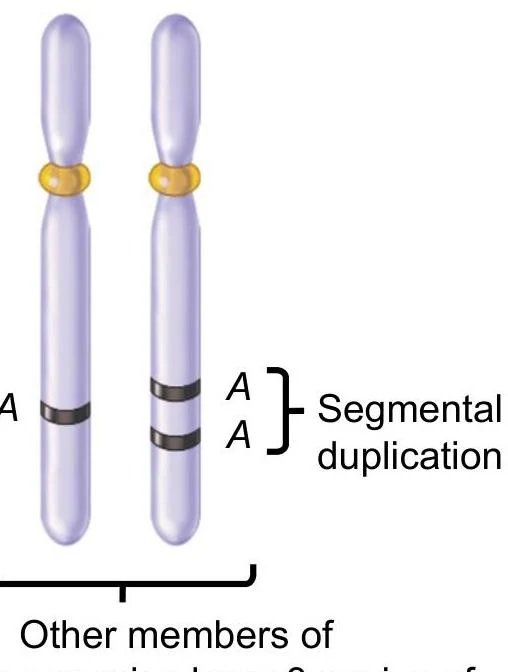
Duplications: In a duplication, a chromosomal segment is repeated, meaning the individual possesses extra copies of certain genes compared to the normal parent chromosome. While duplications can be harmful, they are often considered less lethal than deletions of a similar size because the organism still possesses the original necessary genes.
This diagram illustrates chromosomal abnormalities, specifically duplication and deletion, resulting from a misaligned crossover event between homologous chromosomes with repetitive sequences.Illustration showing a segmental duplication on a chromosome.
Rearrangements (Constant Genetic Material)
In some cases, the total amount of DNA remains the same, but the order or location of the segments is changed.
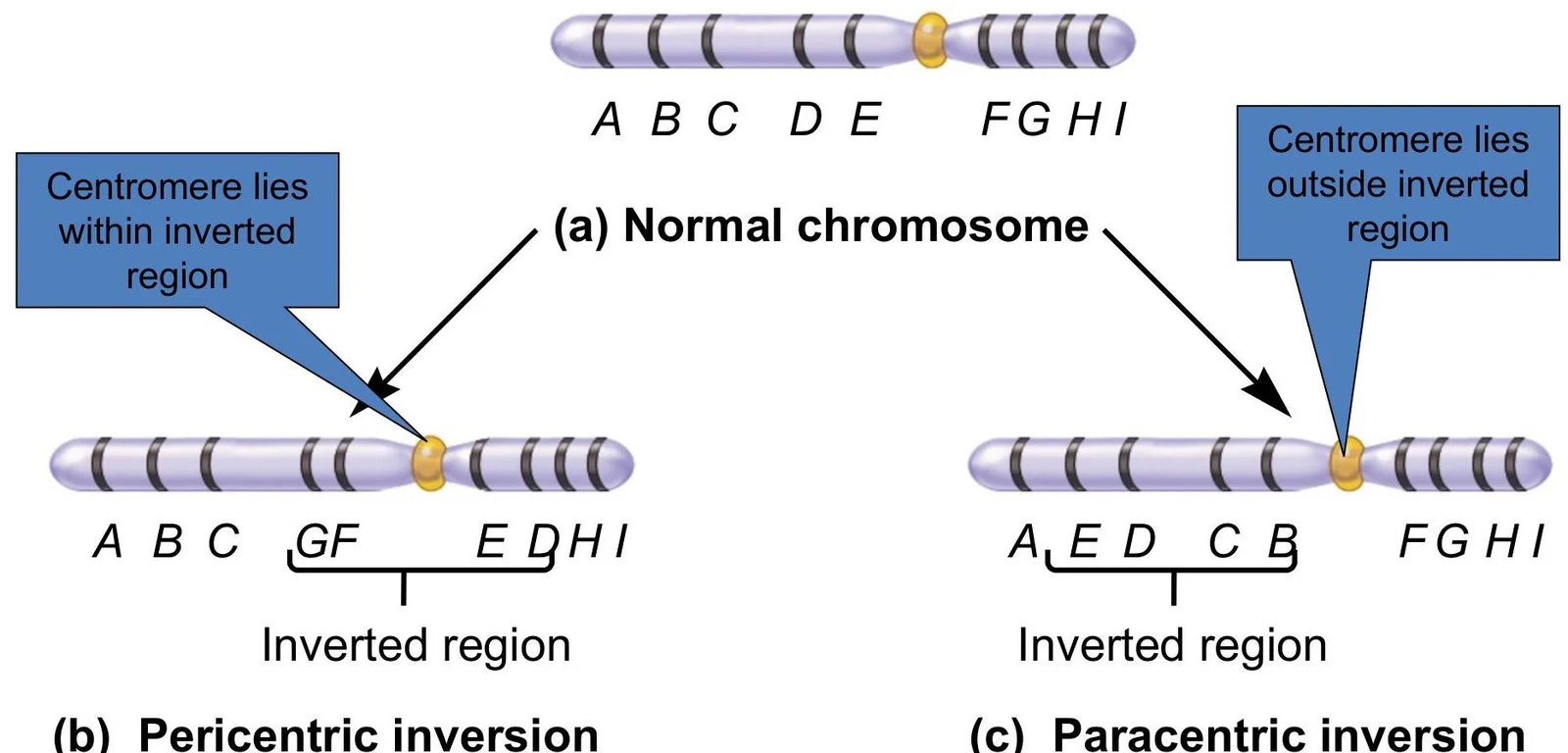
Inversions: An inversion occurs when a segment of genetic material breaks off and reattaches to the same chromosome but in the reverse direction. These can be classified as pericentric (involving the centromere) or paracentric (not involving the centromere).
Diagrams illustrating normal, pericentric, and paracentric inversions in chromosomes, showing the location of the centromere relative to the inverted region.
Translocations: This involves the movement of a segment from one chromosome to a different, non-homologous chromosome.
Simple Translocations: A one-way transfer where a piece of one chromosome attaches to another.
Reciprocal Translocations: A two-way exchange where two different chromosomes swap segments with each other.
Variation in Chromosome Number
Beyond structural changes, organisms can also vary in the total number of chromosomes they possess. These variations are divided into two main categories: Euploidy and Aneuploidy.
Euploidy: Changes in Complete Sets
Euploidy refers to a variation in the number of complete sets of chromosomes.
In Animals: Most animals are diploid ($2n$). While polyploidy (having more than two sets) is generally lethal in animals, some exceptions exist. For example, male honeybees are monoploid (having a single set), and some vertebrate frogs exhibit polyploidy. Additionally, certain tissues can exhibit endopolyploidy, where cells replicate their DNA without dividing, such as in the liver or the polytene chromosomes found in insect salivary glands.
In Plants: Euploidy is very common and often beneficial. Approximately 30-35% of ferns and flowering plants are polyploid. Many agricultural staples, such as wheat, are polyploid and often display larger, more robust characteristics.
Aneuploidy: Changes in Individual Chromosomes
Aneuploidy occurs when an individual has an abnormal number of a particular chromosome rather than a whole set. This creates a "gene dosage" imbalance. For example, having three copies of a gene results in 150% of the normal gene product, while having only one copy results in only 50%.
In humans, aneuploidy is a common cause of spontaneous abortion and can lead to various syndromes:
Trisomy 21 (Down Syndrome): Characterized by mental deficiencies and distinct physical features. The incidence of Down syndrome increases with maternal age.
Trisomy 13 (Patau Syndrome) and Trisomy 18 (Edward Syndrome): Both involve severe physical and mental deficiencies and often result in early death.
Sex Chromosome Aneuploidies: Conditions like Klinefelter syndrome (XXY) or Turner syndrome (X0) are generally less severe than autosomal aneuploidies, partly due to the mechanism of X inactivation.
Mechanisms of Chromosomal Variation
How do these errors occur? There are three primary natural mechanisms:
Meiotic Nondisjunction: This is the failure of chromosomes to segregate properly during anaphase in meiosis. If this occurs in Meiosis I, all four resulting gametes will be abnormal. If it occurs in Meiosis II, only 50% of the gametes will be abnormal.
Mitotic Abnormalities: If nondisjunction or chromosome loss occurs during mitosis after fertilization, the resulting organism will exhibit mosaicism—a condition where different cells in the body have different genetic makeups. A rare, extreme example is a bilateral gynandromorph, where an organism displays both male and female physical characteristics on different sides of its body.
Interspecies Crosses: Hybridization between different species can also lead to changes in chromosome sets.
Exam Tip: When distinguishing between Euploidy and Aneuploidy, remember that Euploidy involves changes in the entire set (e.g., $3n, 4n$), whereas Aneuploidy involves a change in individual chromosomes (e.g., 2n+1 or 2n−1).
Keep reading for free.
Create an account to finish this reading and make it part of your study routine.