Chromosomal Abnormalities and Polyploidy in Genetics
This content explains chromosomal abnormalities like aneuploidy, caused by nondisjunction during meiosis, and polyploidy, the presence of extra chromosome sets. It details their genetic basis, phenotypic consequences, and significance in evolution and agriculture.
In the study of genetics, the stability of the genome is fundamental to the survival and development of an organism. Most animal species are diploid ($2n$), meaning they possess two copies of each gene. However, errors during cell division can lead to significant changes in chromosome number, a phenomenon known as aneuploidy. These abnormalities can range from subtle genetic variations to severe developmental disorders, and in some cases, they can even drive the evolutionary process through polyploidy.
Nondisjunction: The Root of Aneuploidy
Aneuploidy occurs when an individual has an abnormal number of chromosomes, typically due to nondisjunction. Nondisjunction is the failure of chromosomes or sister chromatids to separate properly during cell division. Depending on when this error occurs, the resulting gametes and offspring will have different genetic profiles.
Meiosis I vs. Meiosis II Nondisjunction
The timing of the error during meiosis is critical to the genetic outcome:
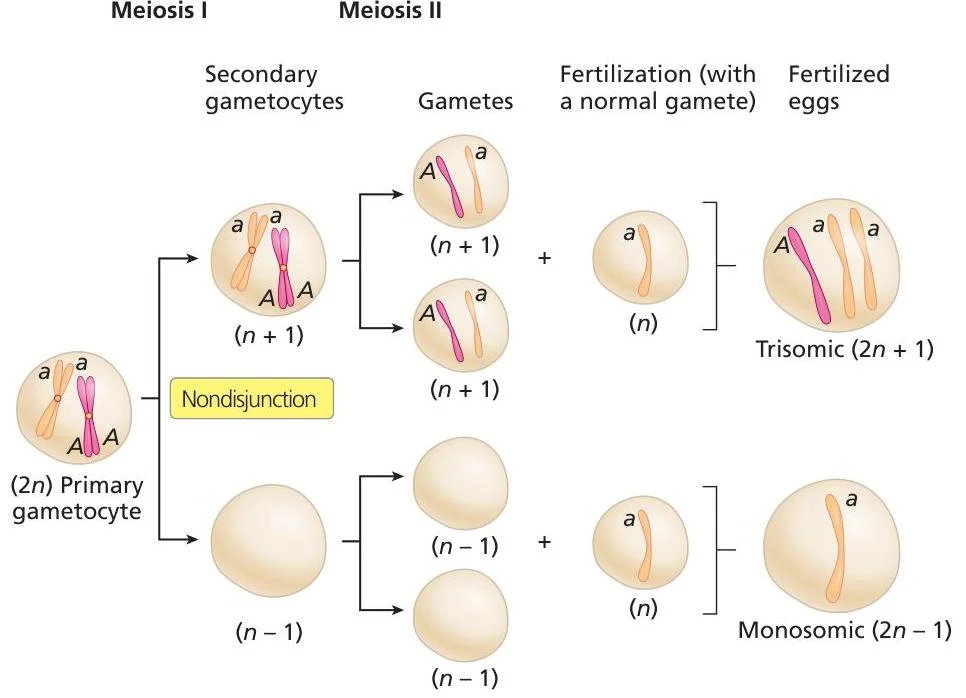
Meiosis I Nondisjunction: This occurs when homologous chromosomes fail to separate. As a result, both homologs move to a single pole, creating gametes that are either n+1 (containing both homologs) or n−1 (containing neither). If these gametes are fertilized by a normal haploid gamete, the resulting zygote will be either trisomic (2n+1) or monosomic (2n−1).
Diagram illustrating nondisjunction during meiosis, leading to aneuploid gametes and resulting in trisomic and monosomic fertilized eggs.
Meiosis II Nondisjunction: In this scenario, meiosis I proceeds normally, but the sister chromatids fail to separate during meiosis II. This error only affects one of the two secondary gametocytes. Consequently, half of the resulting gametes are normal (n), while the other half are aneuploid (n+1 and n−1).
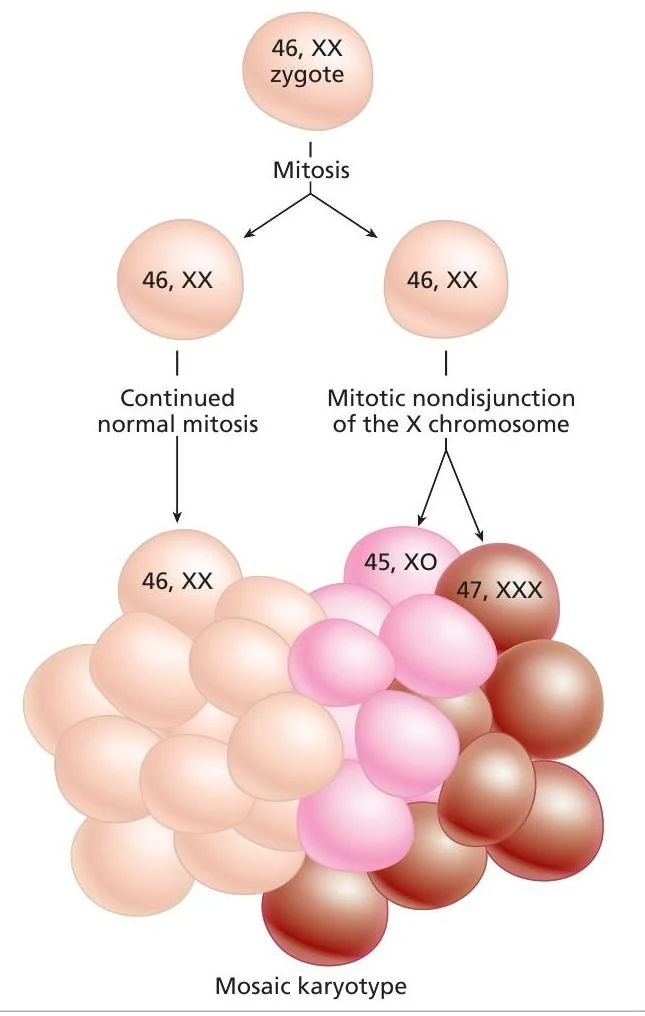
Diagram illustrating the process of mitotic nondisjunction of the X chromosome, leading to a mosaic karyotype with cells having 46, XX, 45, XO, and 47, XXX chromosomal compositions.
Exam Tip: Remember that Meiosis I nondisjunction affects all four resulting gametes, whereas Meiosis II nondisjunction only affects two of the four gametes.
Gene Dosage and Phenotypic Consequences
The biological impact of aneuploidy is driven by gene dosage—the number of copies of a gene present in the genome. In a normal diploid, a gene has a dosage of 100%. A monosomic individual has only 50% dosage, while a trisomic individual has 150%. This imbalance of gene products can disrupt complex developmental pathways, particularly in the nervous system.
Human Aneuploidies
Humans are exceptionally sensitive to gene dosage imbalances, and many aneuploidies are incompatible with life.
Trisomy 21 (Down Syndrome)
Trisomy 21 is the most common autosomal trisomy observed at birth. Most cases are caused by maternal nondisjunction during meiosis I, resulting in a child inheriting two identical maternal copies of chromosome 21 and one paternal copy.
Researchers have identified the Down syndrome critical region (DSCR), a specific portion of chromosome 21 that is responsible for the syndrome's characteristic physical and developmental symptoms. Studies in mice suggest that increased dosage of specific genes within this region, such as DYRK and DSCAM, contributes to brain size reduction and heart abnormalities.
Turner Syndrome and Monosomy
While autosomal monosomies are almost always lethal in humans, sex-chromosome monosomy can occur. Turner Syndrome is a condition where females possess only one X chromosome (XO). This condition is often linked to haploinsufficiency, where a single copy of a gene (such as the SHOX gene) is insufficient to provide the protein levels required for normal development.
Mosaicism and Uniparental Disomy
Not all chromosomal abnormalities affect every cell in an organism.
Mosaicism: This occurs when an organism possesses two or more genetically different cell lines. This is typically the result of mitotic nondisjunction occurring during early embryonic development rather than during meiosis.
Uniparental Disomy (UPD): This is a condition where an individual inherits both copies of a homologous chromosome pair from a single parent. This often arises through trisomy rescue, a process where an initially trisomic zygote ejects one of the three chromosomes during early mitosis to restore a diploid number, potentially leaving two chromosomes from the same parent. UPD is a known factor in conditions such as Angelman and Prader-Willi syndromes.
Polyploidy: Changes in Euploid Content
While aneuploidy involves the gain or loss of individual chromosomes, polyploidy refers to the presence of three or more complete sets of chromosomes ($3n, 4n, 5n$, etc.). Unlike animals, which are mostly diploid, polyploidy is quite common in many plant species.
Autopolyploidy vs. Allopolyploidy
There are two primary mechanisms by which polyploidy arises:
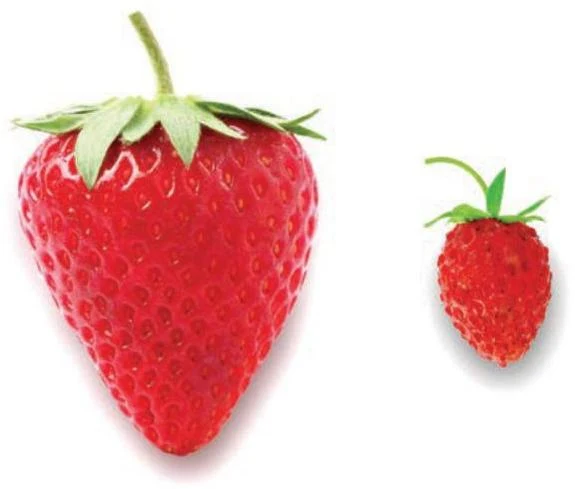
Autopolyploidy: The chromosome sets are derived from a single species. An example is the commercial octaploid strawberry ($8n$).
A large garden strawberry next to a small wild strawberry.
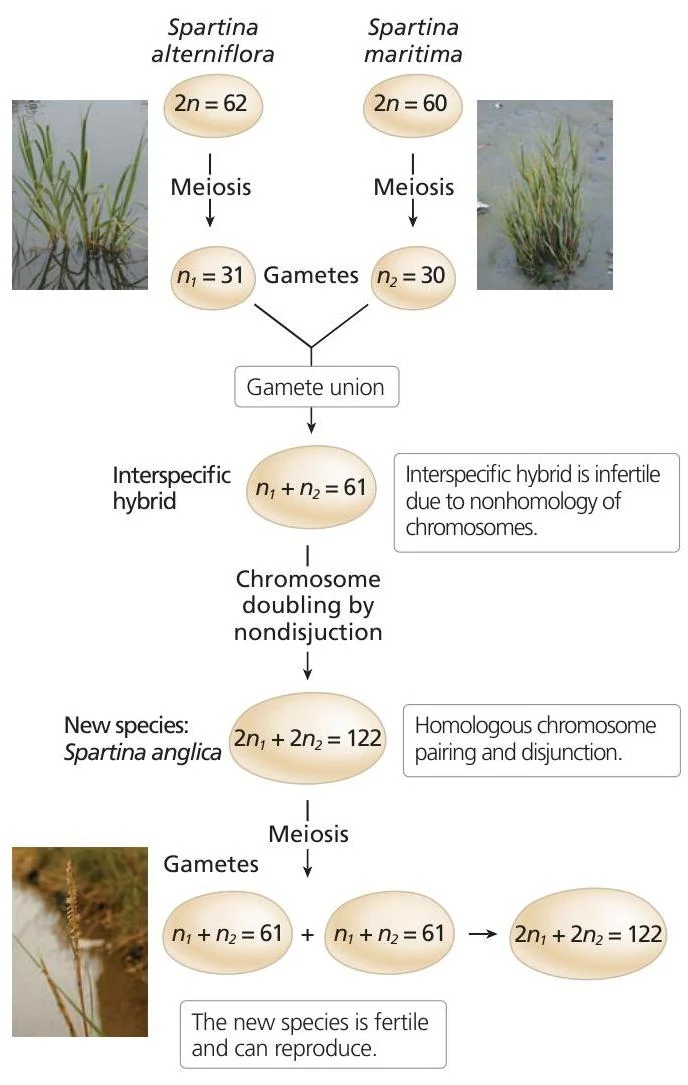
Allopolyploidy: The chromosome sets are derived from two or more different species. This usually follows interspecific hybridization followed by chromosome doubling. Bread wheat is a classic example of an allopolyploid.
Diagram illustrating the process of polyploid speciation in Spartina anglica, originating from the hybridization of Spartina alterniflora and Spartina maritima, followed by chromosome doubling.
Evolutionary and Commercial Significance
Polyploidy has profound implications for both evolution and agriculture:
Hybrid Vigor: In plants, polyploidy is often used commercially to increase fruit and flower size and enhance hybrid vigor, which includes increased growth rates and disease resistance.
Seedless Fruits: Odd-numbered polyploids, such as triploids ($3n$), often suffer from reduced fertility because their chromosomes cannot be evenly distributed during meiosis. This biological "defect" is exploited by humans to produce seedless watermelons and other fruits.
Speciation: Evolutionarily, polyploidy can act as a mechanism for speciation. Because polyploid individuals often cannot successfully interbreed with their diploid parental lineages, they become immediately reproductively isolated, forming new species.
This diagram illustrates the evolutionary history of wheat, showing the ancestral species and their hybridization over time to produce modern wheat varieties.
Keep reading for free.
Create an account to finish this reading and make it part of your study routine.