Chemistry Study Guide: Atoms, Molecules, and Reactions
A comprehensive guide to the fundamental principles of chemistry, covering atomic structure, chemical bonding, and chemical reactions, including the role of enzymes in biological systems.
Understanding the building blocks of matter is essential for grasping how biological systems function. From the way cells generate energy to the way DNA holds genetic information, every physiological process is rooted in the behavior of atoms and molecules. This guide will walk you through the fundamental principles of atomic structure, the forces that bind atoms together, and the chemical reactions that drive life.
Atomic Structure: The Building Blocks
Everything in the universe is composed of matter, and the smallest unit of an element—a substance that cannot be broken down into simpler substances—is the atom. While an element defines the identity of an atom, the arrangement of its subatomic particles determines how that atom will behave in a chemical environment.
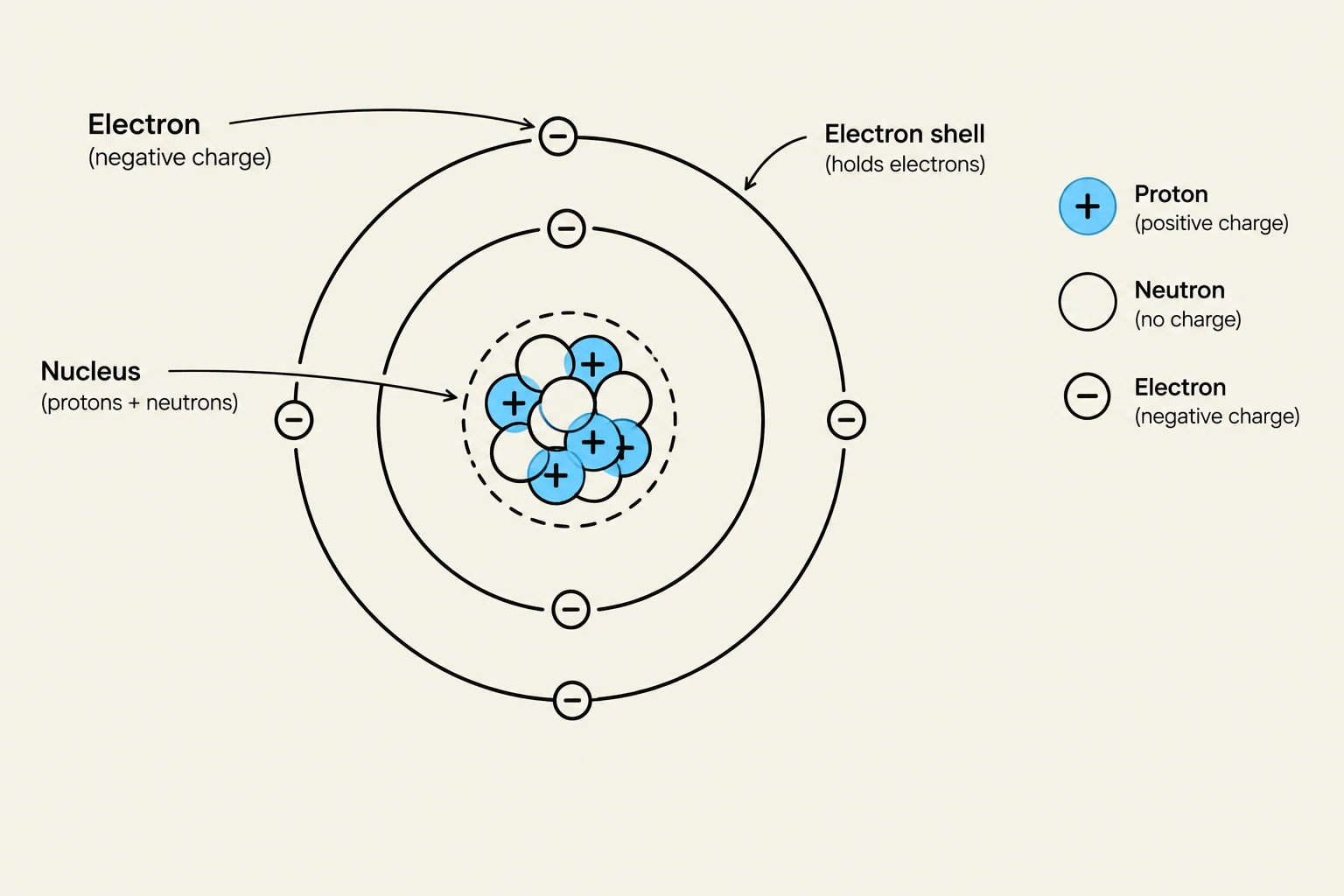
An atom consists of two main regions: a central nucleus and surrounding electron shells.
Protons: Located in the nucleus, these carry a positive charge and determine the atom's identity.
Neutrons: Also located in the nucleus, these are neutral (no charge) and contribute to the atom's mass.
Electrons: These are much smaller, negatively charged particles that orbit the nucleus in specific energy levels called electron shells.
The number of electrons in these shells is the primary driver of chemical reactivity. The first shell is limited to a maximum of two electrons, while subsequent shells can hold more. The outermost shell is known as the valence shell.
The Octet Rule: Atoms are most stable when their valence shell is full. For most elements, this means having eight electrons in the valence shell. If a shell is incomplete, the atom is considered "reactive" and will seek to gain, lose, or share electrons to achieve stability.
Diagram illustrating the structure of an atom, showing a nucleus composed of protons and neutrons, orbited by electrons in electron shells.
Chemical Bonding: Creating Molecules and Compounds
When atoms interact to achieve stability, they form chemical bonds. A molecule is formed when two or more atoms are chemically bonded together. When those atoms come from different elements, the resulting structure is called a compound.
There are three primary types of chemical bonds that dictate how matter is structured:
1. Ionic Bonds
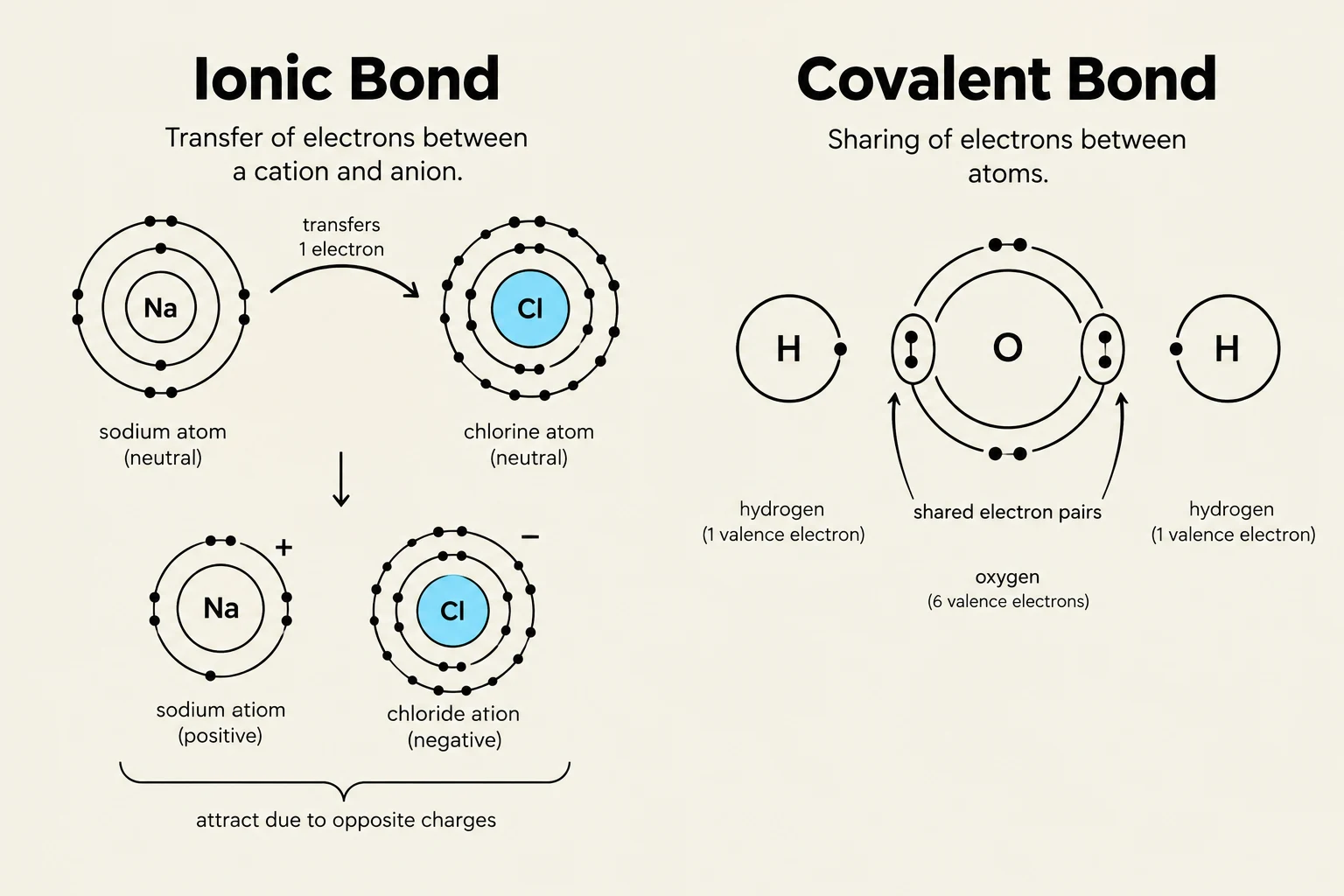
Ionic bonds occur when one atom transfers one or more electrons to another atom. This transfer creates ions—atoms with a net electrical charge.
Cation: An ion with a positive charge, formed when an atom loses electrons.
Anion: An ion with a negative charge, formed when an atom gains electrons.
Because opposite charges attract, the cation and anion bond strongly together. Substances that dissociate into these ions when dissolved in water are known as electrolytes, which are vital for physiological functions like nerve signaling.
2. Covalent Bonds
Covalent bonds are formed when atoms share electrons to satisfy the octet rule. These are generally stronger and more stable in biological systems than ionic bonds.
Nonpolar Covalent Bonds: Electrons are shared equally between atoms.
Polar Covalent Bonds: Electrons are shared unequally, creating partial positive and negative charges within the molecule.
Double Covalent Bonds: These involve the sharing of two pairs of electrons between atoms.
3. Hydrogen Bonds
Hydrogen bonds are much weaker than ionic or covalent bonds. They are attractions between a partially positive hydrogen atom in one molecule and a partially negative atom (often oxygen or nitrogen) in another molecule. A classic example is the attraction between water molecules, which gives water its unique life-sustaining properties.
Diagrams illustrating ionic and covalent bonds, showing the transfer and sharing of electrons between atoms.
Chemical Reactions and Reaction Rates
A chemical reaction is a process where reactants (the starting substances) are transformed into products (the new substances). In biological systems, these reactions can be categorized into three basic types:
Synthesis: Two or more reactants combine to form a single product.
A+B→AB
Decomposition: A single reactant breaks down into two or more products.
AB→A+B
Replacement (Displacement): Atoms or groups of atoms are exchanged between molecules.
AB+CD→AC+BD
Exam Tip: Pay close attention to the formation of ATP (Adenosine Triphosphate). Cells create ATP by adding a phosphate ion to ADP (Adenosine Diphosphate). This is a synthesis reaction that stores energy for cellular work.
The speed at which these reactions occur is known as the chemical reaction rate. Several factors influence this rate:
Temperature: Generally, increasing temperature increases the reaction rate.
Concentration: Higher concentrations of reactants typically speed up reactions.
Pressure: Changes in pressure can affect reaction rates, particularly in gaseous systems.
The Role of Enzymes
While temperature and concentration affect reaction rates, biological organisms cannot simply raise their body temperature to speed up metabolism, as high heat would destroy proteins and cells. Instead, life relies on enzymes.
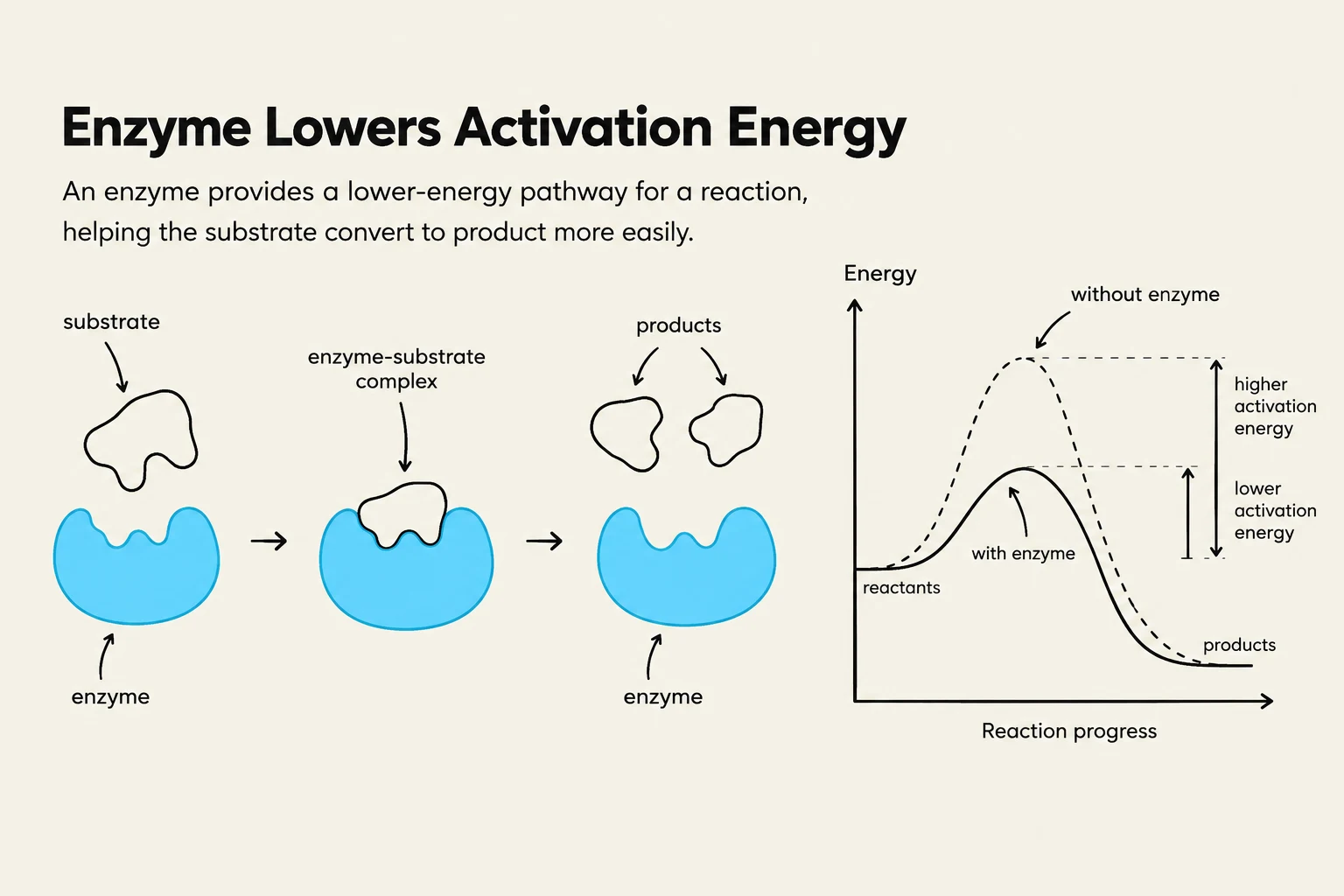
Enzymes are biological catalysts. A catalyst is a substance that increases the rate of a chemical reaction without being consumed in the process. By lowering the energy required to start a reaction, enzymes allow essential life processes—such as digestion and DNA replication—to occur efficiently at physiological temperatures.
This diagram illustrates how enzymes lower the activation energy required for a chemical reaction, facilitating the conversion of substrates into products by providing a lower-energy pathway.
Keep reading for free.
Create an account to finish this reading and make it part of your study routine.