Explore the fundamental building blocks of genetic information: nucleic acids. This guide details the structure of nucleotides, the chemical differences between DNA and RNA, the roles of nitrogenous bases, and the various conformations and stability of DNA.
Nucleic acids are the fundamental biological macromolecules responsible for storing, transmitting, and expressing genetic information. Composed of repeating units called nucleotides, these polymers form the structural basis of DNA (deoxyribonucleic acid) and RNA (ribonucleic acid). Understanding their chemical composition—from the covalent bonds that form their backbones to the hydrogen bonds that stabilize their double helices—is essential for grasping how life functions at a molecular level.
The Building Blocks: Nucleotides and Polynucleotides
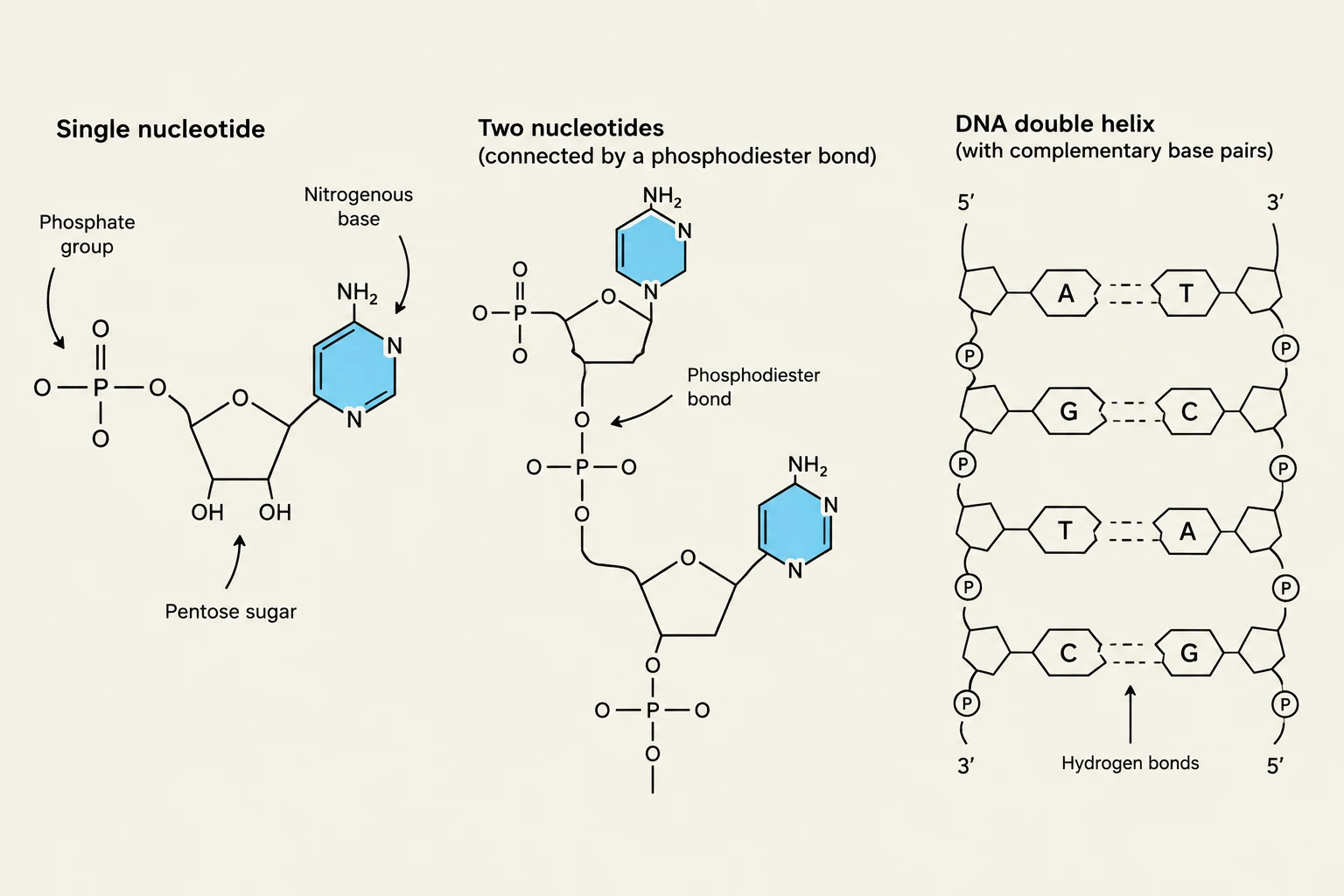
Diagrams illustrating a single nucleotide, two nucleotides connected by a phosphodiester bond, and the DNA double helix with complementary base pairs and hydrogen bonds.
A nucleotide is an organic compound consisting of three joined structures: a nitrogenous base, a pentose sugar (either ribose or deoxyribose), and a phosphate group. The base is covalently attached to the 1’ carbon of the sugar via an N−β-glycosyl bond.
When these nucleotides link together, they form chains. The nature of these chains is defined by their length:
Oligonucleotides: Short chains consisting of 50 or fewer nucleotides.
Polynucleotides: Longer chains of nucleotides.
The nucleotides are connected by phosphodiester bonds. In this linkage, the 5’-phosphate group of one nucleotide is joined to the 3’-hydroxyl group of the next. This creates a directional "backbone" that allows for the organized storage of genetic sequences.
Chemical Stability and the Role of the 2’-Hydroxyl Group
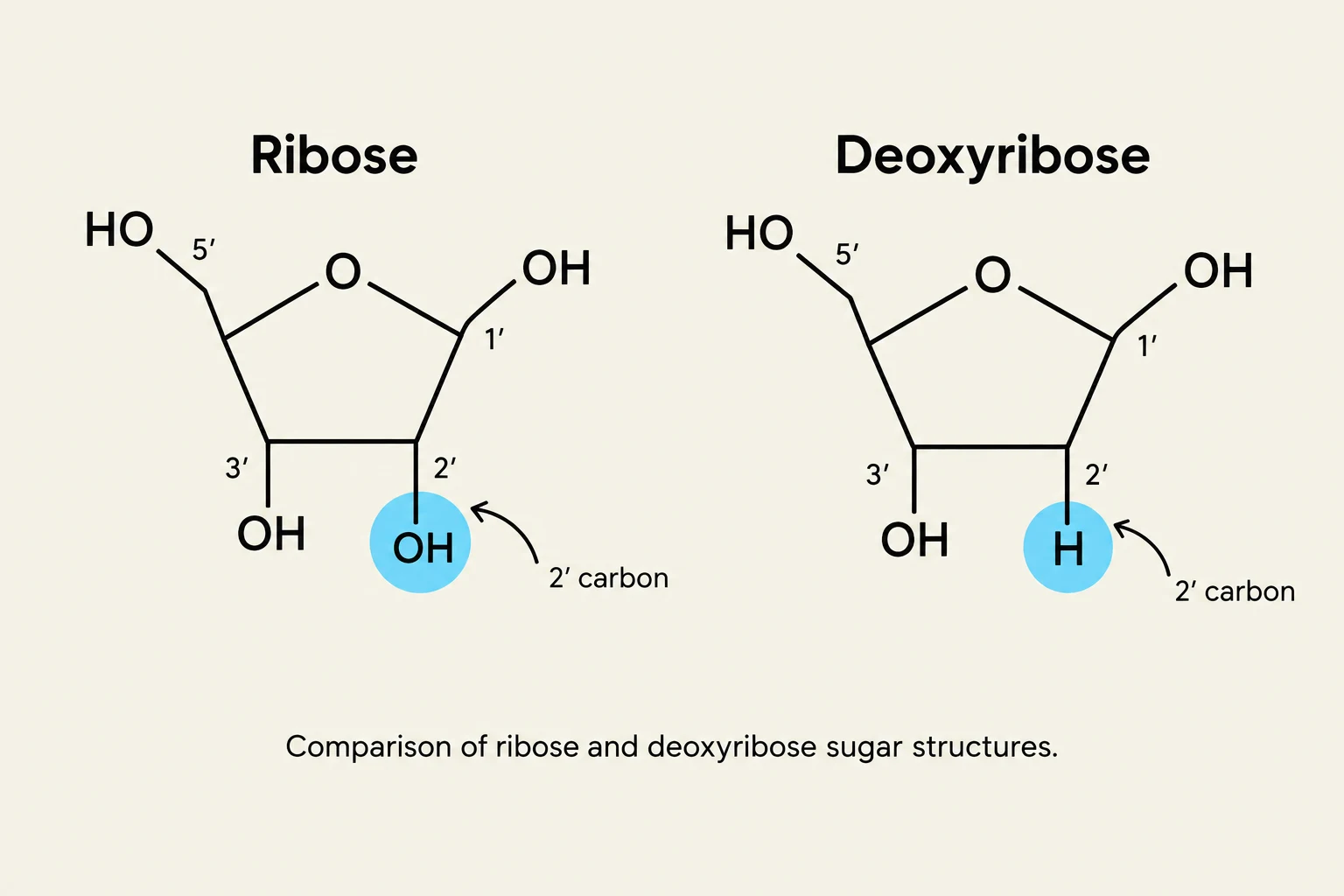
Comparison of ribose and deoxyribose sugar structures.
A critical difference between DNA and RNA lies in the sugar component. RNA contains ribose, while DNA contains 2’-deoxyribose. This seemingly small difference—the presence or absence of a hydroxyl (-OH) group at the 2’ position—has profound implications for chemical stability.
The covalent backbone of both molecules is subject to slow, nonenzymatic hydrolysis. However, RNA is significantly more susceptible to rapid hydrolysis under alkaline (basic) conditions. This is because the 2’-hydroxyl group in RNA acts as a nucleophile in an intramolecular displacement reaction. This process forms 2’,3’-cyclic monophosphate intermediates, which are then further hydrolyzed into a mixture of 2’- and 3’-nucleoside monophosphates. Because DNA lacks this 2’-hydroxyl group, its backbone remains much more stable under similar conditions.
Exam Tip: If asked why DNA is a better long-term storage molecule than RNA, focus on the absence of the 2’-OH group, which prevents the rapid alkaline hydrolysis seen in RNA.
Nitrogenous Bases: Purines and Pyrimidines
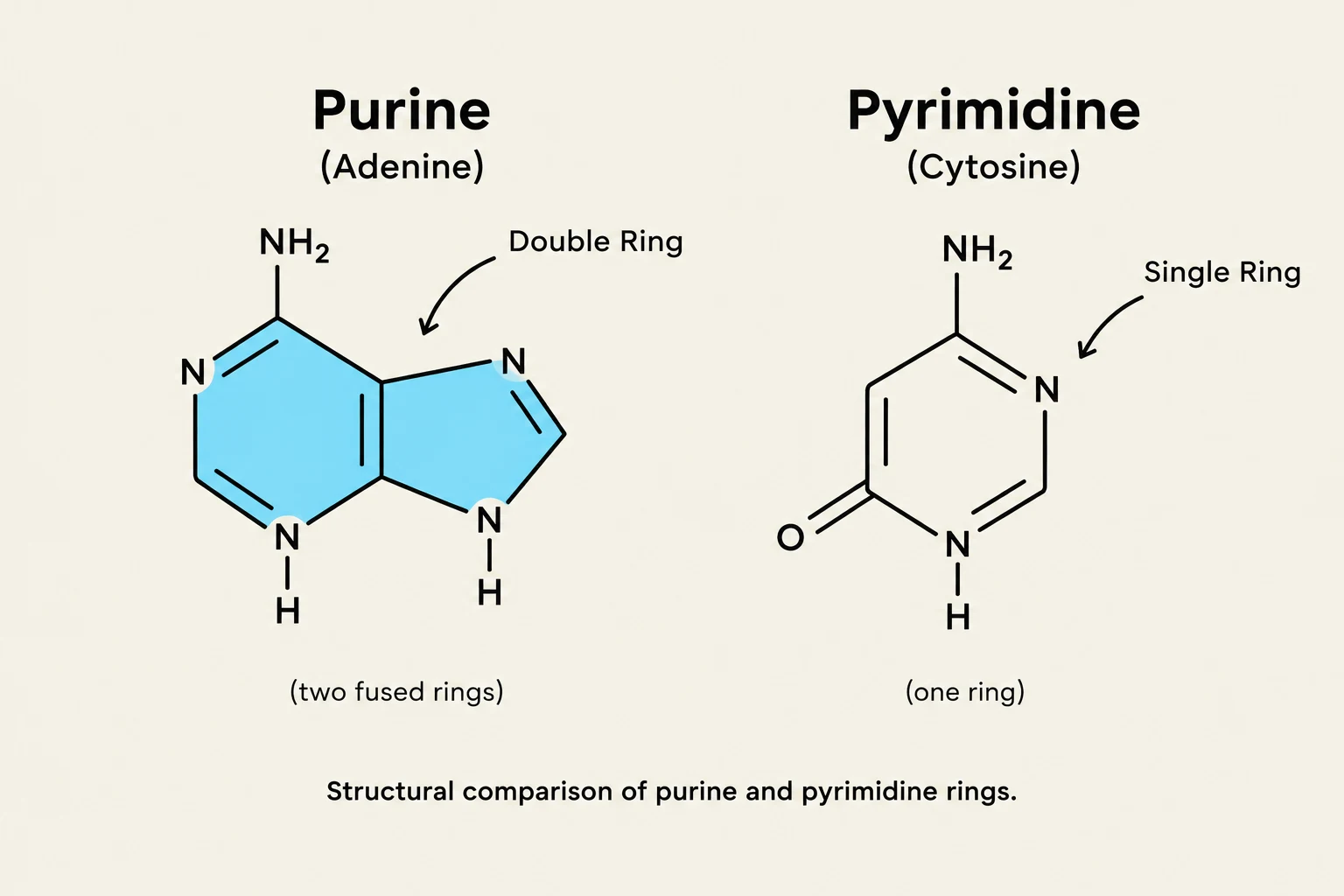
Structural comparison of purine and pyrimidine rings, illustrating the double-ring structure of purines (like adenine) and the single-ring structure of pyrimidines (like cytosine).
The information within a nucleic acid is encoded by its nitrogenous bases. These are categorized into two groups based on their ring structure:
Purines: Double-ring structures, including Adenine (A) and Guanine (G).
Pyrimidines: Single-ring structures, including Cytosine (C), Thymine (T) (found in DNA), and Uracil (U) (found in RNA).
These bases are highly conjugated molecules, meaning they possess extensive systems of alternating single and double bonds. Due to resonance within these ring structures, the bonds exhibit partial double-bond character. This electronic structure has two major physical consequences:
UV Light Absorption: All nucleotide bases strongly absorb ultraviolet light, specifically at a wavelength of approximately 260 nm.
Solubility: The bases are hydrophobic and relatively insoluble in water at the near-neutral pH found in cells. However, if the pH becomes acidic or alkaline, the bases become charged, which increases their solubility.
The interaction between two complementary strands (e.g., A pairing with T/U, and G pairing with C) is mediated by hydrogen bonds involving the amino and carbonyl groups of the bases.
Three-Dimensional Conformations of DNA
DNA does not exist in a single rigid shape; rather, it can adopt different three-dimensional conformations depending on its environment:
Feature
A-form
B-form
Z-form
Helical Sense
Right-handed
Right-handed
Left-handed
Diameter
∼26A˚
∼20A˚
∼18A˚
Base pairs per turn
∼11
∼10.5
∼12
Sugar pucker
C−3′ endo
C−2′ endo
C−2′ endo (pyr);C−3′ endo (pur)
The B-form is considered the standard biological conformation of DNA.
Denaturation, Renaturation, and Hybridization
The stability of the double helix depends on the hydrogen bonds between bases. These bonds can be broken through a process called denaturation. Denaturation is typically caused by:
Significant changes in pH.
An increase in temperature.
When the strands separate, two measurable changes occur: the solubility of the nucleic acid increases, and its UV light absorption increases significantly—a phenomenon known as the hyperchromic effect.
If the environmental conditions (temperature and pH) return to normal, the separated strands can find their complementary partners and reform the double helix; this is called renaturation. If two different species of DNA are denatured and then allowed to renature, they may form complementary "hybrid" helices, a process known as hybridization.
Base Modifications and Mutations
The chemical integrity of DNA is constantly under threat from spontaneous alterations. These include:
Deamination: The conversion of one base to another (e.g., via nitrous acid).
Hydrolysis of the N-glycosyl bond: This results in the loss of the base from the sugar.
UV-induced damage: UV light can cause adjacent pyrimidines to bond covalently, forming cyclobutane pyrimidine dimers.
Alkylation: Chemical agents can add alkyl groups to bases, such as methylating guanine, which prevents proper base-pairing.
While some modifications are enzymatic and regulatory (such as methylation), spontaneous alterations that result in permanent changes to the genetic code are known as mutations.
Keep reading for free.
Create an account to finish this reading and make it part of your study routine.