An exploration of the fundamental principles of chemical equations, the quantitative aspects of stoichiometry, and the energetics that drive chemical reactions, including reaction types, limiting reactants, and factors affecting reaction rates.
Chemistry is often described as the study of change. When substances interact, they undergo chemical reactions to form new substances with different properties. To master chemistry, one must understand not just what happens during these changes, but how much of each substance is involved and how energy moves during the process. This article explores the fundamental principles of chemical equations, the quantitative math of stoichiometry, and the energetics that drive reactions.
Understanding Chemical Equations
A chemical equation is a symbolic representation of a chemical reaction. It shows the reactants (starting materials) on the left and the products (resulting substances) on the right. For an equation to be valid, it must be balanced. This is required by the Law of Conservation of Mass, which dictates that atoms are neither created nor destroyed during a reaction; they are simply rearranged.
Classifying Reaction Types
Chemical reactions can be categorized into several distinct types based on how the atoms are rearranged:
Synthesis: Two or more reactants combine to form a single product (A+B→AB).
Decomposition: A single compound breaks down into two or more simpler substances (AB→A+B).
Single Replacement (Displacement): One element replaces another element in a compound (A+BC→AC+B).
Double Replacement (Displacement): Two compounds exchange ions to form two new compounds (AB+CD→AD+CB).
Oxidation-Reduction (Redox): These reactions involve the transfer of electrons between species.
Oxidation is the loss of electrons, resulting in an increase in oxidation number.
Reduction is the gain of electrons, resulting in a decrease in oxidation number.
The substance that is oxidized acts as the reducing agent, while the substance that is reduced acts as the oxidizing agent.
Exam Tip: To identify redox reactions, look for changes in oxidation states. For example, if a neutral metal atom (charge 0) becomes a positive ion (charge +1 or +2), it has been oxidized.
Stoichiometry: The Mathematics of Chemistry
Stoichiometry is the study of the quantitative relationships between reactants and products in a chemical reaction. Because equations are balanced in terms of moles, we use the mole ratio to convert between different substances.
The Stoichiometric Workflow
To solve a stoichiometry problem, follow these standard steps:
Convert Mass to Moles: Use the molar mass of the substance.
moles=molar massmass
Use the Mole Ratio: Look at the coefficients in the balanced equation to transition from your known substance to your unknown substance.
Convert Moles back to Mass: If the question asks for grams, multiply the moles by the molar mass.
Limiting and Excess Reactants
In many real-world scenarios, reactants are not provided in the exact amounts required by the balanced equation. This leads to two important concepts:
Limiting Reactant: The reactant that is completely consumed first. It dictates the maximum amount of product that can be formed.
Theoretical Yield: The maximum amount of product that can be produced based on the limiting reactant.
Excess Reactant: The reactant that remains after the limiting reactant has been exhausted.
Analogy for Limiting Reactants: Imagine making sandwiches. If a recipe requires 2 slices of bread and 1 slice of cheese, and you have 10 slices of bread and 3 slices of cheese, you can only make 3 sandwiches. The cheese is the limiting reactant, and the 3 sandwiches represent your theoretical yield.
Percent Yield
In practice, the amount of product actually collected in a lab (the actual yield) is often less than the calculated theoretical yield due to spills, incomplete reactions, or side reactions. We measure this efficiency using the percent yield formula:
Chemical reactions are also governed by the Law of Conservation of Energy, which states that energy is neither created nor destroyed, only transformed. The way energy moves between a reaction and its surroundings defines the reaction type.
Exothermic vs. Endothermic Reactions
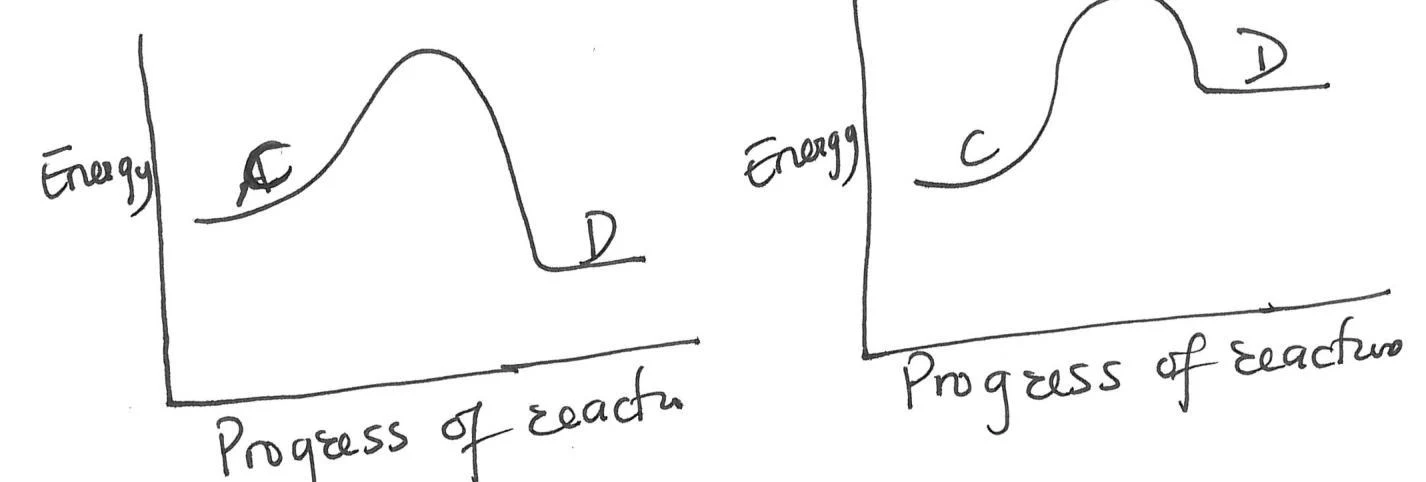
Exothermic Reactions: These reactions release energy (usually as heat) to the surroundings. Because they release energy, they are often considered spontaneous (occurring without continuous external intervention). In an exothermic reaction, the temperature of the surroundings increases.
Endothermic Reactions: These reactions absorb energy from the surroundings. They are considered non-spontaneous because they require a continuous input of energy to proceed. In an endothermic process, the temperature of the surroundings decreases.
Energy profile diagrams illustrating reaction progress.
Reaction Energy Diagrams and Activation Energy
To transform from reactants to products, a reaction must overcome an energy barrier called the activation energy (Ea).
A reaction energy profile diagram showing activation energy and enthalpy change.
The height of this barrier determines how easily a reaction can proceed.
Factors Affecting Reaction Rate
The reaction rate is the speed at which reactants turn into products. Several factors can influence this speed:
Concentration: Increasing the concentration of reactants typically increases the reaction rate because there are more particles available to collide.
Temperature: Increasing the temperature provides particles with more kinetic energy, making it easier to overcome the activation energy barrier.
Activation Energy: Using a catalyst to lower the required activation energy will significantly increase the reaction rate.
Keep reading for free.
Create an account to finish this reading and make it part of your study routine.