Chemical Reactions and Gibbs Free Energy in Metabolism
Explore the fundamental concepts of reversible and irreversible chemical reactions, equilibrium, and Gibbs free energy (ΔG) as they apply to biological systems and metabolic pathways. Understand exergonic and endergonic reactions and the role of enzymes in overcoming activation energy.
In the complex environment of a living cell, thousands of chemical reactions occur simultaneously to maintain life. This entire network of reactions is known as metabolism. Metabolism is not a random collection of events; it is a highly organized system of pathways that allow cells to build structures, break down nutrients, and manage energy. To understand how these biological processes are controlled and why some reactions happen spontaneously while others require constant energy input, we must look at the nature of chemical reactions and the concept of Gibbs free energy.
Reversible and Irreversible Reactions
Chemical reactions in biological systems can be categorized based on their directionality. Understanding this distinction is crucial for understanding how cells regulate metabolic flux and prevent "futile cycles"—situations where two opposing reactions run at the same time with no net production of ATP, essentially wasting energy.
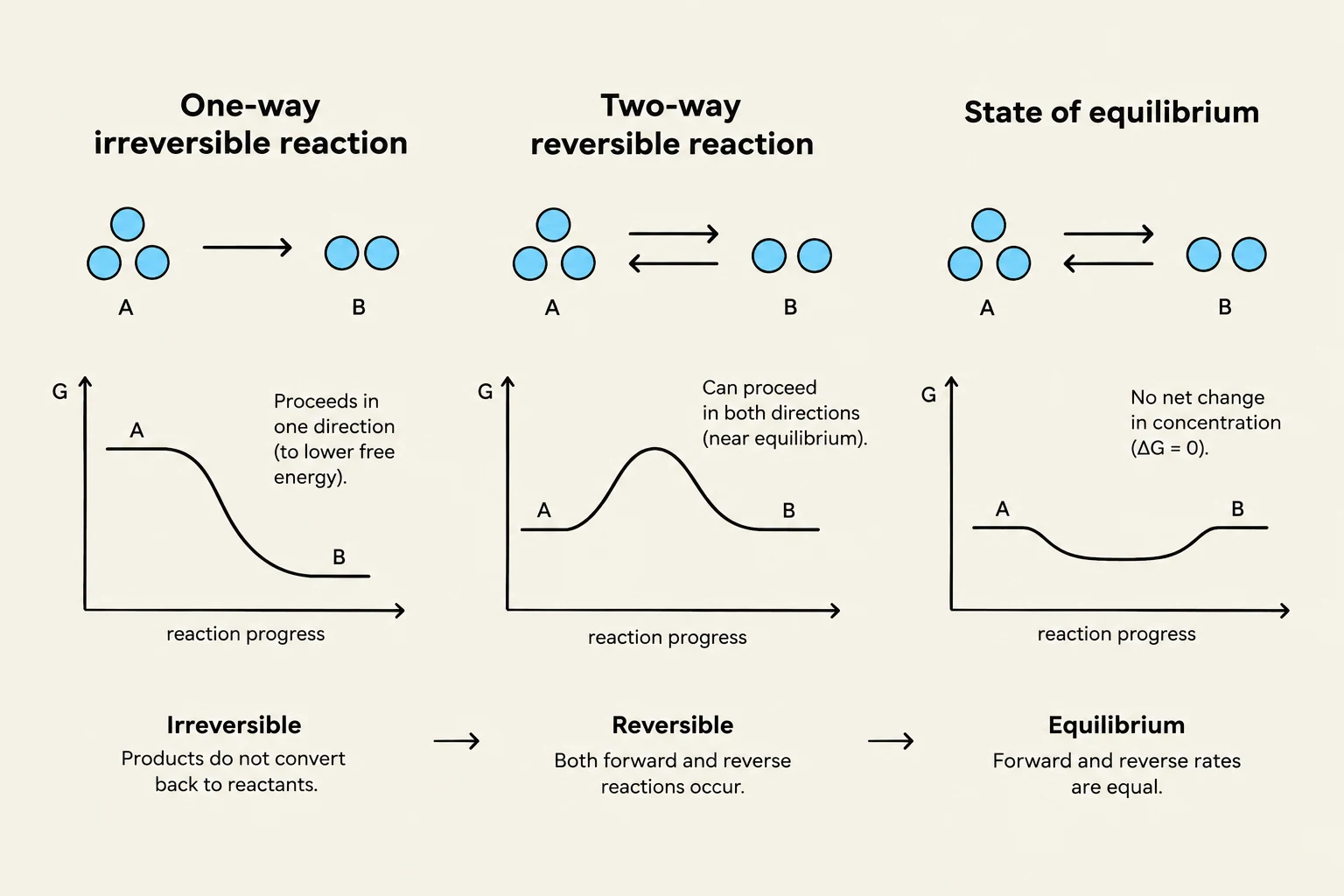
Irreversible chemical reactions are those that can occur in only one direction. In metabolic pathways, these are often the "control points." Cells utilize irreversible steps to ensure that a pathway moves forward and to keep opposing processes, such as anabolism (synthesis) and catabolism (degradation), separate.
Reversible chemical reactions can occur in both directions. These reactions allow the cell to adjust the concentrations of metabolites based on current needs.
Equilibrium is a specific state reached by reversible reactions. It occurs when the forward and reverse reactions happen at the same rate, resulting in no overall change in the amounts of reactants and products.
Diagrams illustrating irreversible reactions, reversible reactions, and the state of equilibrium, showing energy profiles and molecular representations.
Exam Tip: In metabolic regulation, cells often use irreversible reactions to act as "valves." If a reaction were entirely reversible and reached equilibrium, the cell would lose its ability to drive the pathway toward a specific product.
Gibbs Free Energy and Reaction Favorability
To determine whether a reaction will proceed spontaneously, scientists use a thermodynamic value called Gibbs free energy (G). Gibbs free energy represents the "usable" energy available in a system to perform work.
When a reaction occurs, we look at the change in free energy (ΔG). The value of ΔG tells us about the energetic favorability of the process:
ΔG<0 (Negative): The reaction is energetically favorable. The products have lower free energy than the reactants.
ΔG>0 (Positive): The reaction is energetically unfavorable. The products have higher free energy than the reactants.
ΔG=0: The system is at equilibrium.
This graph illustrates the energy profile of an exergonic reaction, showing the change in energy as reactants progress to products. It highlights the activation energy required for the reaction to occur and the overall decrease in energy (ΔG < 0) as the reaction proceeds.
Exergonic vs. Endergonic Reactions
In the context of metabolism, we classify reactions based on whether they release or consume energy. This is closely linked to the sign of ΔG.
Exergonic Reactions
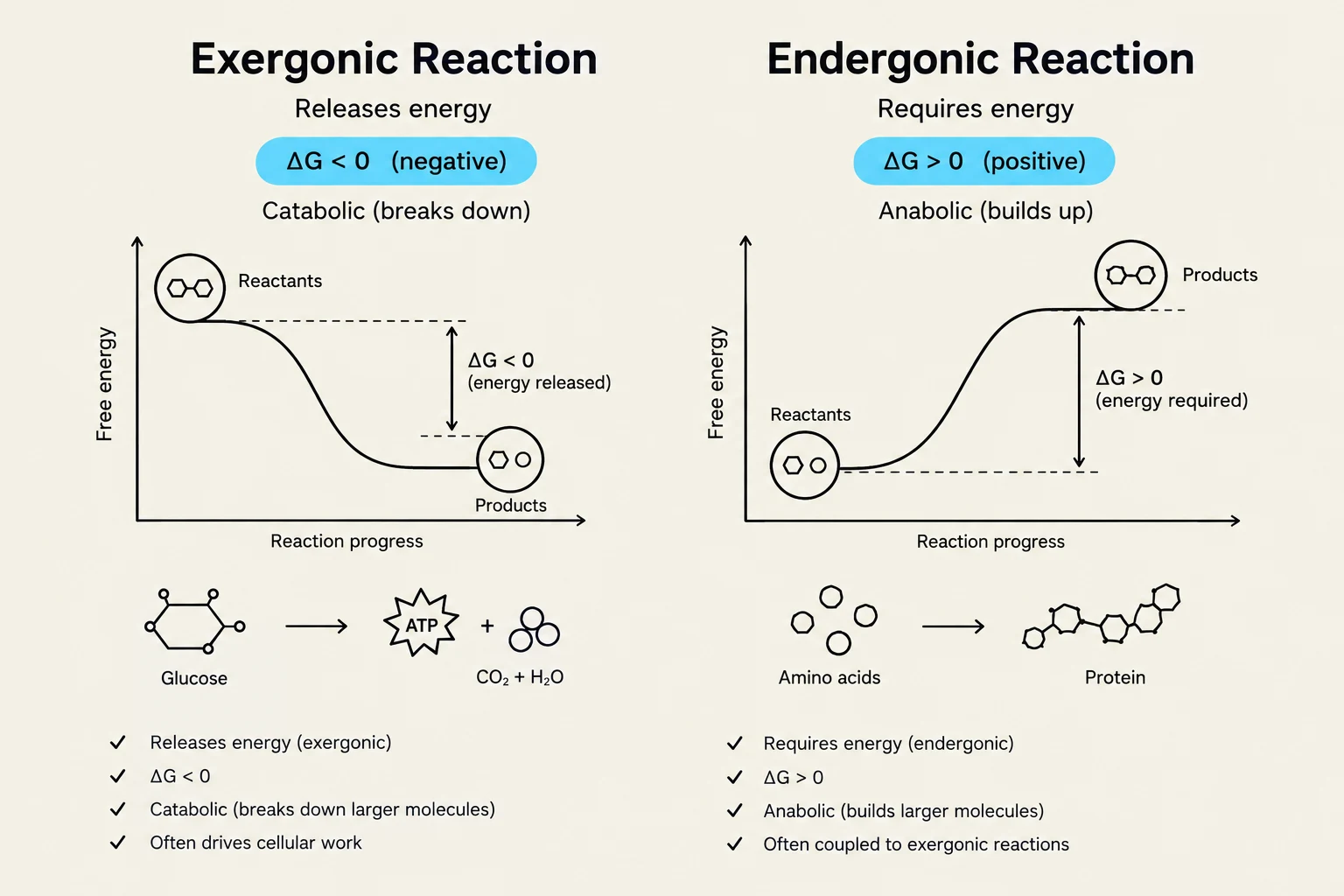
Exergonic reactions are characterized by a negative change in free energy (ΔG<0). These reactions release energy and are considered spontaneous and "favorable". In metabolism, catabolic pathways—which degrade complex molecules into smaller ones—are typically exergonic because they produce energy (such as ATP or NADH). Because they are irreversible, they serve as the driving force for many cellular processes.
Endergonic Reactions
Endergonic reactions are characterized by a positive change in free energy (ΔG>0). These reactions require an input of energy to proceed and are considered "unfavorable". Anabolic pathways—which synthesize macromolecules like proteins or nucleic acids for cell growth and maintenance—are endergonic.
This illustration compares exergonic and endergonic reactions, showing their energy profiles and examples. Exergonic reactions release energy (ΔG < 0) and are catabolic, like the breakdown of glucose. Endergonic reactions require energy (ΔG > 0) and are anabolic, like the synthesis of protein from amino acids.
Key Concept Connection: While an endergonic reaction is "unfavorable" on its own, cells make it happen by coupling it with a highly exergonic reaction (like the hydrolysis of ATP). This allows the overall ΔG of the combined process to be negative.
The Role of Enzymes and Activation Energy
It is important to note that even if a reaction is thermodynamically favorable (ΔG<0), it might not happen quickly enough to sustain life. This is due to activation energy, the energy barrier that must be overcome to start a reaction.
In a laboratory, extreme heat might provide enough energy to break down sugars, but biological systems cannot survive such temperatures. Instead, cells use enzymes—complex proteins that act as catalysts. Enzymes work by lowering the activation energy required for a reaction to occur, allowing vital metabolic processes to proceed rapidly at body temperature.
Summary Table of Metabolic Pathways
To synthesize these concepts, the following table summarizes the relationship between metabolic types and their energetic profiles:
Feature
Catabolism
Anabolism
Process
Degradative (Breakdown)
Synthetic (Building)
Energy Change
Energy producing
Energy requiring
Thermodynamics
Exergonic (−ΔG)
Endergonic (+ΔG)
Directionality
Often Irreversible
Often Reversible
Typical Products
ATP, NADH
Macromolecules (Proteins, Lipids)
Keep reading for free.
Create an account to finish this reading and make it part of your study routine.