


In chemical engineering, the ability to quantify the movement of matter through a process is fundamental. Whether you are designing a new reactor or optimizing an existing distillation column, you must account for every gram of material that enters and leaves your system. This discipline is known as Material Balance Analysis. By applying the principle of conservation of mass, engineers can determine unknown flowrates, compositions, and the impact of chemical reactions on a process.
The General Material Balance Equation
At the heart of all process analysis is the General Material Balance Equation. This equation provides a mathematical framework to track any substance within a defined system boundary. A system boundary is an imaginary line or surface that separates the process of interest from the rest of the world.
The general relationship is expressed as:
In many industrial applications, we focus on continuous processes operating at steady state. In a steady-state process, the variables within the system do not change over time, meaning the accumulation term is equal to zero. This simplifies our work significantly, as we only need to balance what comes in against what goes out.
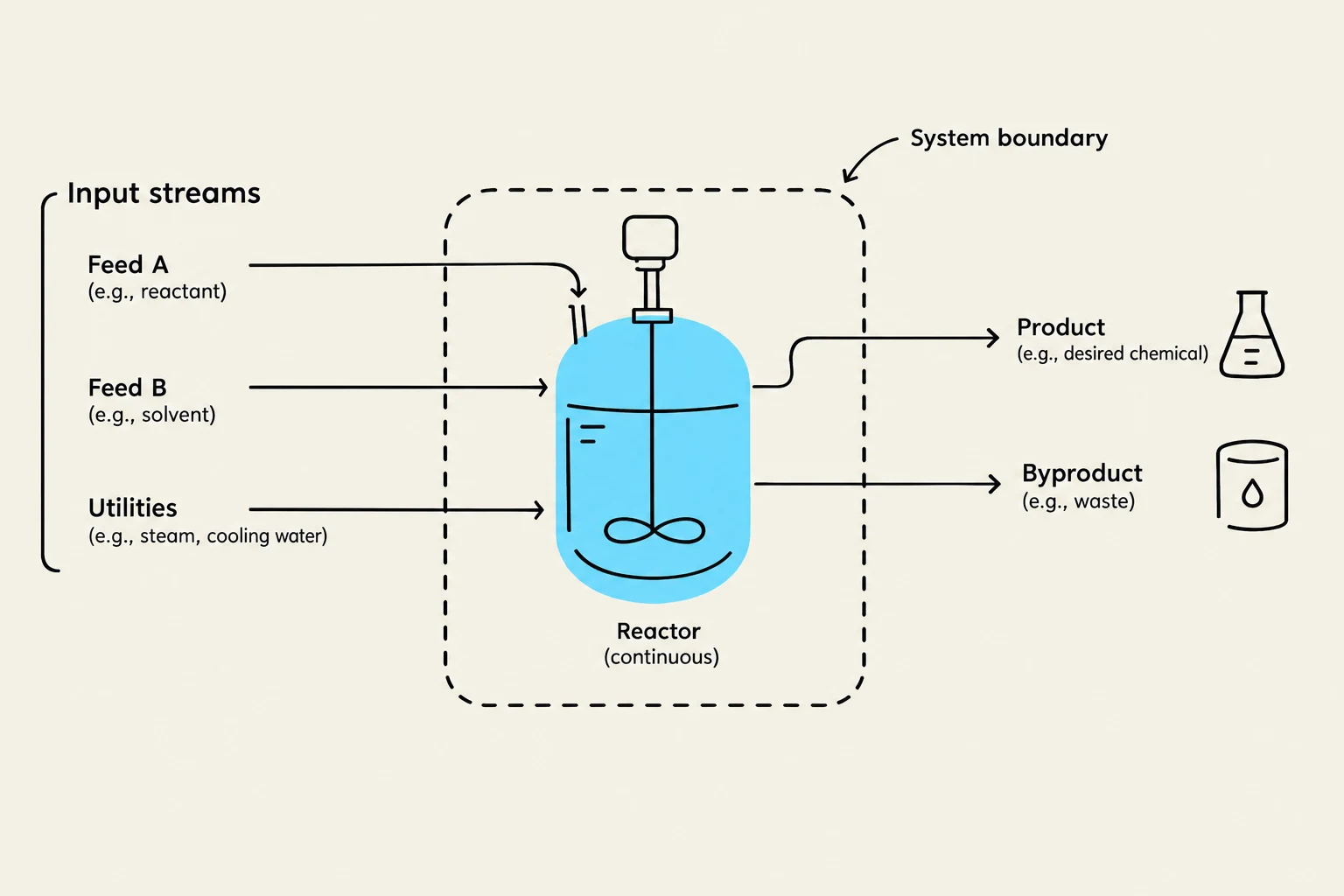
Non-Reactive vs. Reactive Systems
The complexity of a material balance depends heavily on whether a chemical reaction occurs within the system boundary.
Non-Reactive Systems
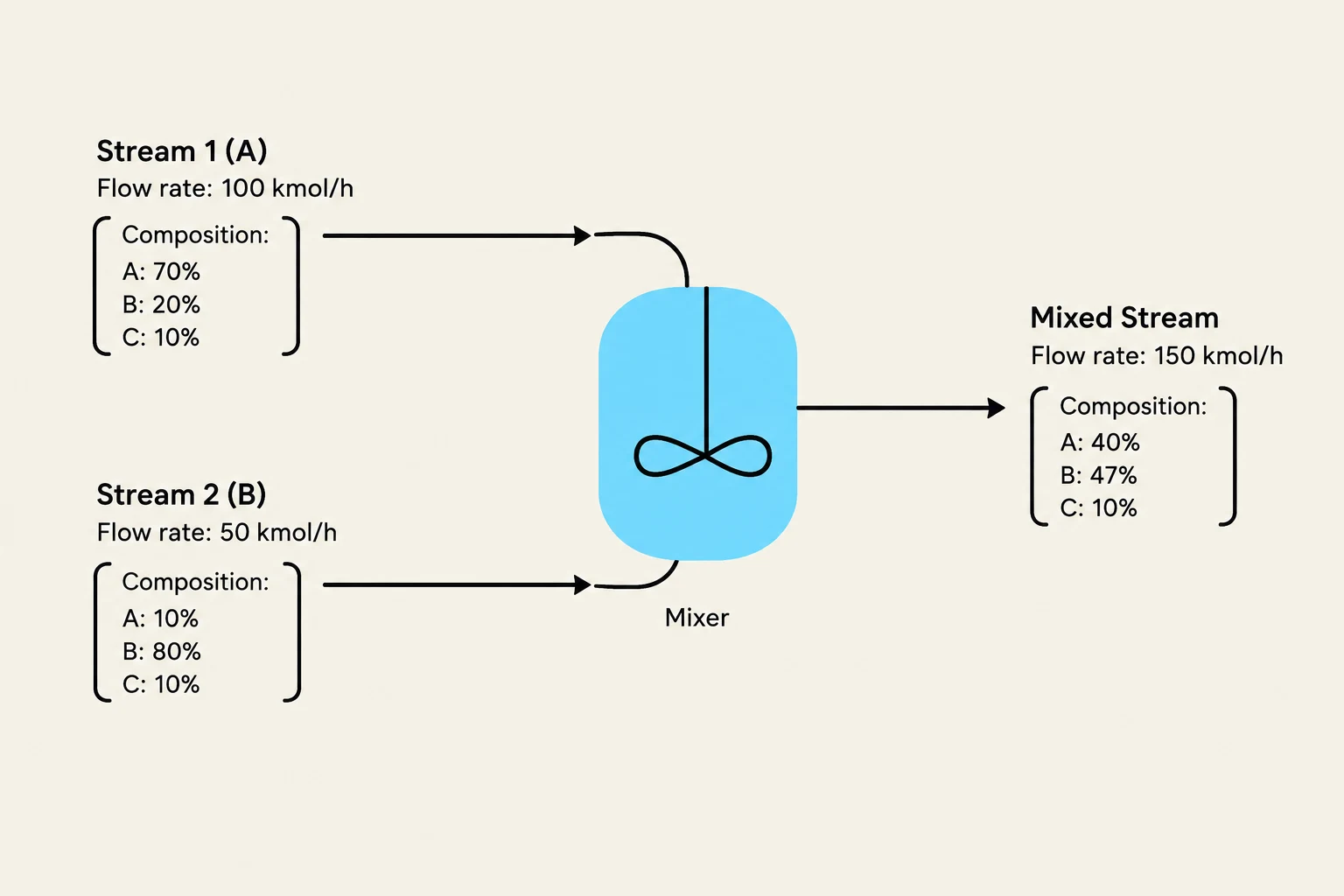
When no chemical reaction is involved, there is no creation or destruction of molecules. Therefore, the generation and consumption terms are both zero. In these systems, mass is conserved, and because no bonds are being broken or formed, the balance is equally valid whether you perform your calculations on a mass basis (using kg or g) or a mole basis (using kmol or mol).
Keep reading for free.
Create an account to finish this reading and make it part of your study routine.
Continue reading freeAlready have an account? Log in
Updated