Chemical Mutagens and Radiation-Induced DNA Damage
This document explains how mutagens, including chemical agents and radiation, induce DNA damage and mutations. It details various types of chemical mutagens, radiation-induced damage, and the Ames test for assessing mutagenicity.
DNA is the fundamental blueprint of life, but its stability is constantly challenged by various environmental factors. Mutagens are agents that induce DNA damage and permanent mutations through specific interactions with nucleotide bases or the DNA molecule itself. These agents can alter the genetic code in several ways, leading to different types of mutations such as base-pair substitutions or frameshifts. Understanding these mechanisms is crucial for studying genetics, toxicology, and the development of diseases like cancer.
Chemical Mutagens
Chemical mutagens are diverse agents that interact with DNA through various biochemical pathways. They are generally classified by their specific mode of action on the DNA molecule.
Nucleotide Base Analogs
Some chemicals are so structurally similar to the standard nitrogenous bases (Adenine, Guanine, Cytosine, and Thymine) that DNA polymerases mistakenly incorporate them into the growing DNA strand during replication. A classic example is 5-bromodeoxyuridine (5-BrdU).
These analogs can exist in different chemical forms (such as keto and enol forms), which allows them to shift their base-pairing properties. This instability often results in transition mutations, where a purine is replaced by another purine, or a pyrimidine by another pyrimidine.
Deaminating Agents
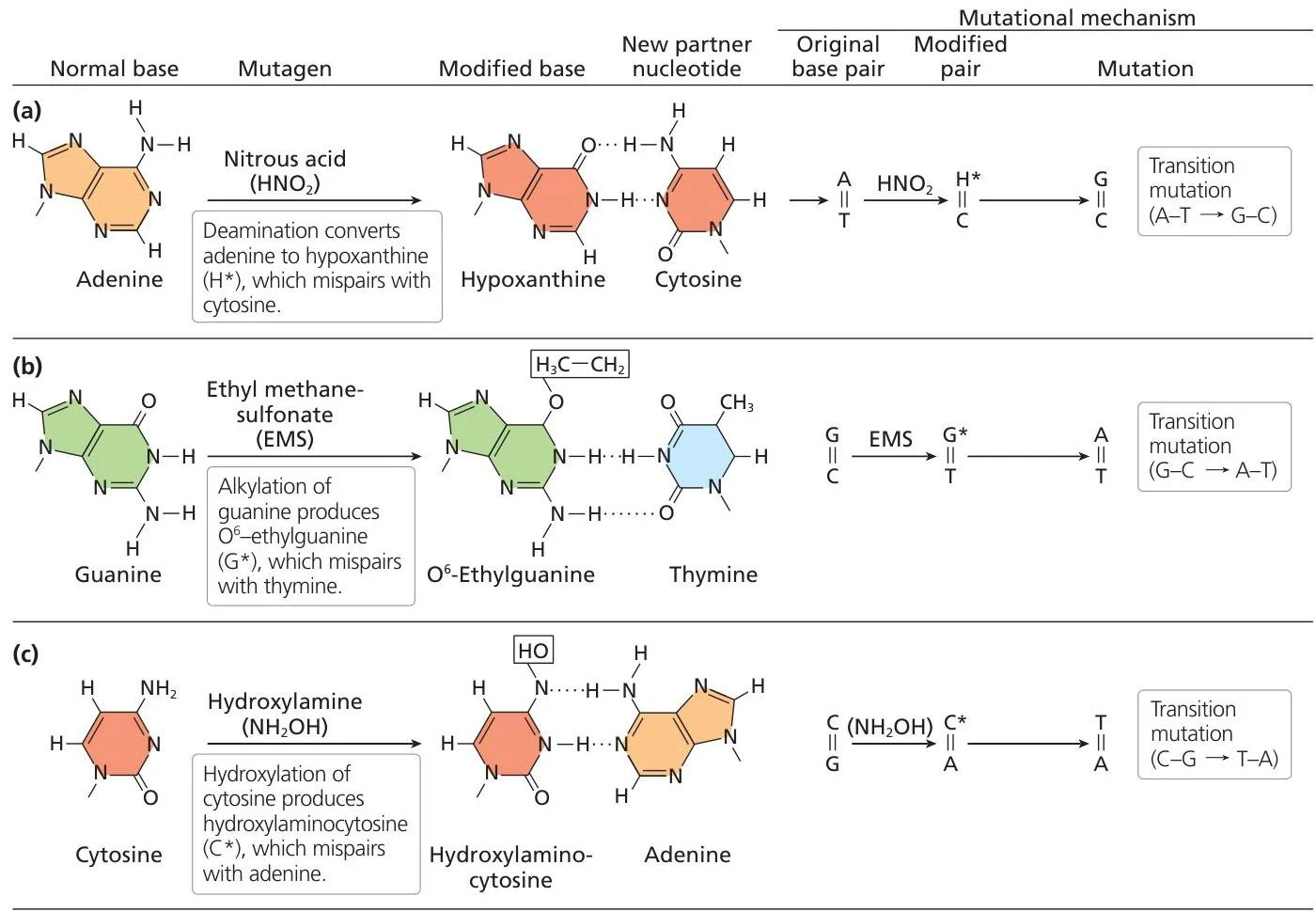
Deamination involves the removal of an amino group from a nucleotide base. For instance, nitrous acid can deaminate adenine, converting it into hypoxanthine. Because hypoxanthine mispairs with cytosine during replication, this leads to A-T to G-C substitutions.
Another critical example is the deamination of 5-methylcytosine. This process converts the base into thymine, resulting in C-G to T-A transitions. This specific mutation is particularly significant because it frequently occurs at CpG dinucleotides, which are key sites for epigenetic regulation.
This diagram illustrates three mechanisms of point mutations in DNA: deamination of adenine by nitrous acid, alkylation of guanine by ethyl methanesulfonate (EMS), and hydroxylation of cytosine by hydroxylamine. Each process leads to a modified base that mispairs with a different nucleotide, resulting in a transition mutation.
Alkylating and Hydroxylating Agents
Alkylating agents, such as ethyl methanesulfonate (EMS), work by adding bulky alkyl groups (like methyl or ethyl groups) to the nitrogenous bases. This modification distorts the DNA double helix and induces transition mutations.
Similarly, hydroxylating agents like hydroxylamine add hydroxyl groups to bases. For example, they can create hydroxylaminocytosine, a modified base that has the tendency to mispair with adenine, leading to further substitution errors.
Intercalating Agents
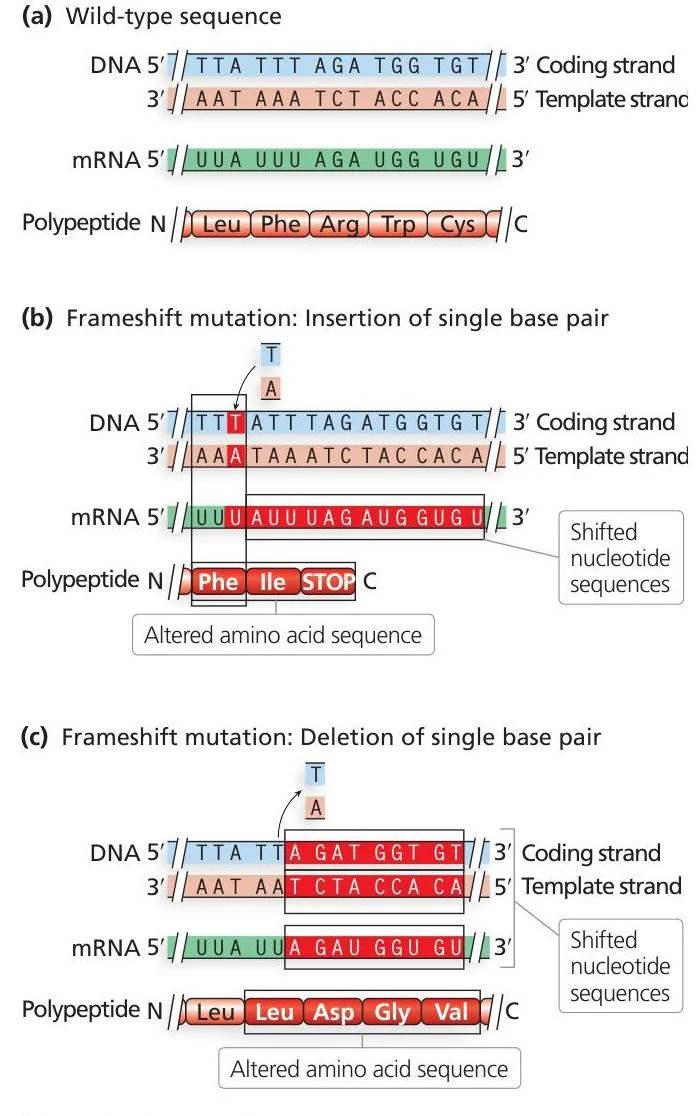
Unlike the agents mentioned above, intercalating agents are relatively small, flat molecules like proflavin or benzo(a)pyrene. Instead of modifying a specific base, they "wedge" themselves between the stacked base pairs of the DNA helix. This causes significant helical distortion and can lead to DNA strand nicking. The primary consequence of intercalation is the induction of frameshift mutations, which alter the reading frame of the genetic code.
Diagram illustrating the intercalation of Proflavin and Benzo(a)pyrene (BaP) into DNA.
This illustration demonstrates the effects of frameshift mutations on DNA sequences, mRNA transcription, and polypeptide chains. It shows a wild-type sequence and how the insertion or deletion of a single base pair can lead to altered amino acid sequences, including premature stop codons.
Oxidizing Agents
Oxidizing agents, including highly reactive oxygen radicals, can damage DNA by stripping electrons from bases. These oxidative lesions often result in transversion mutations, where a purine is replaced by a pyrimidine, or vice versa.
Radiation-Induced DNA Damage
Radiation causes damage through different physical mechanisms depending on the energy level of the radiation.
Ionizing Radiation
High-energy radiation, such as X-rays, gamma rays, and cosmic rays, is known as ionizing radiation. These rays possess enough energy to strip electrons from atoms, creating ions. This process can lead to severe structural damage, including single-strand and double-strand breaks in the DNA backbone, which can result in large-scale chromosome rearrangements.
Ultraviolet (UV) Radiation
In contrast to ionizing radiation, Ultraviolet (UV) radiation is non-ionizing but highly mutagenic due to its ability to create photoproducts. UV light induces the formation of covalent bonds between adjacent pyrimidine bases on the same DNA strand.
The most common lesion is the thymine dimer, where two adjacent thymines are joined together (specifically at the 5 and 6 carbons). Another common lesion is the 6-4 photoproduct. If these dimers are not repaired by cellular mechanisms like nucleotide excision repair, they block DNA polymerase during replication, leading to mutations and potentially contributing to the development of skin cancer.
Diagram illustrating the formation of thymine dimers in DNA when exposed to UV light, showing adjacent thymines forming covalent bonds.
This diagram illustrates the process of nucleotide excision repair in DNA, where UV-induced thymine dimers are removed and the DNA duplex is restored.
The Ames Test: Assessing Mutagenicity
How do scientists determine if a new chemical is a mutagen? One of the most widely used methods is the Ames test.
The Ames test is a biological assay that utilizes specific strains of the bacterium Salmonella typhimurium. These strains are "auxotrophic," meaning they are mutants ($his^-$) that cannot synthesize the essential amino acid histidine and therefore cannot grow on minimal media.
If a test chemical is mutagenic, it may induce a "reversion mutation" that restores the bacteria's ability to synthesize histidine ($his^+$). If the bacteria begin to grow on the histidine-free medium, the chemical is identified as a mutagen.
Exam Tip: Metabolic Activation
Many chemicals are not mutagenic themselves but become mutagenic after being processed by the liver. To account for this in the Ames test, researchers add an S9 extract (derived from mammalian liver enzymes). This mimics human metabolism, allowing the test to identify "pro-mutagens" that require metabolic activation to cause DNA damage.
Keep reading for free.
Create an account to finish this reading and make it part of your study routine.