


To understand how the human body functions, we must first look at its most fundamental building blocks. The chemical level of organization is the first level of studying the human body, focusing on the structure and behavior of matter. By understanding how atoms interact to form molecules and how those molecules drive biological processes, we gain insight into the very essence of life.
Matter and Mass
Everything in the universe that occupies space and possesses mass is considered matter. In the context of biological studies on Earth, mass is often treated as equivalent to weight, representing the total amount of material contained within that matter.
The Atom: The Smallest Unit of Matter
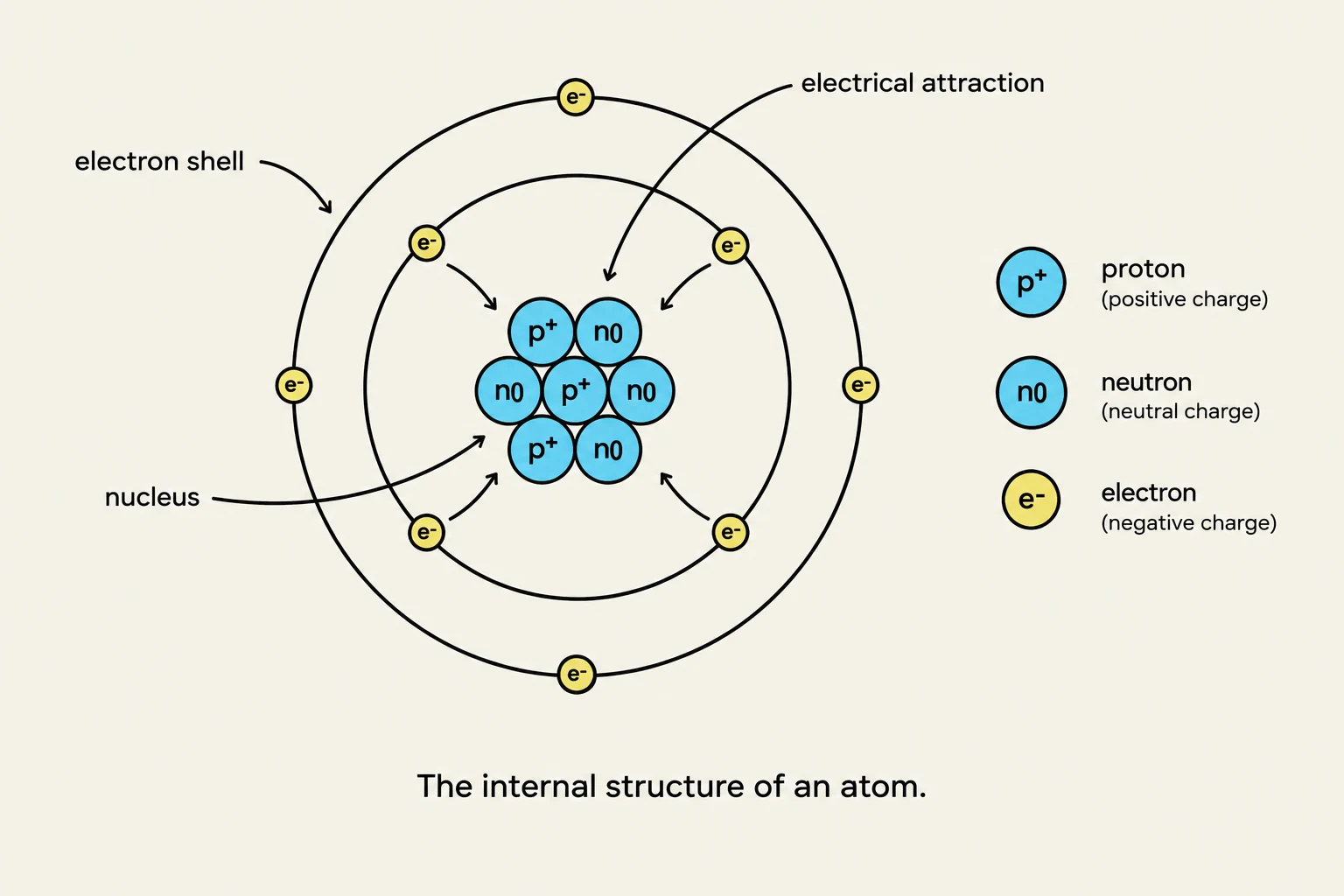
Atomic Structure
An atom is divided into two primary regions:
- The Nucleus: Located at the center of the atom, the nucleus contains protons ($p^+$), which carry a positive electrical charge, and neutrons (), which are electrically neutral. The mass of an atom is primarily determined by the number of these two particles.
- The Electron Cloud: Surrounding the nucleus is a region where electrons ($e^-$) whirl. Electrons carry a negative charge and are significantly smaller than protons or neutrons—approximately of their mass. The electrical attraction between the positive nucleus and the negative electrons keeps them in "orbit".
Keep reading for free.
Create an account to finish this reading and make it part of your study routine.
Continue reading freeAlready have an account? Log in
Updated