Learn how to determine the elemental composition of substances using chemical formulas, percent composition, empirical formulas, and molecular formulas. This guide covers calculations based on atomic and molar masses.
Understanding the composition of matter is a cornerstone of chemistry. Whether you are analyzing the air we breathe or the complex molecules in our bodies, you must be able to quantify exactly which elements are present and in what proportions. This article explores how we use chemical formulas to represent substances and how we apply mathematical principles to determine their elemental makeup through percent composition, empirical formulas, and molecular formulas.
The Foundation: Chemical Formulas and Valency
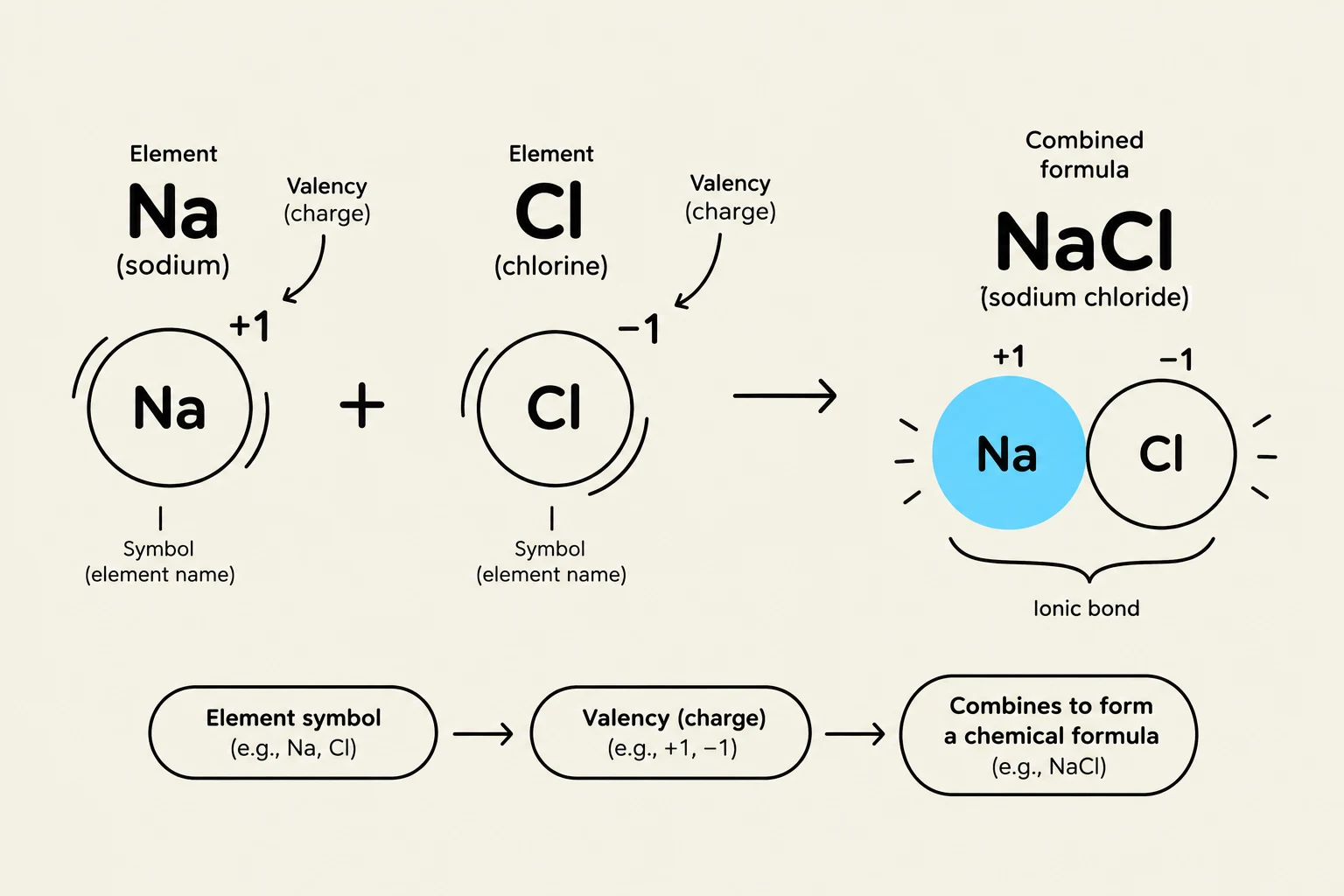
A chemical formula is a succinct symbolic representation of a substance, providing the relative numbers of atoms of each element present in a compound. To write these formulas correctly, one must understand the concept of valency (or valency factor). Valency refers to the combining power of an element, often determined by the number of electrons it can gain, lose, or share during chemical bonding.
For example, in the case of an ionic compound like aluminium chloride (AlCl3), the aluminium ion (Al3+) has a valency of three, which dictates that it must bond with three chloride ions (Cl−) to achieve stability.
Exam Tip: When determining the formula of a compound, always look at the charges of the ions. The total positive charge must equal the total negative charge to ensure the compound is electrically neutral.
This diagram illustrates the formation of sodium chloride (NaCl) from sodium (Na) and chlorine (Cl) elements. It shows the valency of each element and how they combine to form a chemical formula, highlighting the concept of an ionic bond.
Quantifying Composition: Percent Composition
Once a formula is established, we can determine the percent composition of the substance. This tells us the mass percentage of each individual element within the whole compound. This is a vital tool in analytical chemistry to verify if a synthesized substance matches its theoretical design.
The percent composition of an element is calculated by dividing the mass of that specific element by the total mass of the compound and multiplying by 100%:
\text{% Element} = \frac{\text{mass of element}}{\text{mass of compound}} \times 100\%
To perform this calculation, you must use atomic masses (the mass of a single atom) or molar masses (the mass of one mole of a substance) found on the periodic table.
From Ratios to Reality: Empirical and Molecular Formulas
In many laboratory scenarios, you might not know the exact structure of a molecule, but you can determine its simplest ratio. This leads us to the distinction between empirical and molecular formulas.
The Empirical Formula
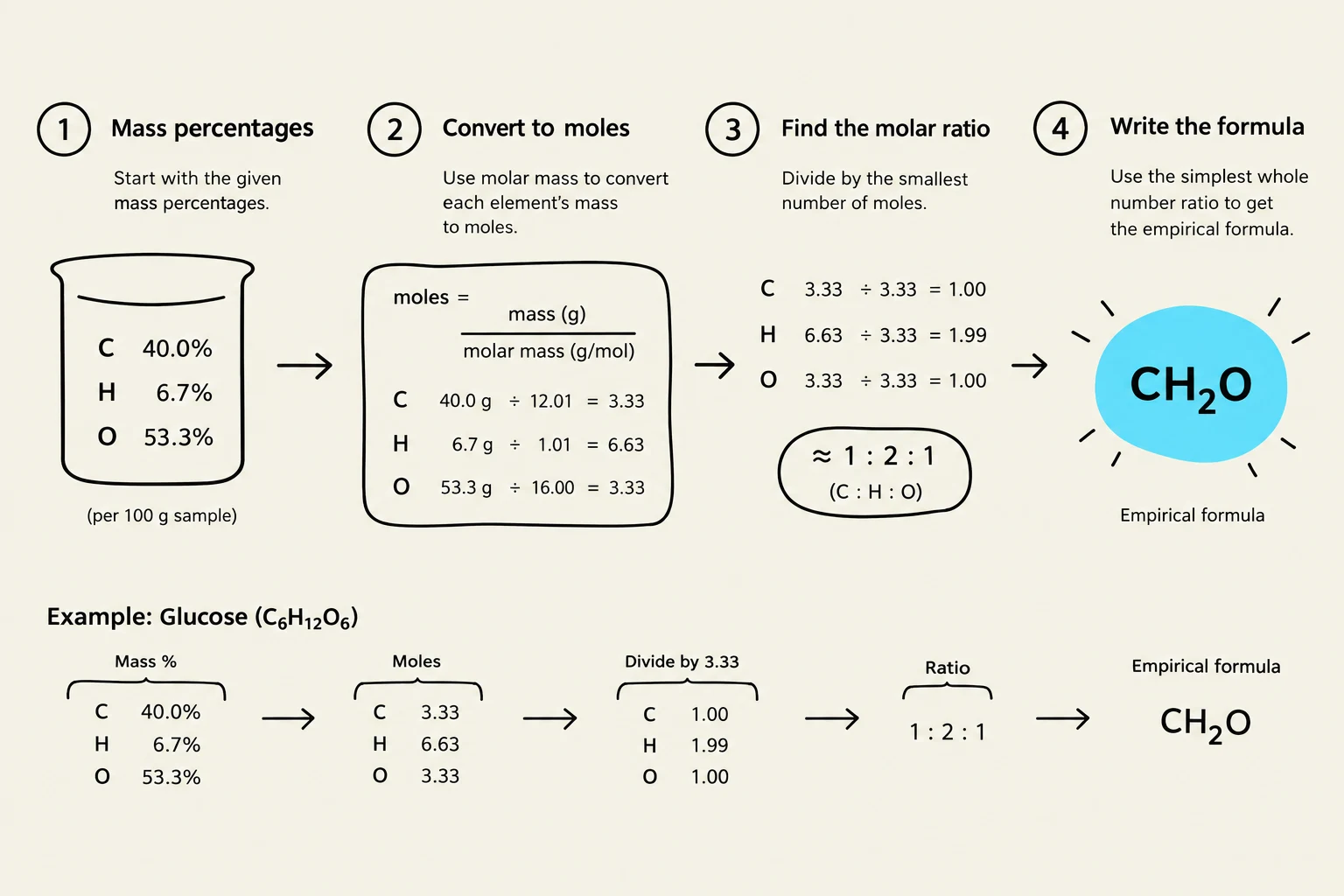
The empirical formula represents the simplest whole-number ratio of atoms in a compound. If you are given the mass or percent composition of a substance, you can derive the empirical formula using these steps:
Convert to Moles: Convert the mass of each element into moles using its molar mass.
Find the Ratio: Divide each molar amount by the smallest molar amount obtained among all elements.
Clear Decimals: If the resulting ratios are not whole numbers (e.g., 1.5 or 1.33), multiply all subscripts by a common integer to reach the smallest whole-number ratio.
The Molecular Formula
The molecular formula represents the actual, absolute number of atoms of each element in a single molecule. The molecular formula is always a whole-number multiple of the empirical formula. To find the multiplier (n), you must know the actual molecular (or molar) mass of the substance:
n=empirical formula massmolecular or molar mass
Once n is found, multiply every subscript in the empirical formula by n to get the molecular formula: (AxBy)n=AxnByn.
This illustration demonstrates the process of determining the empirical formula of a compound from its mass percentages. It outlines four key steps: calculating mass percentages, converting these to moles, finding the molar ratio, and finally writing the empirical formula. An example using glucose is provided to clarify the procedure.
Worked Example: Finding the Molecular Formula
Suppose a compound has an empirical formula of CH2O with an empirical formula mass of approximately 30 amu. If a laboratory analysis determines the actual molecular mass of the compound is 180 amu, what is its molecular formula?
Step 1: Calculate the multiplier (n)n=30 amu180 amu=6
Step 2: Apply the multiplier to the empirical formulaMolecular Formula=(CH2O)6=C6H12O6
Summary of Key Relationships
It is helpful to visualize how these concepts connect. While the empirical formula provides the "recipe ratio," the molecular formula provides the "actual serving size."
Feature
Empirical Formula
Molecular Formula
Definition
Simplest whole-number ratio
Actual number of atoms
Information Provided
Relative proportions
Absolute composition
Example (Glucose)
CH2O
C6H12O6
Note on Precision: When performing these calculations, always pay close attention to significant figures. In chemistry, your final answer's precision is limited by the least precise measurement used in your calculations.
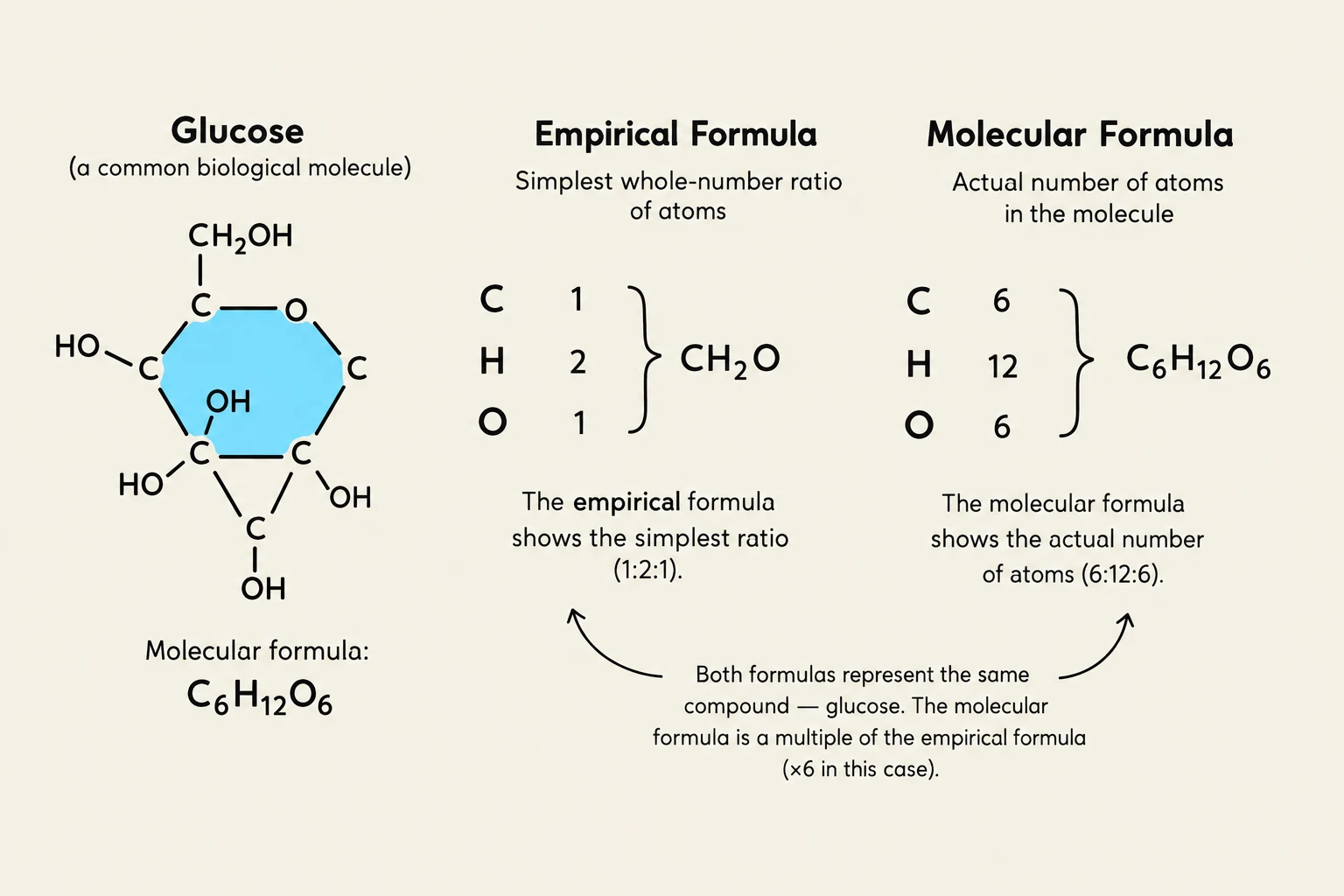
This illustration explains the difference between the empirical and molecular formulas of glucose, a common biological molecule. The empirical formula (CH2O) represents the simplest whole-number ratio of atoms, while the molecular formula (C6H12O6) shows the actual number of atoms in the molecule.
By mastering these calculations, you gain the ability to decode the chemical language used to describe the world around us, from the simplest salts to the most complex organic molecules.
Keep reading for free.
Create an account to finish this reading and make it part of your study routine.