Chemical Equilibrium, Reaction Quotient, and Gibbs Free Energy
Explore the concepts of chemical equilibrium, the reaction quotient, and Gibbs free energy. Learn how to interpret equilibrium constants, predict reaction direction using the reaction quotient, and understand the relationship between Gibbs free energy and spontaneity under various conditions.
In chemistry, many reactions do not simply go from start to finish in a single direction. Instead, they reach a state of balance where the forward and reverse processes occur at the same rate. Understanding this balance—and the energy that drives it—is essential for predicting how chemical systems behave under different conditions. This article explores the relationship between chemical equilibrium, the reaction quotient, and Gibbs free energy.
Chemical Equilibrium and the Law of Mass Action
When a chemical reaction begins, reactants are consumed to form products. As the concentration of reactants decreases, the rate of the forward reaction slows down. Simultaneously, as products accumulate, they begin to react with one another to re-form the reactants—a process known as the reverse reaction.
Chemical equilibrium is achieved when the rates of the forward and reverse reactions are equal, resulting in no observable changes in the concentrations of reactants and products over time. It is important to note that at equilibrium, the concentrations of reactants and products are not necessarily equal; they are simply constant.
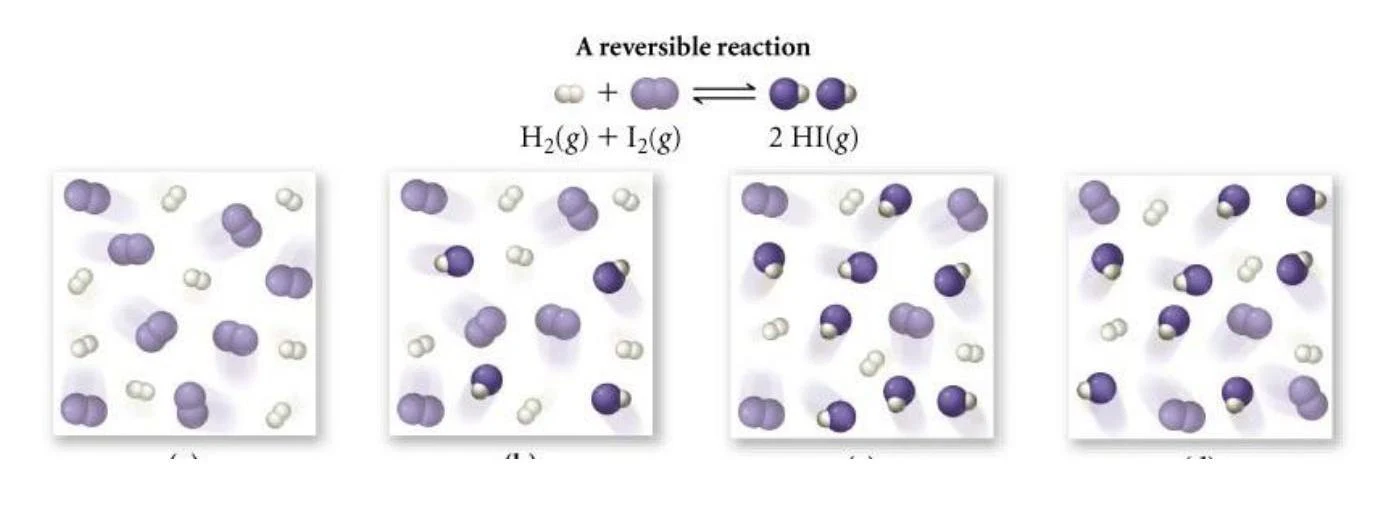
A reversible reaction between hydrogen gas and iodine gas to form hydrogen iodide gas.
The relationship between the concentrations of products and reactants at equilibrium is defined by the Law of Mass Action. For a general reaction:
aA+bB⇌cC+dD
The equilibrium constant (K) is expressed as the ratio of the product concentrations to the reactant concentrations, each raised to the power of their stoichiometric coefficients:
K=[A]a[B]b[C]c[D]d
Note that K is a unitless value.
Interpreting the Equilibrium Constant (K)
The magnitude of K tells us the "position" of the equilibrium:
If K≫1: The equilibrium favors the products (the forward reaction is favored).
If K≪1: The equilibrium favors the reactants (the reverse reaction is favored).
If K=1: Neither direction is significantly favored.
Equilibrium Constants for Gases (Kc and Kp)
When dealing with gases, the concentration of a substance is proportional to its partial pressure. Therefore, we can express the equilibrium constant in terms of molarity (Kc) or partial pressure (Kp):
Kc=[A]a[B]b[C]c[D]dandKp=PAaPBbPCcPDd
In Kp expressions, partial pressures must be in atmospheres (atm). The two constants are related by the following equation:
Kp=Kc(RT)Δn
where Δn is the difference between the moles of gaseous products and gaseous reactants, R is the gas constant (0.08206 L⋅atm/mol⋅K), and T is the temperature in Kelvin.
Important Note: Pure solids and pure liquids are excluded from equilibrium constant expressions because their concentrations do not change significantly during the reaction.
The Reaction Quotient (Q) and the Direction of Change
If a reaction mixture is not at equilibrium, we can still use the same mathematical expression used for K, but we call it the reaction quotient (Q). By comparing Q to K, we can predict which direction the reaction will shift to reach equilibrium:
If Q<K: The ratio of products to reactants is less than the equilibrium ratio. The reaction will proceed in the forward direction to produce more products.
If Q>K: The ratio of products to reactants is greater than the equilibrium ratio. The reaction will proceed in the reverse direction to produce more reactants.
If Q=K: The system is already at equilibrium.
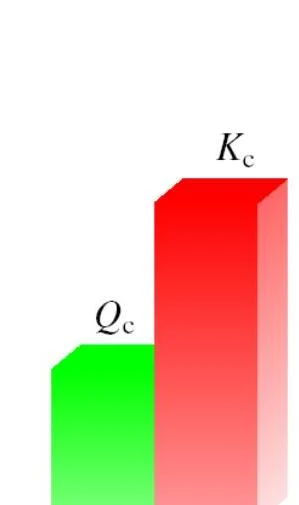
A bar chart showing two values, Qc and Kc.
Solving for Equilibrium: The ICE Table
To find equilibrium concentrations when starting from initial amounts, chemists use an ICE table (Initial, Change, Equilibrium):
I (Initial): List the starting concentrations.
C (Change): Use stoichiometry to represent the change in each species as +x or −x.
E (Equilibrium): Sum the initial and change values to find the equilibrium concentrations.
Gibbs Free Energy (ΔG) and Spontaneity
Thermodynamics allows us to predict whether a process will occur spontaneously (without ongoing outside intervention). This is determined by the Gibbs Free Energy (ΔG).
Standard vs. Nonstandard Conditions
The Standard Gibbs Free Energy (ΔG∘) refers to the free energy change when all reactants and products are in their standard states (1 M concentration for solutions, 1 atm for gases, and a specified temperature, usually 298 K).
However, most real-world reactions occur under nonstandard conditions. The relationship between the actual free energy change (ΔG) and the standard free energy change (ΔG∘) is:
ΔG=ΔG∘+RTlnQ
where R is the gas constant (8.314 J/mol⋅K) and Q is the reaction quotient.
The Relationship Between ΔG∘ and K
At equilibrium, the system has no driving force to change, meaning ΔG=0. By substituting this into the equation above, we derive a fundamental link between thermodynamics and equilibrium:
0=ΔG∘+RTlnK⟹ΔG∘=−RTlnK
This relationship allows us to predict the equilibrium constant if we know the standard free energy, or vice versa:
ΔG∘
K
Meaning
ΔG∘<0
K>1
Spontaneous under standard conditions; favors products.
ΔG∘>0
K<1
Nonspontaneous under standard conditions; favors reactants.
ΔG∘=0
K=1
Standard state is the equilibrium state.
Exam Tip: When calculating ΔG using ΔG=ΔG∘+RTlnQ, ensure your units for ΔG∘ and R are consistent (e.g., convert kJ to J or vice versa).
Worked Example: Calculating ΔG under Nonstandard Conditions
Problem: Calculate ΔG at 298 K for the reaction:
2 NO(g)+O2(g)→2 NO2(g)
Given ΔG∘=−71.2 kJ, with partial pressures: PNO=0.100 atm, PO2=0.100 atm, and PNO2=2.00 atm.