Explore the fundamental concepts of chemical compounds, focusing on molecular compounds and the nature of covalent bonds. Learn about Lewis structures, the octet rule, and exceptions to this rule, with examples like nitrogen dioxide and benzene. Understand how molecular structures predict physical properties.
At the heart of chemistry lies the quest to understand how atoms combine to form the vast array of substances that make up our world. When atoms interact, they do so to achieve a state of stability, often by rearranging their electrons. This process results in the formation of chemical compounds, which are broadly categorized into two main types: ionic compounds and molecular compounds. While ionic compounds involve the transfer of electrons, molecular compounds rely on a different mechanism: the sharing of electrons.
The Nature of Molecular Compounds
Molecular compounds are typically formed when atoms, usually nonmetals, interact with one another. Unlike the rigid lattice structures often found in ionic salts, molecular compounds are defined by the way their constituent atoms share their valence electrons—the electrons located in the outermost shell of an atom.
Covalent Bonds
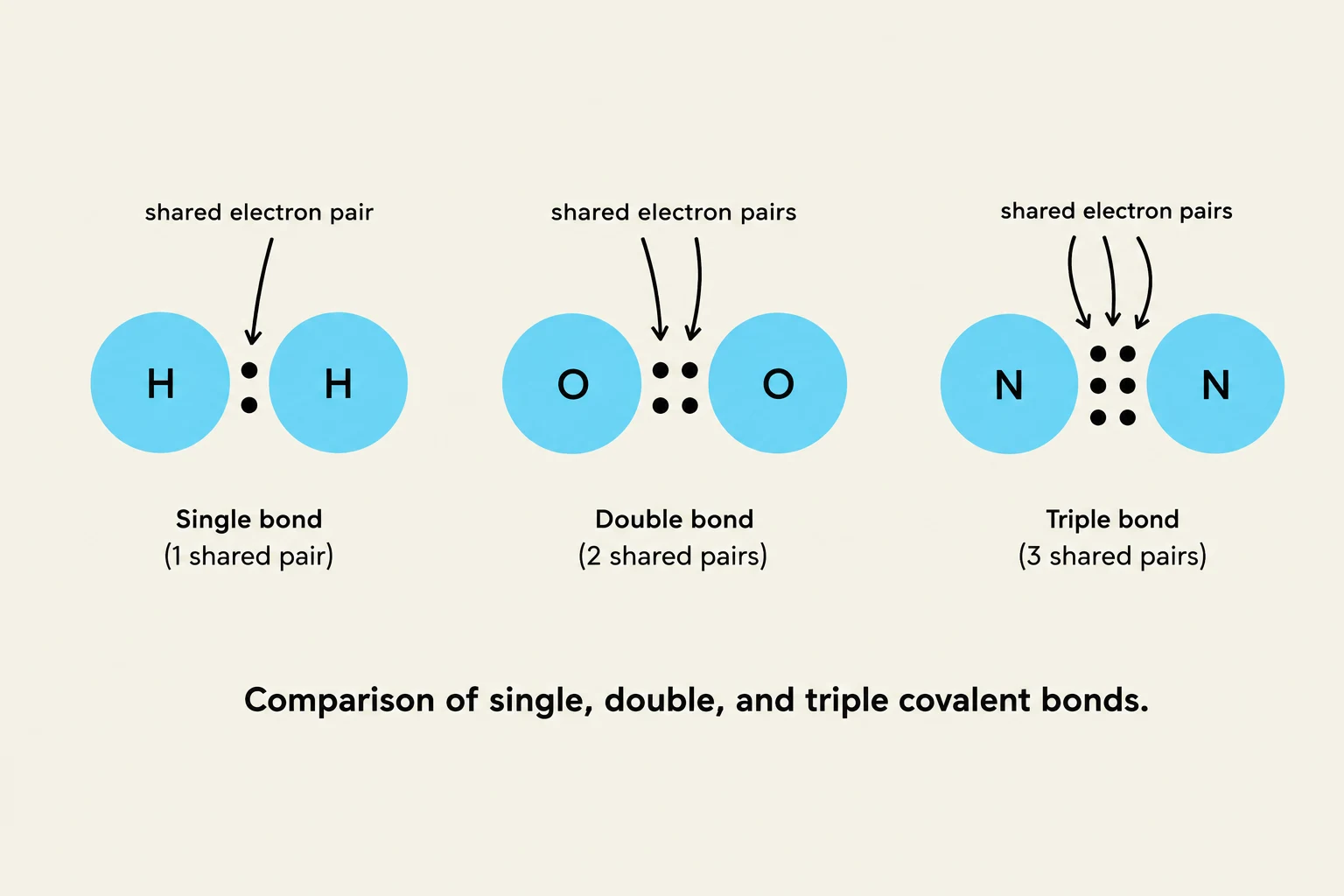
Comparison of single, double, and triple covalent bonds.
The fundamental "glue" that holds a molecule together is the covalent bond. A single covalent bond is formed when two atoms share a single pair of valence electrons. However, bonding is not always limited to single pairs. Depending on the needs of the atoms to reach stability, molecules may contain:
Single bonds: One shared pair of electrons.
Double bonds: Two shared pairs of electrons.
Multiple bonds: Three or more shared pairs of electrons.
Visualizing Molecules: Lewis Structures
Because electrons are far too small to see, chemists use graphical models to predict how atoms are connected. One of the most important tools is the Lewis structure. These diagrams are used to represent the arrangement of valence electrons within a molecule or a molecular polyatomic ion. By drawing Lewis structures, scientists can visualize how many bonds exist between atoms and how many "lone pairs" of electrons remain unbonded.
LEARNING TIP: Exceptions to the Rule
As we develop a better understanding of chemical compounds, our models of atoms will improve. The octet rule is very helpful as we start to learn about molecules; however, there are oddities and exceptions to the rule. Scientific knowledge is always evolving, and there is definitely room for future discoveries.
The Octet Rule and Its Exceptions
A fundamental concept in chemistry is the octet rule, which suggests that atoms are most stable when they possess eight electrons in their valence shell, mimicking the electron configuration of a noble gas. While this rule is an excellent starting point for predicting bonding patterns, it is not a universal law. Nature frequently presents "oddities" that defy this simple model.
Nitrogen Dioxide (NO2)
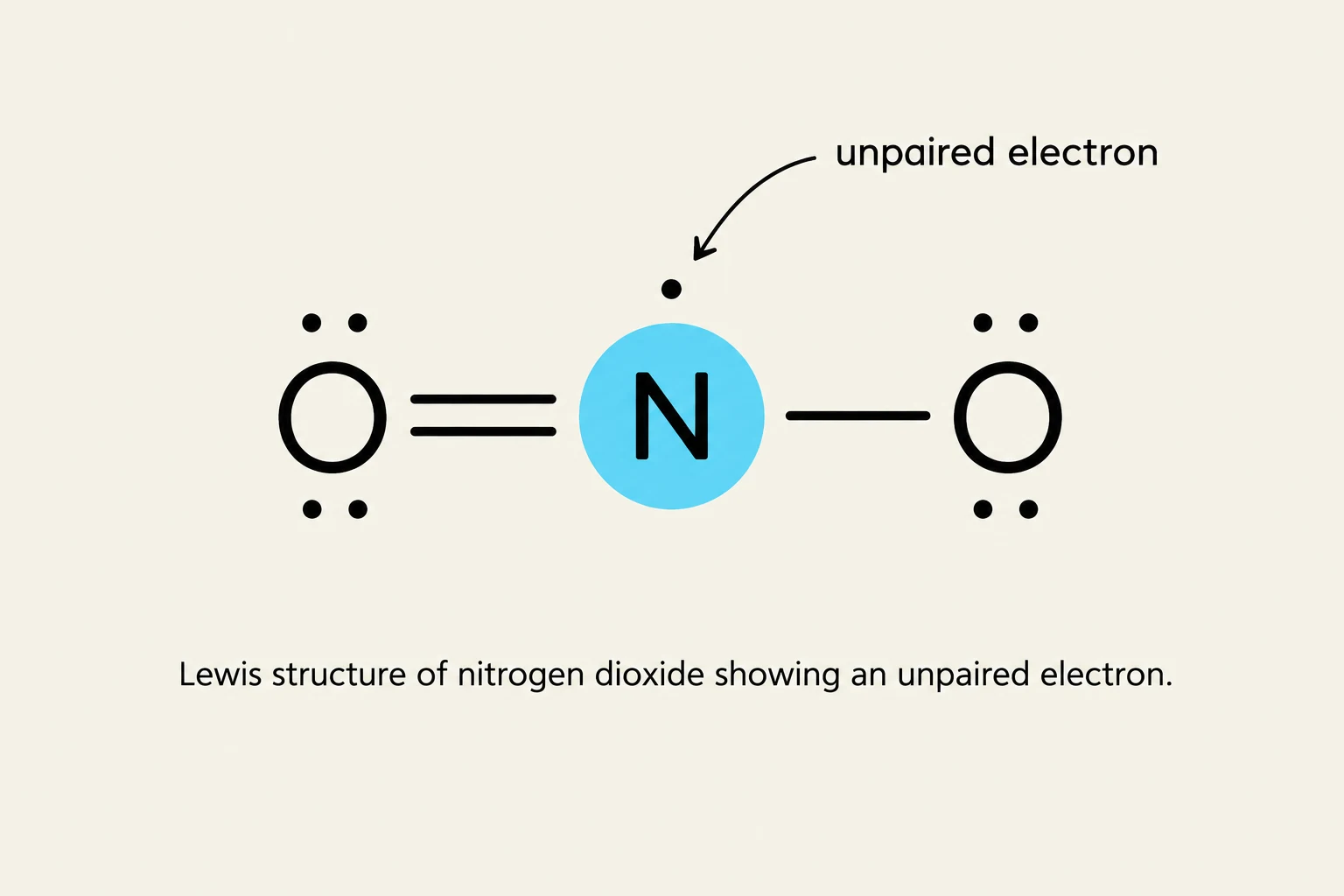
Lewis structure of nitrogen dioxide showing an unpaired electron.
One of the most notable exceptions is nitrogen dioxide (NO2). This substance is a toxic, reddish-brown gas that contributes significantly to respiratory problems caused by smog. From a structural standpoint, NO2 is an anomaly because its structure contains an unpaired electron. This "extra" electron is precisely what makes the molecule so chemically reactive and toxic.
Nitrogen dioxide gasFigure 11: (a) Nitrogen dioxide gas causes (b) the familiar brownish colour of visible air pollution.
Benzene (C6H6)
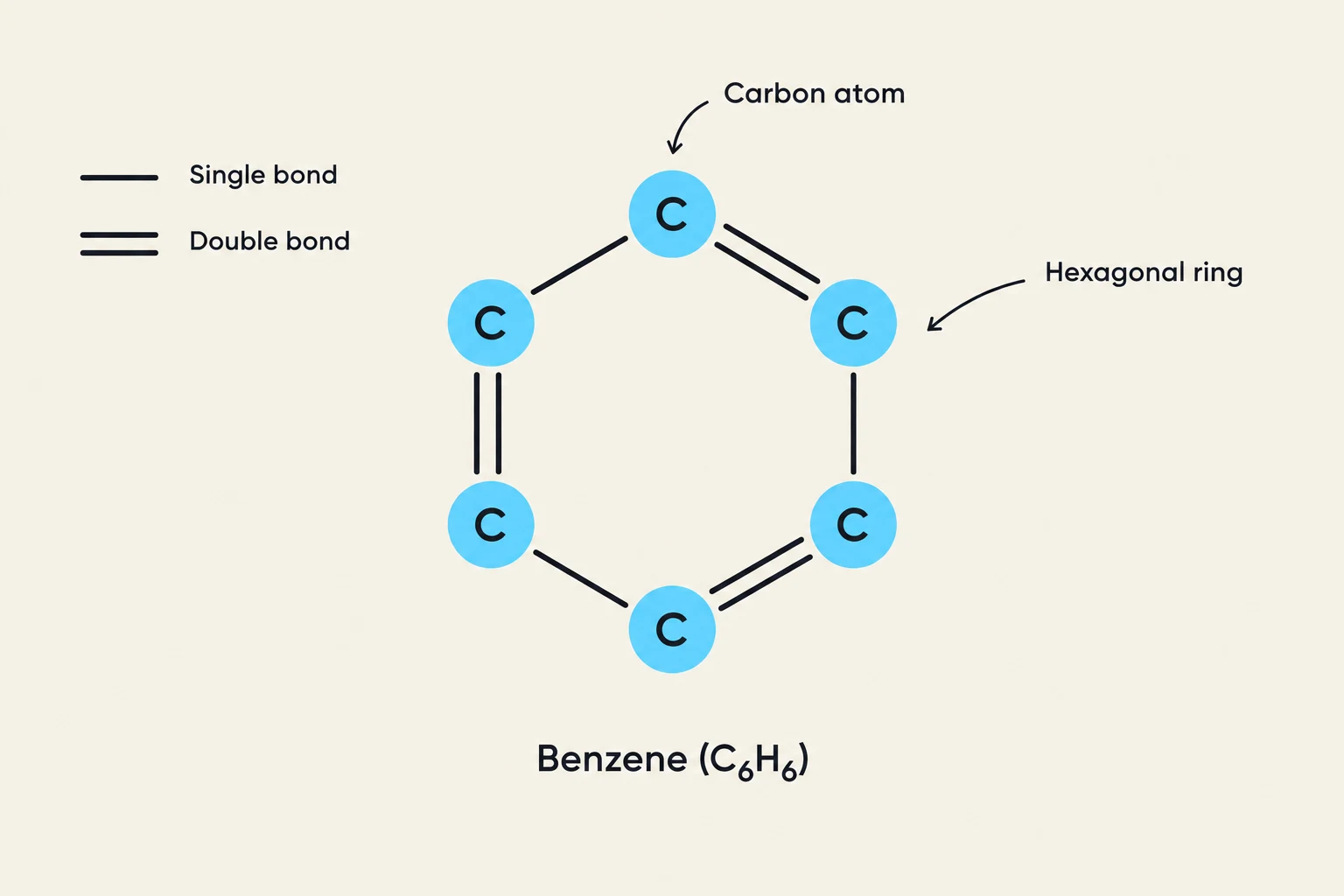
The image displays the molecular structure of benzene, a hexagonal ring composed of six carbon atoms. It indicates single and double bonds between carbon atoms and labels a carbon atom and the hexagonal ring.
Another fascinating case is benzene (C6H6), a complex molecule consisting of a hexagonal ring of six carbon atoms. The discovery of its structure is steeped in scientific history. The German chemist Friedrich August Kekulé famously conceptualized its ring structure after dreaming of a snake biting its own tail.
Kekulé's Dream DiagramFigure 10: Kekulé suggested that his dream of the snake biting its tail gave him the idea of a carbon ring.
Predicting Physical Properties
Understanding the nature of covalent bonds and the resulting molecular shapes is not just an academic exercise; it is essential for predicting how a substance will behave in the real world.
The physical properties of molecular compounds—such as their melting point, boiling point, and electrical conductivity—are determined by the forces of attraction between individual molecules. These forces are directly influenced by:
The specific types of covalent bonds present between atoms.
The geometric arrangement (the shape) of the atoms within the molecule.
For example, while molecular compounds generally have lower melting and boiling points compared to ionic compounds, their specific behavior in different states (solid, liquid, or gas) depends entirely on these intermolecular attractions.
Summary Comparison
To master this topic, it is helpful to compare the two main classes of compounds across various physical properties:
Property
Ionic Compounds
Molecular Compounds
Bonding Type
Electron transfer
Electron sharing (Covalent)
State at Ambient Temp
Often crystalline solids
Can be gas, liquid, or solid
Conductivity
Conducts when dissolved/molten
Generally poor conductors
(Note: This table is a summary based on the comparison concepts discussed in the text.)
By studying Lewis structures and recognizing the exceptions to the octet rule, students can begin to predict the reactivity and physical characteristics of the chemical world around them.
Keep reading for free.
Create an account to finish this reading and make it part of your study routine.