Characteristics of SAR Supergroup Protists: Diatoms, Brown Algae, and Water Molds
An overview of the SAR supergroup of protists, focusing on the characteristics, structures, and ecological roles of diatoms, brown algae, and water molds.
The study of protists can often feel like navigating "nature's junk drawer" because they are a diverse group of eukaryotes that do not fit neatly into the kingdoms of plants, animals, or fungi. To bring order to this complexity, biologists use the supergroup system. One of the most significant and diverse lineages is the SAR supergroup, a massive clade that includes the alveolates, rhizarians, and the stramenopiles.
This article focuses on the stramenopiles (sometimes called "strawmen"), a subgroup within the SAR clade. A defining characteristic of many stramenopiles is the presence of two flagella during certain stages of their life cycle: one is smooth, while the other is "hairy" or covered in cilia. Within this group, we find organisms ranging from microscopic glass-shelled wonders to giant underwater forests and decomposers that mimic fungi.
Diatoms: The Glass-Shelled Engineers
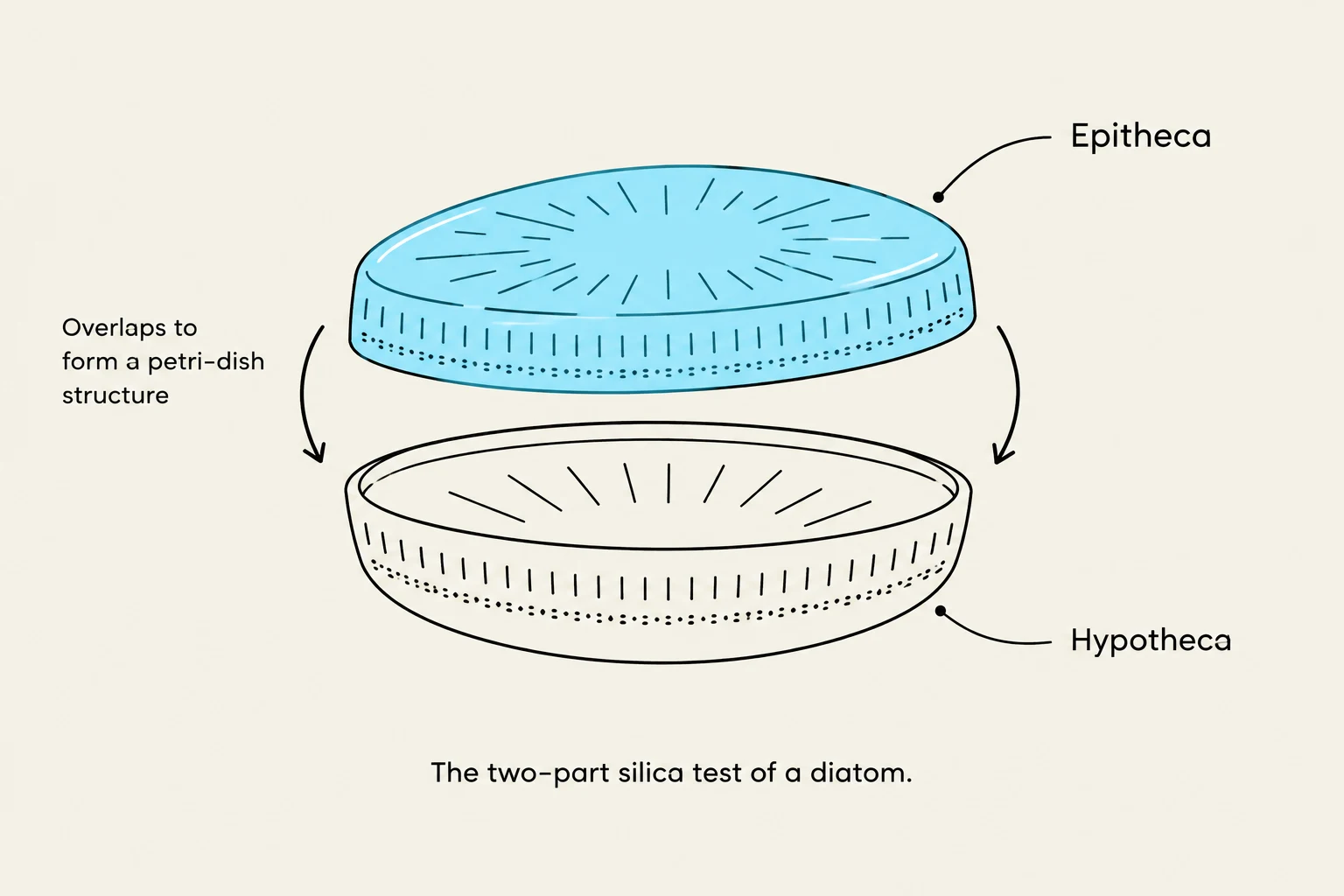
The two-part silica test of a diatom.
Diatoms are unicellular, photosynthetic organisms that play a monumental role in global ecology. They are a primary component of phytoplankton—the microscopic, photosynthetic organisms that inhabit the upper layers of aquatic systems. Because they form the base of many aquatic food chains and contribute significantly to oxygen production (potentially up to one-third of the world's oxygen), they are vital to life on Earth.
The most striking feature of a diatom is its test, which is its protective shell. Unlike the shells of many other organisms, a diatom's test is composed of silica, giving it a glass-like appearance. The test is constructed of two halves that fit together precisely, much like a petri dish.
Study Tip: Diatomaceous Earth
Because silica is highly resistant to decay, diatoms fossilize exceptionally well. Over vast periods, their accumulated shells form a sedimentary rock known as diatomaceous earth. This material is used commercially in products like cat litter and as a treatment for plants.
Brown Algae: The Giants of the Sea
While diatoms are unicellular, brown algae are primarily multicellular. In fact, brown algae represent perhaps the only group of protists that is exclusively multicellular. This group includes some of the largest protists on the planet, such as the giant kelp, which can grow up to 40 meters long.
Although brown algae may look like plants, they are not true plants. They exhibit convergent evolution, meaning they have developed structures that look similar to plants but evolved independently. Crucially, they lack the vascular tissue (tubing) that plants use to conduct water throughout their bodies.
Anatomy of Brown Algae
Diagram illustrating the parts of a kelp plant: blades, stipes, and holdfast, with a note that the holdfast is for attachment, not nutrient absorption.
To understand how these large organisms function in an aquatic environment, we can compare their structures to plant organs:
Blades: These are broad, flat structures used to capture light for photosynthesis. They are functionally analogous to leaves.
Stipes: These are stem-like structures that provide support and help raise the blades toward the sunlight.
Holdfasts: Unlike plant roots, which absorb nutrients from soil, holdfasts are purely attachment structures used to anchor the organism to a substrate in the water.
Water Molds: The Decomposers
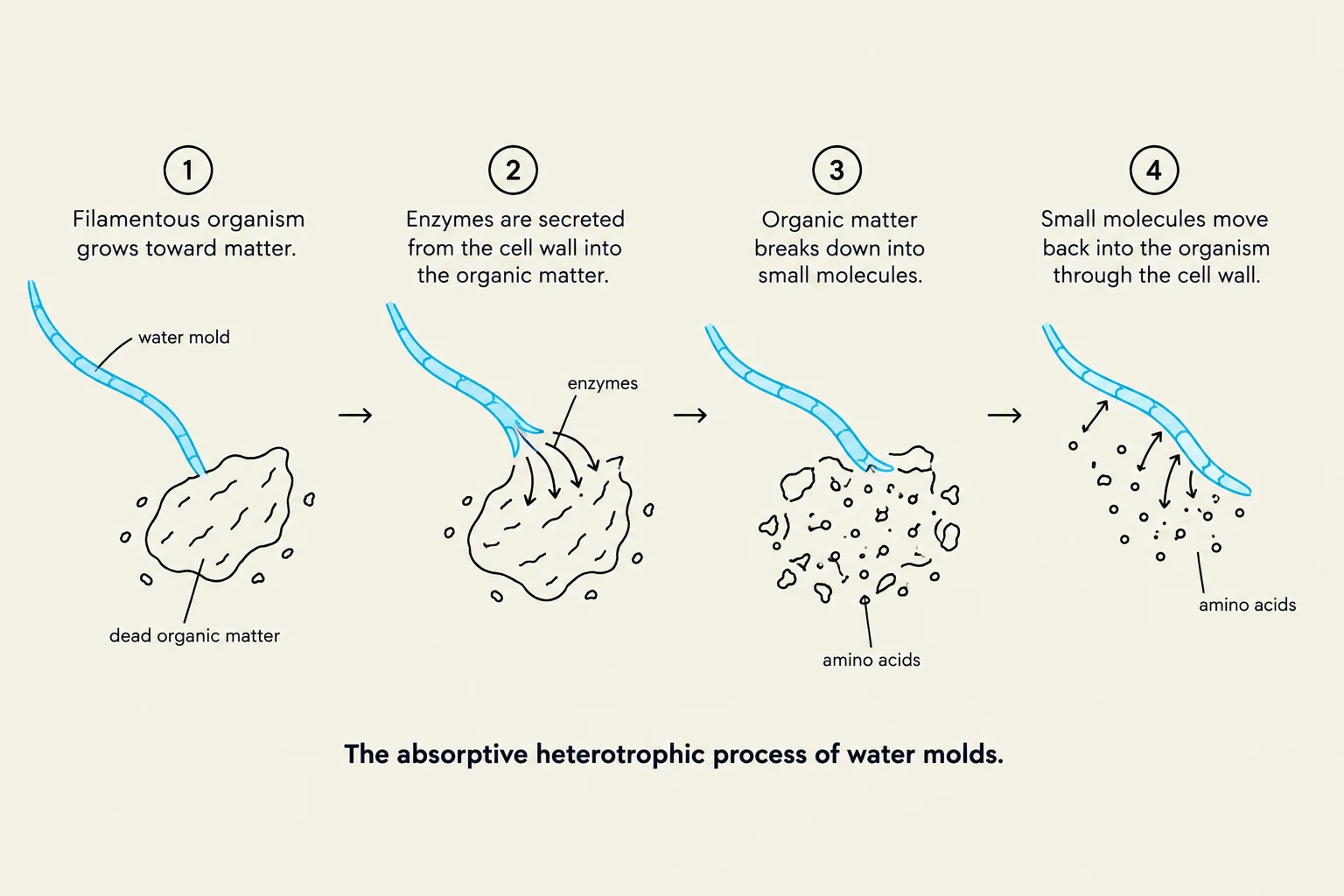
The absorptive heterotrophic process of water molds.
The third major group of stramenopiles discussed here is the water molds. These organisms possess a filamentous structure that makes them look very similar to the molds found on decaying food.
Water molds are saprobes, meaning they obtain nutrients from dead organic matter. They function as absorptive heterotrophs, a nutritional method that involves several specific steps:
The organism grows into a medium (such as a dead insect or organic debris).
It secretes powerful enzymes outside of its body into the surrounding environment.
These enzymes digest complex organic matter into small, simple molecules, such as amino acids.
The organism then absorbs these small molecules through its cell wall and plasma membrane.
Exam Alert: Water Molds vs. Fungi
While water molds and fungi share similar lifestyles (both are saprobes and absorptive heterotrophs), they are biologically distinct. A key way to tell them apart is their cell wall composition: water molds have cell walls made of cellulose, whereas fungi have cell walls made of chitin.