Cervical Cancer Management: Staging, Treatment, and Survivorship
Comprehensive overview of cervical cancer management, including clinical staging (FIGO system), pathological assessment, fertility-sparing and non-fertility-sparing surgical approaches, chemoradiation for locally advanced disease, systemic therapy for metastatic disease, molecular profiling, and gynecologic survivorshi
Cervical cancer management is a complex, multidisciplinary endeavor that requires precise staging and highly individualized treatment pathways. The NCCN Guidelines for Cervical Cancer provide a standardized framework for managing various histological types, including squamous cell carcinoma, adenocarcinoma, adenosquamous carcinoma, and small cell neuroendocrine carcinoma (NECC). Because treatment decisions—ranging from conservative surgery to aggressive chemoradiation—depend heavily on the extent of the disease, clinicians must adhere strictly to established staging and pathologic assessment protocols.
Clinical Staging and Pathologic Assessment
Management begins with accurate staging, which is currently based on the FIGO 2018 staging system. Staging is determined through a combination of clinical examination, imaging, and surgical findings.
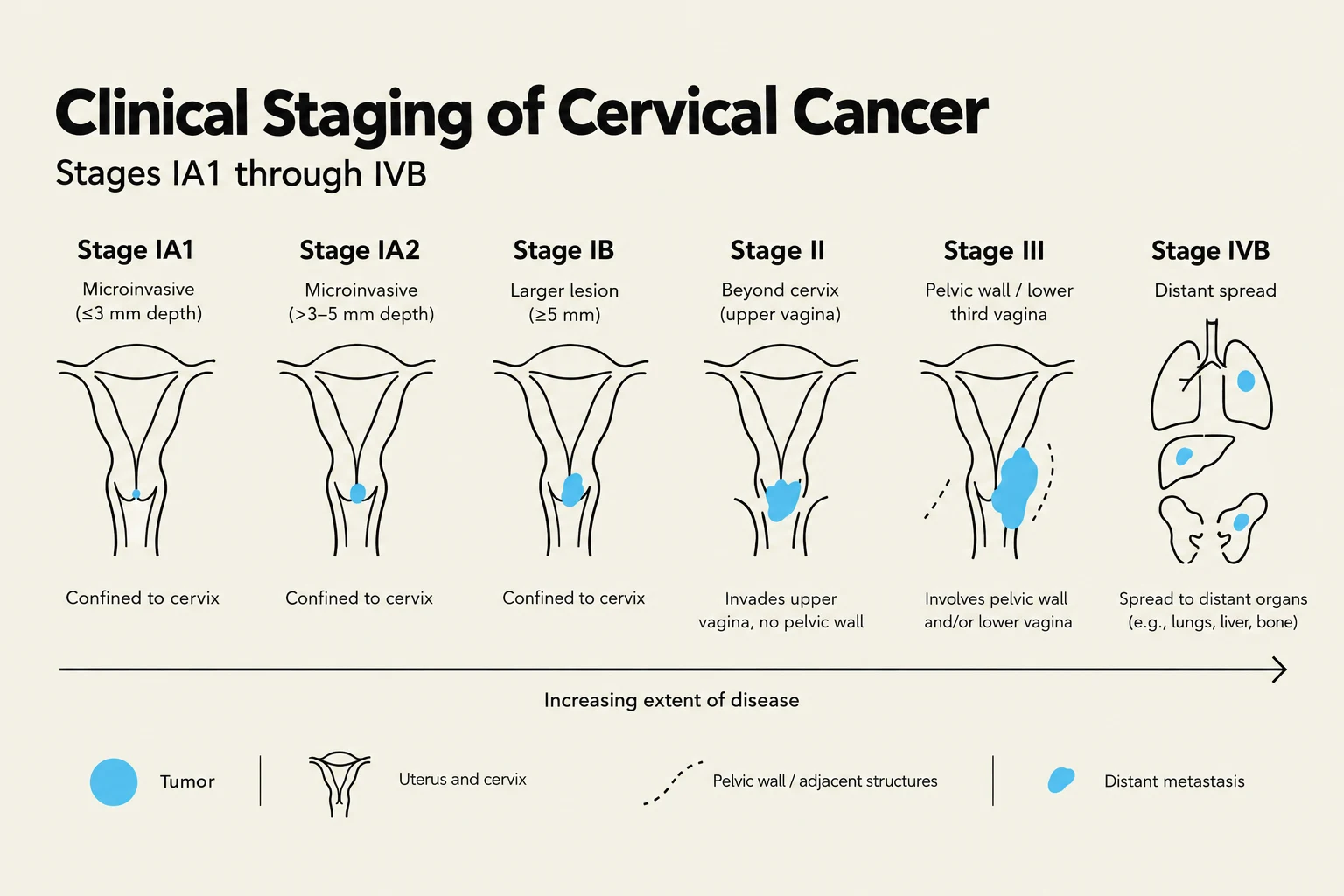
Key stages include:
Stage IA1: Microinvasive disease with no lymphovascular space invasion (LVSI).
Stage IA2: Microinvasive disease with LVSI.
Stage IB1: Invasive carcinoma >5 mm and ≤2 cm in greatest diameter.
Stage IB2: Tumors >2 cm and ≤4 cm.
Stage IB3: Tumors >4 cm.
Stage IIIC: Nodal involvement, subdivided into IIIC1 (pelvic nodes) and IIIC2 (para-aortic nodes).
Effective management also relies on rigorous pathologic assessment. Pathologists must evaluate the depth of invasion, the presence of LVSI, and the number and location of lymph nodes containing isolated tumor cells. For HPV-associated endocervical adenocarcinomas, clinicians should also look for specific patterns, such as the Silva pattern of invasion.
Exam Tip: Always check for LVSI (Lymphovascular Space Invasion) during pathologic review. The presence of LVSI can shift a patient from a low-risk category to a higher-risk category, fundamentally changing the recommended surgical or radiation approach.
This diagram illustrates the clinical staging of cervical cancer, from Stage IA1 to Stage IVB, showing the progression and spread of the disease.
Primary Treatment: Fertility-Sparing Approaches
For patients who wish to preserve reproductive function, the NCCN guidelines outline specific conservative surgery criteria. These options are generally reserved for early-stage, low-risk patients.
Stage IA1 (no LVSI): The preferred approach is a cone biopsy with negative margins (at least 1 mm).
Stage IA1 (with LVSI): Options include cone biopsy with negative margins combined with sentinel lymph node (SLN) mapping (preferred) or pelvic lymphadenectomy.
Stage IA2–IB1: If all conservative surgery criteria are met (including negative margins and no LVSI), patients may undergo a cone biopsy or a simple trachelectomy.
In these cases, assessing nodal status is critical. Sentinel lymph node (SLN) mapping is often preferred over full pelvic lymphadenectomy for tumors <2 cm to minimize surgical morbidity.
When fertility preservation is not desired or clinically appropriate, treatment involves various levels of hysterectomy. The extent of surgery is categorized using the Querleu and Morrow classification:
Type A: Simple or extrafascial hysterectomy.
Type B: Modified radical hysterectomy.
Type C: Radical hysterectomy.
For patients with Stage IA2–IB1 who meet conservative surgery criteria but opt for non-fertility sparing treatment, a Type A hysterectomy combined with SLN mapping or pelvic lymphadenectomy is recommended. As the disease progresses to Stage IB3 or Stage IIA2, the management shifts toward more intensive modalities.
Locally Advanced and Metastatic Disease
For locally advanced disease (Stage IIB–IVA), the standard of care is chemoradiation. This typically involves:
Pelvic External Beam Radiation Therapy (EBRT).
Brachytherapy: High-dose-rate (HDR) brachytherapy is used to deliver a concentrated dose to the tumor surrogate (Point A or HR-CTV).
Concurrent Platinum-containing Chemotherapy: Usually administered as single-agent cisplatin (or carboplatin if the patient is cisplatin-intolerant).
A notable recent update includes the INTERLACE protocol, which involves induction chemotherapy (carboplatin/paclitaxel) followed by chemoradiation.
For metastatic disease (Stage IVB), the focus shifts to systemic therapy. A Category 1 recommendation for certain patients is the combination of carboplatin/paclitaxel + bevacizumab.
Molecular Profiling and Biomarkers
As treatment becomes increasingly personalized, Multigene Panel Testing (MGPT) has become preferred for patients with advanced or recurrent disease. This testing identifies specific biomarkers that can guide the use of targeted therapies:
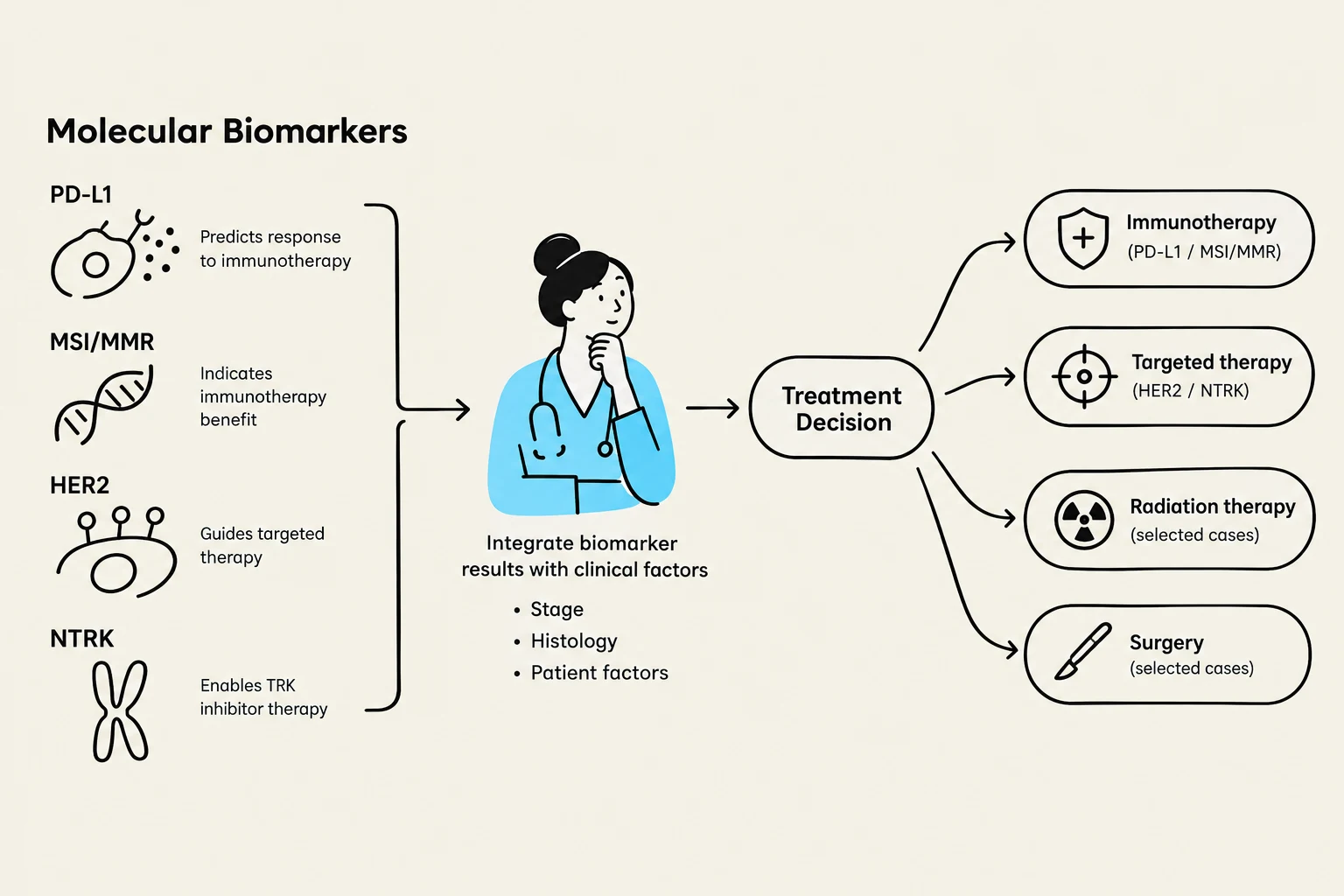
PD-L1: To determine eligibility for immunotherapy.
MSI/MMR: To guide the use of agents such as Dostarlimab in patients with high microsatellite instability (MSI-H) or mismatch repair deficiency (dMMR).
HER2(ERBB2): To identify candidates for anti-HER2 therapy in advanced or recurrent cases.
NTRK1/2/3 and RET: To identify opportunities for rare pan-tumor targeted therapies.
This diagram illustrates how molecular biomarkers like PD-L1, MSI/MMR, HER2, and NTRK are used to inform treatment decisions, including immunotherapy, targeted therapy, radiation therapy, and surgery, by integrating biomarker results with clinical factors such as stage, histology, and patient factors.
Gynecologic Survivorship
The management of cervical cancer does not end with the completion of primary treatment. Gynecologic survivorship principles emphasize the need for long-term monitoring of both physical and psychosocial health.
Clinicians should:
Document long-term effects through thorough physical examinations and imaging.
Screen for genitourinary symptoms, such as vulvovaginal dryness, and refer patients to pelvic floor or sexual therapy as needed.
Recommend vaginal dilators and moisturizers (with water-based lubricants) to prevent or manage vaginal stenosis following radiation.
Consider hormone therapy for treatment-related menopause in appropriate patients.
Clinical Pearl: Post-radiation care is vital. The use of local vaginal estrogen and moisturizers can significantly improve tissue quality and quality of life for survivors.
Keep reading for free.
Create an account to finish this reading and make it part of your study routine.