Cervical Cancer: Clinical Management and Survivorship Principles
This article explores current clinical guidelines for managing cervical cancer, from risk assessment and primary treatment to the long-term care required for survivors. It details treatment modalities including radiation therapy, chemoradiation, and systemic therapies guided by molecular profiles, as well as gynecologi
Cervical cancer management is a highly individualized process that integrates surgical precision, advanced radiation techniques, and evolving systemic therapies. As our understanding of the molecular landscape of cervical tumors improves, treatment has shifted from a "one size fits all" approach to one guided by specific biomarkers and histological subtypes. This article explores the current clinical guidelines for managing cervical cancer, from risk assessment and primary treatment to the long-term care required for survivors.
Risk Assessment and Pathological Prognosis
Effective management begins with a precise pathological assessment. Clinicians must look beyond the stage to identify specific features that dictate the need for adjuvant therapy.
Key Pathological Indicators
Several critical factors influence the prognosis and the decision to escalate treatment:
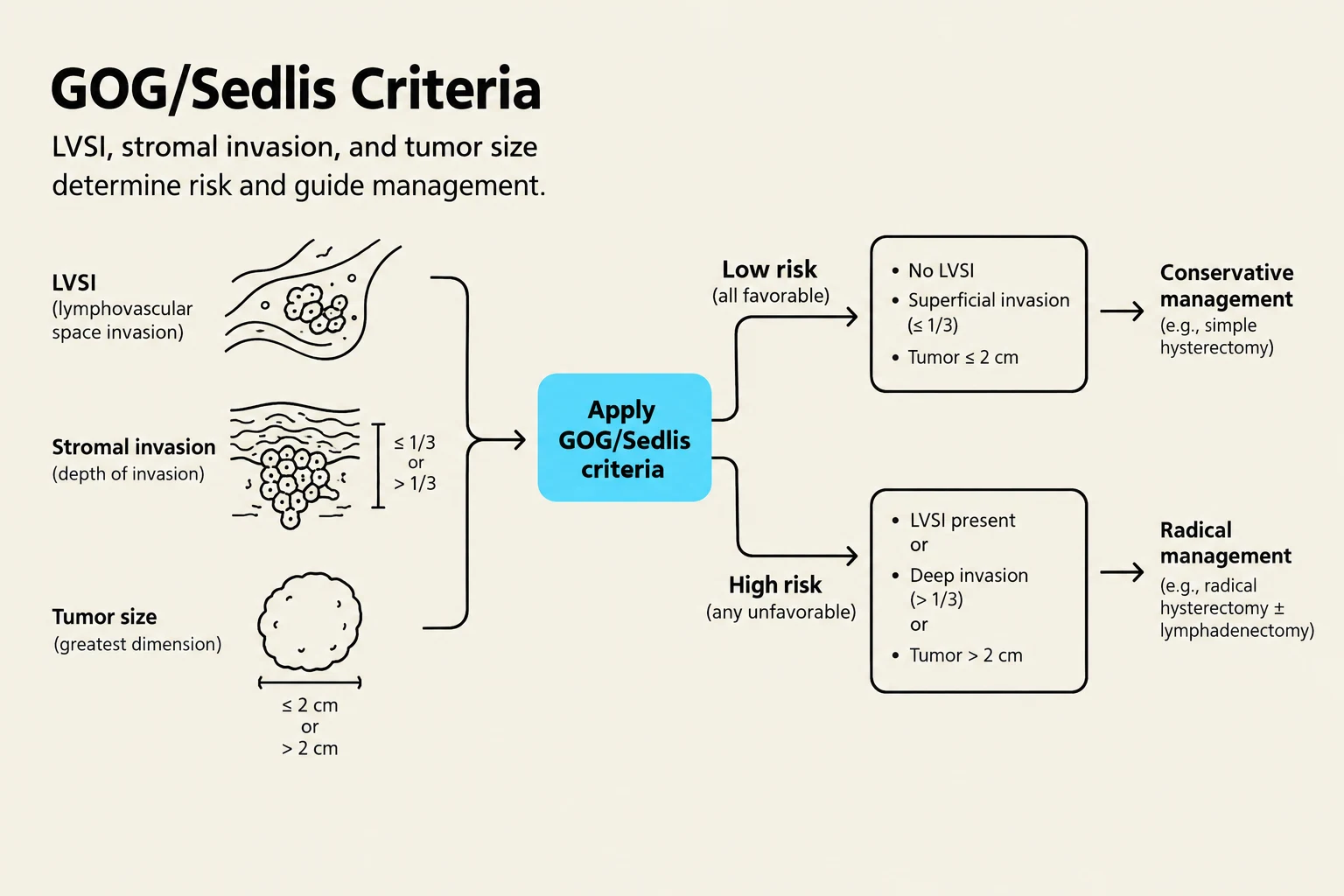
Lymphovascular Space Invasion (LVSI): The presence of tumor cells within lymphatic or vascular channels is a significant risk factor for nodal involvement.
Stromal Invasion Depth: This is particularly vital in squamous cell carcinoma, where the depth of invasion can alter the surgical or radiation approach.
Tumor Size: While important for many, tumor size is a critical prognostic factor for adenocarcinoma, especially when it occurs in conjunction with LVSI.
The GOG/Sedlis Criteria
In cases where a patient has undergone a radical hysterectomy and the nodes are negative, clinicians use the GOG/Sedlis criteria to determine if adjuvant external pelvic radiation (EBRT) is necessary. These criteria help identify patients who, despite having node-negative disease, remain at high risk for local recurrence due to specific pathological features.
Exam Tip: If a question asks about the necessity of adjuvant radiation in a node-negative patient after radical hysterectomy, immediately look for the GOG/Sedlis criteria components: LVSI, stromal invasion depth, and tumor size.
This diagram illustrates the GOG/Sedlis criteria, which use lymphovascular space invasion (LVSI), stromal invasion depth, and tumor size to determine risk and guide management for gynecological cancers. Low-risk cases may receive conservative management, while high-risk cases may require radical management.
Treatment Modalities
Radiation Therapy (RT) and Chemoradiation
Radiation is a cornerstone for locally advanced disease. This often involves a combination of external beam radiation therapy (EBRT) and brachytherapy. For many patients, concurrent platinum-containing chemotherapy (typically cisplatin or carboplatin) is administered alongside radiation to enhance its efficacy.
However, pelvic RT carries significant long-term risks. Complications can include fibrosis, vulvovaginal atrophy, and even the development of secondary cancers. Furthermore, pelvic RT may increase the risk of bone loss and pelvic fractures, making regular monitoring of bone density a clinical necessity for survivors.
Systemic Therapy
Systemic therapy is utilized for recurrent, metastatic, or progressive disease. Modern oncology has moved toward "precision medicine," where the choice of drug is dictated by the tumor's molecular profile.
First-Line Therapy
For recurrent or metastatic disease, preferred regimens often involve platinum-based agents (Cisplatin or Carboplatin) combined with immunotherapy or anti-angiogenic agents.
PD-L1-Positive Tumors: For patients with PD-L1–positive tumors, combinations such as Cisplatin/Paclitaxel + Pembrolizumab ± Bevacizumab are utilized.
The INTERLACE Protocol: Recent updates suggest that for certain stages, induction chemotherapy (carboplatin/paclitaxel) followed by single-agent cisplatin (or carboplatin) and radiation can be considered.
Second-Line and Targeted Therapies
If first-line therapy fails, treatment is selected based on specific biomarkers identified through Multigene Panel Testing (MGPT):
MSI-H/dMMR Tumors: Patients with high microsatellite instability (MSI-H) or mismatch repair deficiency (dMMR) may benefit from agents like Dostarlimab-gxly.
HER2(ERBB2)-Positive Tumors: Targeted therapy such as Fam-trastuzumab deruxtecan may be used in patients demonstrating HER2 amplification or overexpression.
NTRK Gene Fusions: For tumors with NTRK1/2/3 fusions, specific targeted therapies are indicated.
TMB-H Tumors: High tumor mutational burden (TMB-H) is another biomarker that guides systemic selection.
Tisotumab Vedotin: This is a preferred option for certain second-line scenarios.
Small Cell Neuroendocrine Carcinoma (NECC)
NECC is a distinct and aggressive histological subtype of cervical cancer. Unlike standard squamous or adenocarcinoma, NECC is typically treated with Cisplatin/Etoposide combinations.
This diagram outlines treatment strategies for different subtypes of cervical cancer, including Squamous Cell Carcinoma, Adenocarcinoma, and Small Cell Carcinoma. Treatment decisions are based on stage, histology, and patient factors.
Gynecologic Survivorship and Long-Term Care
Survivorship care is not merely about monitoring for recurrence; it is about managing the profound physical and psychosocial impacts of life-saving treatments.
Genitourinary Health and Vaginal Care
One of the most common long-term side effects of pelvic radiation and surgery is vaginal changes.
Vaginal Stenosis Prevention: To prevent the narrowing of the vaginal canal (stenosis), the use of vaginal dilators (used with water-based lubricants) is recommended for a minimum of 12 months following treatment.
Tissue Quality: To manage vulvovaginal dryness and improve tissue quality, clinicians should recommend vaginal moisturizers and, in select patients, local vaginal estrogen.
Psychosocial and General Health
Survivors face unique challenges, including infertility, early menopause, and sexual dysfunction.
Menopause Management: For treatment-induced menopause, hormone therapy should be considered in appropriate candidates.
Comprehensive Monitoring: Regular medical follow-up must include screening for chronic diseases, cardiovascular risks, and the long-term toxicities associated with immunotherapy.
Clinical Pearl: When assessing a survivor, always ask about genitourinary symptoms, including dryness, regardless of whether the patient is currently sexually active. This ensures early intervention for potential stenosis or atrophy.
This diagram illustrates the various aspects of a survivorship plan, including medical oncology, physical therapy, nutrition, mental health, and sexual health, all centered around the survivor and their overall quality of life.
Summary Table: Biomarker-Driven Systemic Therapy
Biomarker
Potential Targeted/Preferred Therapy
PD-L1 Positive
Pembrolizumab combinations
MSI-H / dMMR
Dostarlimab-gxly
HER2(ERBB2)+
Fam-trastuzumab deruxtecan
NTRK1/2/3 Fusion
NTRK-targeted therapies
Small Cell NECC
Cisplatin + Etoposide
Keep reading for free.
Create an account to finish this reading and make it part of your study routine.