Cellular Respiration: Stages, Mechanisms, and Energy Production
An in-depth explanation of cellular respiration, covering redox reactions, glycolysis, pyruvate oxidation, the citric acid cycle, oxidative phosphorylation, and alternative metabolic pathways. It details the processes of ATP generation through substrate-level and oxidative phosphorylation, and discusses the regulation
Cellular respiration is the fundamental metabolic process by which cells harvest chemical energy from organic molecules, such as glucose, to power cellular work. While we often think of "breathing" as the intake of oxygen, at the cellular level, respiration is a complex series of catabolic pathways that break down complex molecules into simpler ones, releasing stored energy in the process. This energy is not released all at once—which would be explosive and destructive—but is instead captured in small, manageable steps to regenerate ATP from ADP and inorganic phosphate.
Energy Flow and Redox Reactions
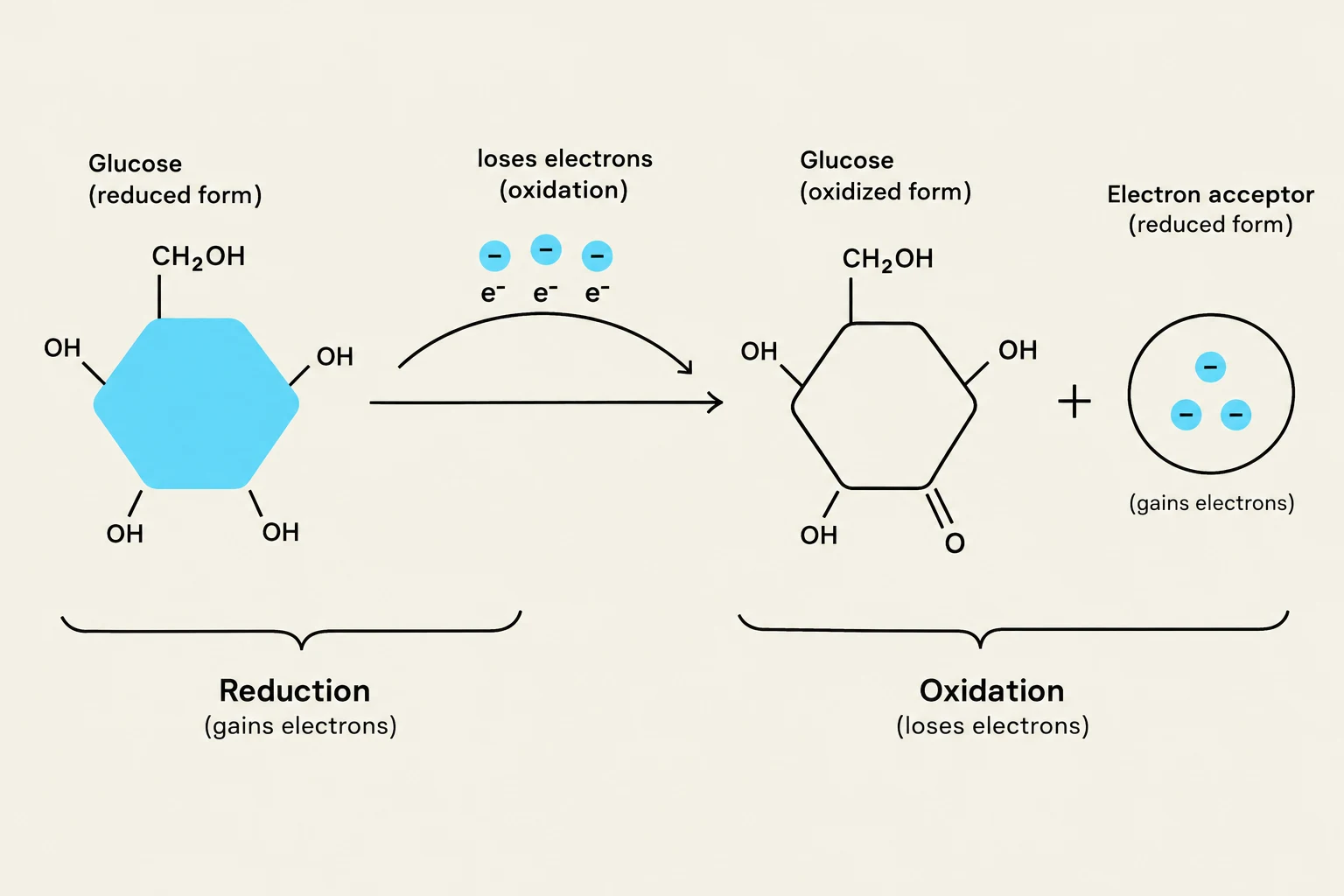
To understand how energy is harvested, we must first understand redox reactions (oxidation-reduction reactions). In these reactions, energy is transferred via the movement of electrons.
Oxidation is the loss of electrons from a substance.
Reduction is the gain of electrons by a substance.
A helpful mnemonic to remember this is OIL RIG: Oxidation Is Loss, Reduction Is Gain.
In cellular respiration, the fuel molecule (glucose) is oxidized, while the final electron acceptor (oxygen) is reduced. This transfer often occurs through dehydrogenation, where hydrogen atoms (consisting of one electron and one proton) are removed from a substrate. To facilitate this, cells use coenzymes like NAD+ and FAD as electron carriers. When these coenzymes accept electrons and protons, they are "reduced" to NADH and FADH2, respectively, acting as mobile shuttles that carry high-energy electrons to the final stages of respiration.
This diagram illustrates the chemical processes of oxidation and reduction, showing how glucose loses electrons (oxidation) and an electron acceptor gains them (reduction).
The Stages of Aerobic Respiration
Aerobic respiration is divided into four main stages: glycolysis, pyruvate oxidation, the citric acid cycle, and oxidative phosphorylation.
1. Glycolysis
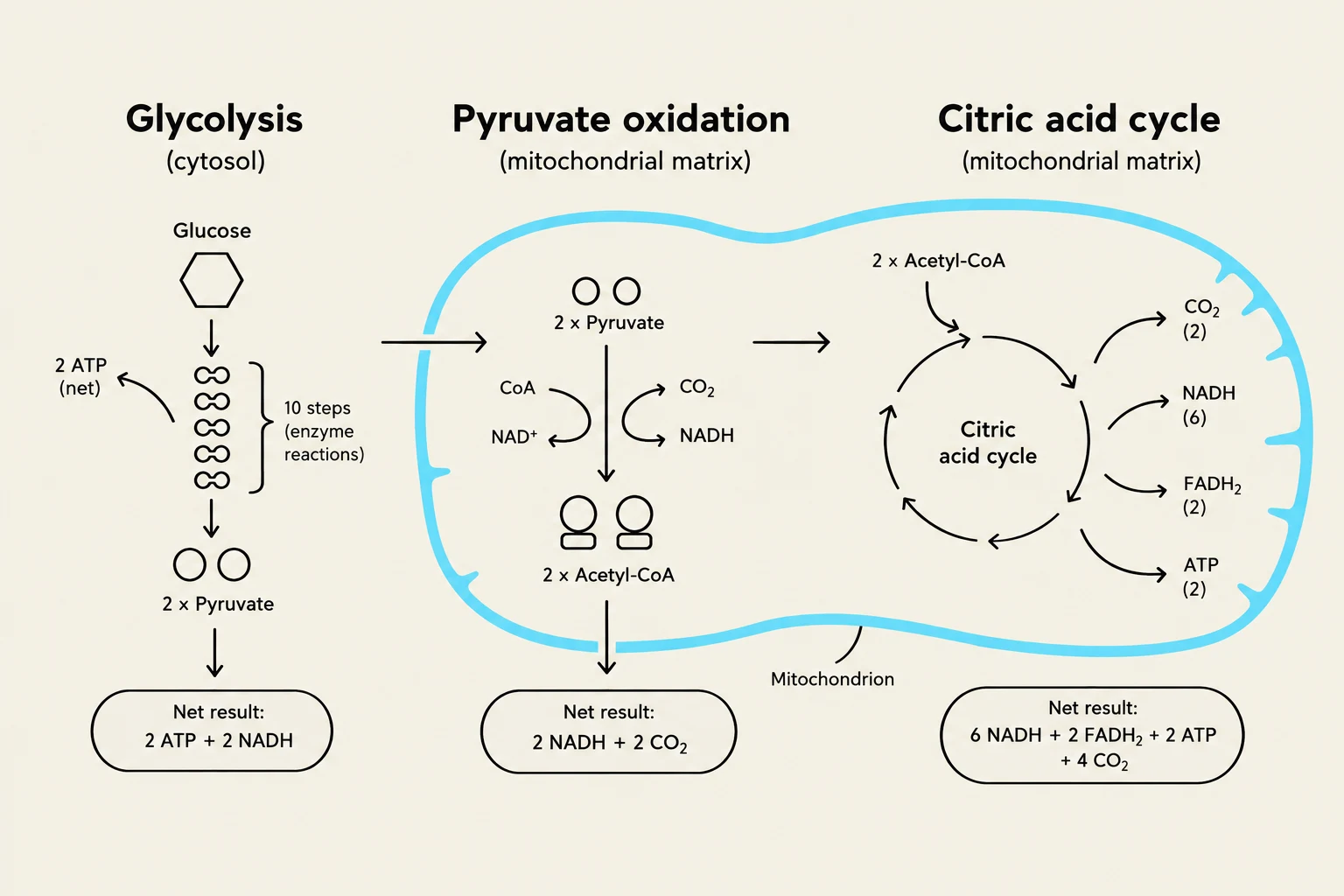
Occurring in the cytosol, glycolysis is the first step in breaking down glucose. This six-carbon sugar is split into two three-carbon molecules called pyruvate. Glycolysis consists of an energy investment phase, where 2 ATP are consumed, and an energy payoff phase, where 4 ATP are produced, resulting in a net yield of 2 ATP.
The ATP produced here is generated via substrate-level phosphorylation, a process where an enzyme transfers a phosphate group directly from a high-energy substrate to ADP. Additionally, 2 NAD+ are reduced to 2 NADH.
2. Pyruvate Oxidation
If oxygen is present, the pyruvate molecules enter the mitochondrial matrix. Here, the enzyme pyruvate dehydrogenase catalyzes three critical reactions: the oxidation of pyruvate's carboxyl group (releasing CO2), the reduction of NAD+ to NADH, and the attachment of the remaining two-carbon fragment to coenzyme A to form acetyl CoA.
3. The Citric Acid Cycle (Krebs Cycle)
Acetyl CoA enters the citric acid cycle by combining with a four-carbon molecule called oxaloacetate. As the cycle turns, the original carbon skeleton from glucose is completely oxidized, releasing CO2 as a waste product.
Because one glucose molecule produces two pyruvates, the cycle must turn twice per glucose molecule. Each single turn of the cycle produces:
1 ATP (via substrate-level phosphorylation)
3 NADH
1 FADH2
2 CO2
This diagram illustrates the key stages of cellular respiration: glycolysis, pyruvate oxidation, and the citric acid cycle, showing the inputs, outputs, and net results of each process.
Oxidative Phosphorylation: The Energy Payoff
While glycolysis and the citric acid cycle produce some ATP, the vast majority (nearly 90%) is generated during oxidative phosphorylation in the inner mitochondrial membrane. This stage consists of two tightly coupled processes: the Electron Transport Chain (ETC) and chemiosmosis.
The Electron Transport Chain (ETC)
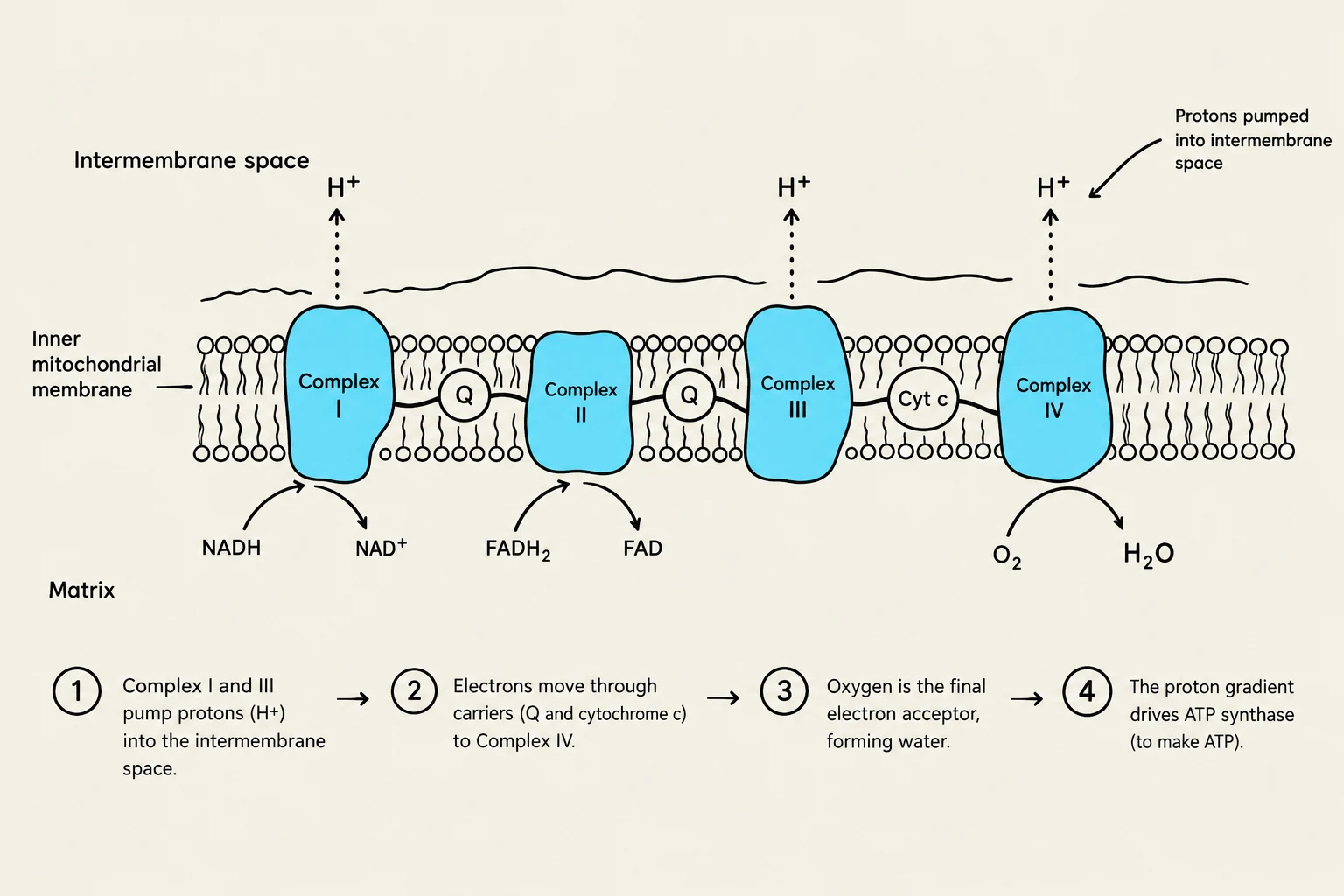
NADH and FADH2 donate their high-energy electrons to a series of protein complexes embedded in the inner membrane. As electrons "slide" down the chain from higher to lower energy states, they release energy that the complexes use to actively pump protons ($H^+$) from the mitochondrial matrix into the intermembrane space. This creates an electrochemical gradient known as the proton-motive force. At the end of the chain, oxygen acts as the final electron acceptor, combining with electrons and protons to form water (H2O).
Chemiosmosis and ATP Synthase
The protons stored in the intermembrane space "want" to move back into the matrix to balance the concentration gradient. They can only cross the membrane through a specialized protein complex called ATP synthase.
As protons flow through ATP synthase, they cause the enzyme to rotate like a molecular motor. This rotational energy is used to catalyze the phosphorylation of ADP into ATP.
Exam Tip: Remember the distinction between the two types of phosphorylation! Substrate-level phosphorylation happens in glycolysis and the citric acid cycle via direct enzyme action. Oxidative phosphorylation happens in the ETC and chemiosmosis using the proton gradient.
Alternative Pathways and Regulation
Fermentation and Anaerobic Respiration
When oxygen is unavailable, the ETC stops working, and NADH can no longer be oxidized back to NAD+ via the mitochondria. To prevent glycolysis from halting, cells use fermentation to regenerate NAD+.
Alcohol Fermentation: Pyruvate is converted to acetaldehyde, which then accepts electrons from NADH to produce ethanol and CO2.
Lactic Acid Fermentation: Pyruvate is reduced directly by NADH to form lactate.
Note that fermentation is different from anaerobic respiration. While fermentation uses an organic molecule as an electron acceptor, anaerobic respiration still uses an electron transport chain but employs an inorganic molecule (like sulfate) instead of oxygen.
Catabolism of Other Molecules
Cells are versatile. They don't just use glucose. Fats undergo beta oxidation to produce acetyl CoA, which can enter the citric acid cycle. Proteins must first undergo deamination to remove their amino groups before their carbon skeletons can be used for energy.
Regulation via Feedback
Cells avoid wasting resources through allosteric regulation. An enzyme called phosphofructokinase (a key enzyme in glycolysis) acts as a metabolic valve. If ATP levels are high, ATP binds to an allosteric site on the enzyme, inhibiting its activity and slowing down respiration. Conversely, if ATP is low and AMP levels are high, the enzyme is activated to speed up energy production.
Diagram illustrating the electron transport chain in cellular respiration, showing the movement of electrons and protons across the inner mitochondrial membrane to generate ATP.
Summary of ATP Yield
The total ATP yield from one glucose molecule is not an exact number because the efficiency of transporting NADH into the mitochondria can vary. However, it typically ranges from 30 to 32 ATP per glucose molecule.
Stage
ATP Produced (Net)
Mechanism
Glycolysis
2 ATP
Substrate-level
Citric Acid Cycle
2 ATP (1 per turn × 2)
Substrate-level
Oxidative Phosphorylation
~26–28 ATP
Oxidative
Total
~30–32 ATP
Keep reading for free.
Create an account to finish this reading and make it part of your study routine.