Cellular Respiration: Pathways and Metabolic Inhibitors
An in-depth explanation of aerobic cellular respiration, including pyruvate oxidation, the citric acid cycle, and oxidative phosphorylation. It also details metabolic flexibility through the glyoxylate bypass and the disruptive effects of various enzyme inhibitors like fluoroacetate, cyanide, and oligomycin on these pa
Cellular respiration is a sophisticated, multi-stage metabolic process designed to convert the chemical energy stored in nutrients into adenosine triphosphate (ATP), the universal energy currency of the cell. While glycolysis initiates the breakdown of glucose in the cytosol, the most efficient energy extraction occurs through the integration of pyruvate oxidation, the citric acid cycle, and oxidative phosphorylation. Understanding these pathways is not only fundamental to biology but also essential for understanding how specific toxins can catastrophically disrupt life by inhibiting key enzymes.
Aerobic Cellular Respiration: From Pyruvate to ATP
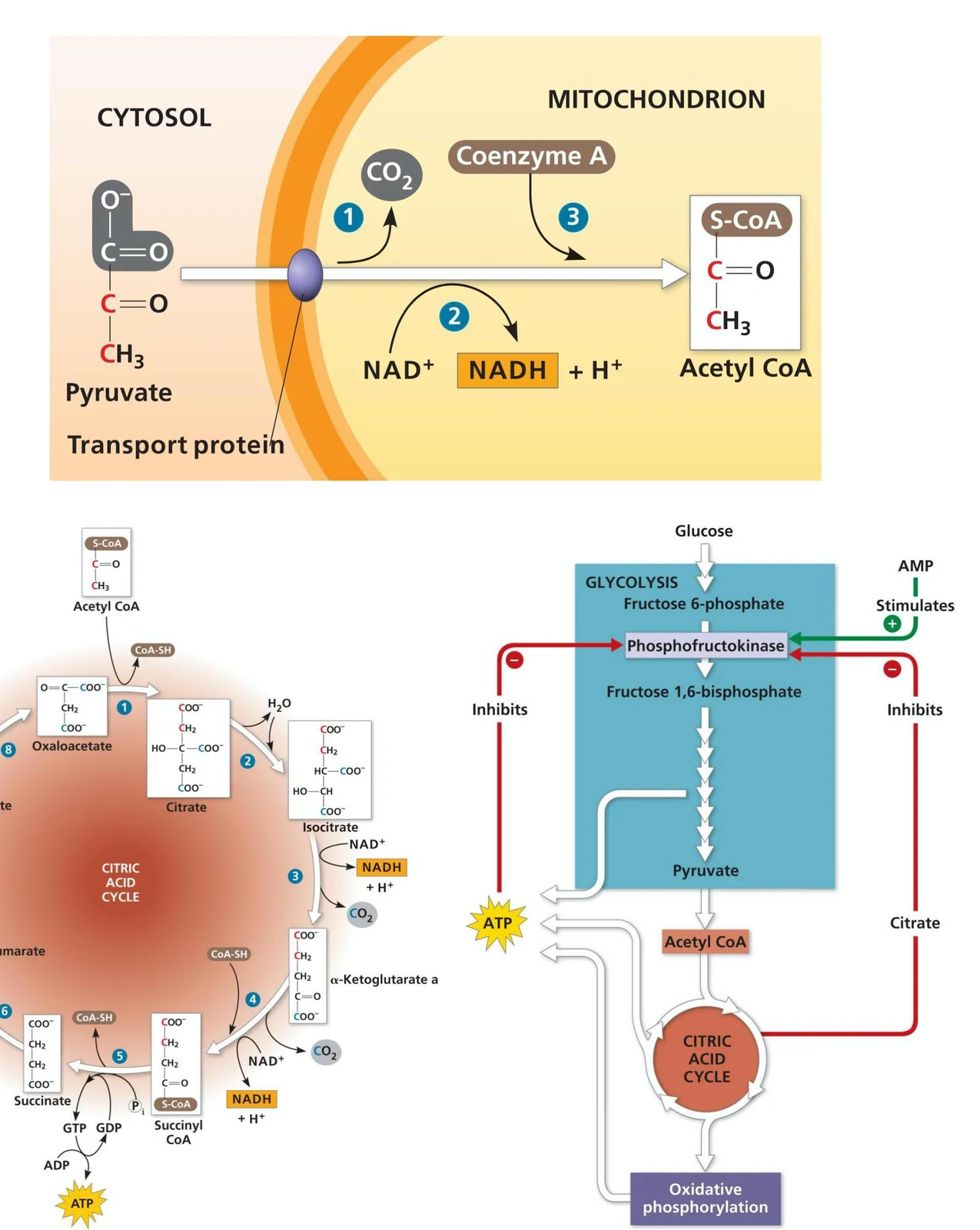
The transition from glycolysis to the high-yield stages of respiration begins with pyruvate oxidation. In eukaryotes, this occurs within the mitochondria. A multi-enzyme complex catalyzes the conversion of pyruvate into acetyl-CoA, a critical two-carbon intermediate. During this process, NAD+ is reduced to NADH and CO2 is released.
Per molecule of glucose (which yields two pyruvates), this stage produces:
Once acetyl-CoA is formed, it enters the citric acid cycle (also known as the TCA or Krebs cycle). This cycle is characterized by its circular nature, as it begins and ends with the molecule oxaloacetate. The primary goal of the cycle is to oxidize the acetyl group, transferring high-energy electrons to the carriers NADH and FADH2.
Diagram of the citric acid cycle, also known as the Krebs cycle or TCA cycle, illustrating the biochemical reactions that convert acetyl-CoA into carbon dioxide, producing ATP, NADH, and FADH2.
The energy yield per cycle is as follows:
Per acetyl-CoA: 3 NADH, 1 FADH2, 1 ATP, and 2 CO2.
Per glucose molecule: 6 NADH, 2 FADH2, 2 ATP, and 4 CO2.
Oxidative Phosphorylation
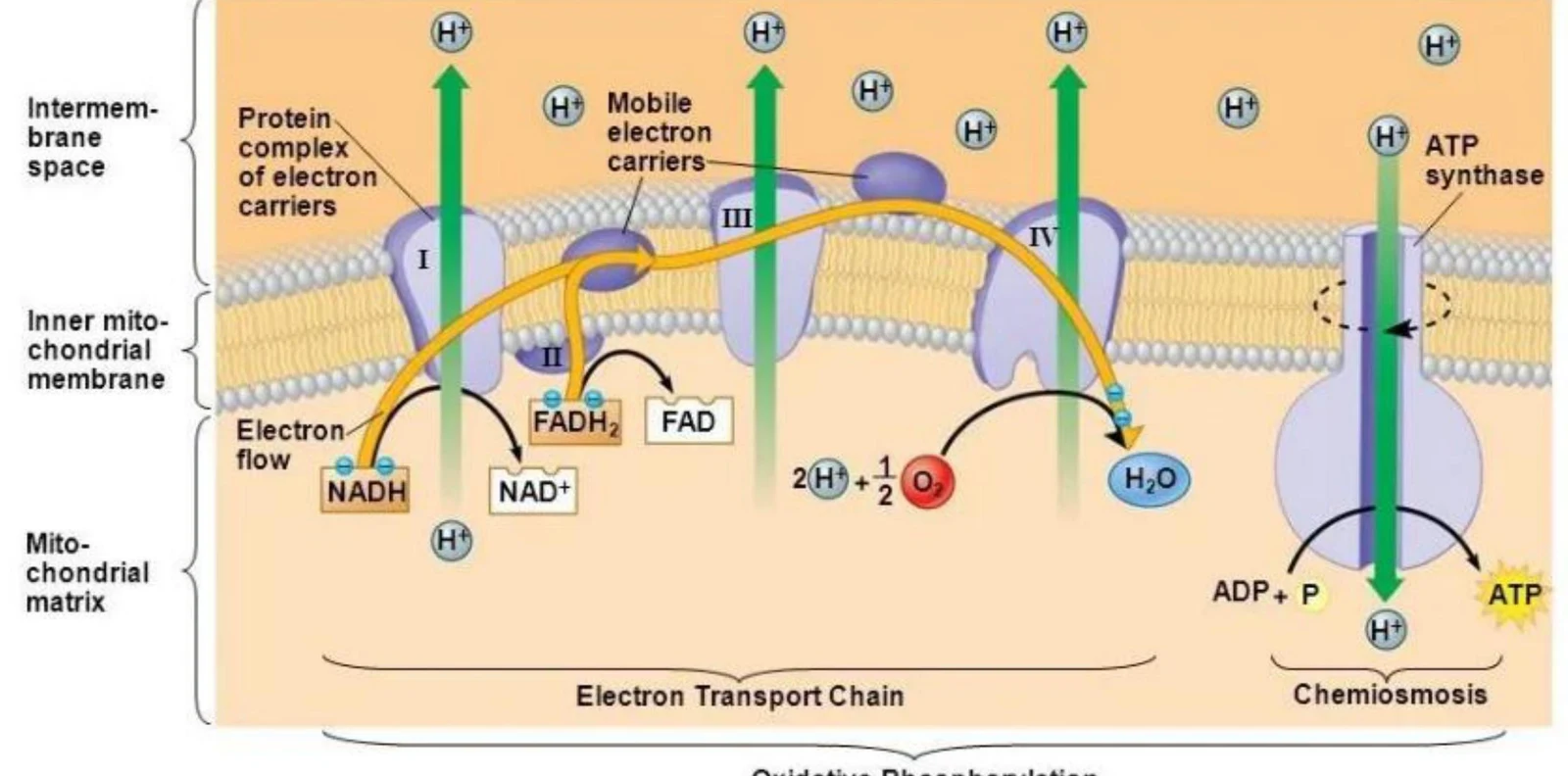
The electron carriers (NADH and FADH2) produced in the previous steps travel to the inner mitochondrial membrane to participate in oxidative phosphorylation. This stage consists of two integrated processes:
The Electron Transport Chain (ETC): Electrons are passed through a series of redox reactions involving multiprotein complexes and non-protein prosthetic groups. As electrons move toward the final electron acceptor, oxygen (O2), the energy released is used to pump protons (H+) across the membrane, establishing a proton-motive force.
Chemiosmosis: The enzyme ATP synthase utilizes the potential energy of the H+ gradient to drive the phosphorylation of ADP into ATP.
Diagram illustrating the process of oxidative phosphorylation, including the electron transport chain and chemiosmosis within the inner mitochondrial membrane.
The theoretical maximum yield of cellular respiration is approximately 30 to 32 ATP per glucose molecule, representing an efficiency of roughly $34%$.
Metabolic Flexibility: The Glyoxylate Bypass
Not all organisms follow the standard TCA cycle exclusively. Some cells possess a metabolic "shortcut" known as the glyoxylate bypass. This pathway allows cells to bypass the decarboxylation steps (where CO2 is lost) of the TCA cycle.
In the glyoxylate bypass, isocitrate is converted into glyoxylate and succinate. Subsequently, glyoxylate and acetyl-CoA are converted into malate. This mechanism is vital for certain organisms to conserve carbon atoms for biosynthesis rather than losing them as CO2 during respiration.
Enzyme Inhibition and Metabolic Disruption
Metabolic pathways are tightly regulated to ensure energy production meets cellular demand. A primary regulatory point is the enzyme phosphofructokinase in glycolysis, which is allosterically regulated by levels of ATP, AMP, and citrate.
However, this regulation can be hijacked by toxins through enzyme inhibition.
Fluoroacetate Poisoning
Fluoroacetate is a potent pesticide because it is lethal to obligate aerobic organisms. Its toxicity stems from its ability to mimic acetate, leading to the formation of fluorocitrate. Fluorocitrate acts as a dual threat:
It is a competitive inhibitor of aconitase, an enzyme essential to the TCA cycle.
It acts as an allosteric inhibitor of phosphofructokinase, effectively shutting down glycolysis.
By inhibiting these two critical points, fluoroacetate completely halts central carbon metabolism, preventing the production of ATP and leading to cell death.
This diagram illustrates the interconnectedness of glycolysis, the citric acid cycle, and oxidative phosphorylation in cellular respiration, showing the conversion of pyruvate to acetyl CoA and its subsequent entry into the citric acid cycle, as well as the regulation of glycolysis by AMP and citrate.
Other Metabolic Inhibitors
Other toxins target different stages of the respiratory process:
Arsenate: This molecule can replace phosphate in compounds like 1,3-bisphosphoglycerate, resulting in no net ATP production during glycolysis.
Cyanide: Blocks Complex IV of the electron transport chain, preventing the transfer of electrons to oxygen.
Oligomycin: An antibiotic that directly blocks the ATP synthase enzyme.
FCCP: An ionophore that makes the membrane permeable to protons, dissipating the proton-motive force.
Exam Tip: Comparing Inhibitor Effects
If a toxin like cyanide blocks the ETC, NADH levels will increase because it can no longer donate electrons to the chain, while NAD+ and ATP levels will decrease.
Metabolite
Cyanide
Oligomycin
FCCP
NADH
Increase
Increase
No change
NAD⁺
Decrease
Decrease
No change
ATP
Decrease
Decrease
Decrease
H⁺ (Intermembrane Space)
Decrease
Increase
Decrease
Keep reading for free.
Create an account to finish this reading and make it part of your study routine.